This story was originally published by EdSource. Sign up for their daily newsletter.
Top Takeaways
- “California Dreams: The Making and Remaking of the University of California” traces the university’s evolution through the lives of five students, from pioneering early academic Millicent Shinn to José Alamillo, who paved the way in Chicano studies.
- Making higher education accessible was key to the university in its early days, not even 20 years after the Gold Rush, when California social structures were still in flux.
- History sheds light on recurring issues at the university: Who deserves a slot, what is the role of research and how do we pay for it.

Journalist and author Miriam Pawel, known for her histories of Cesar Chavez, the United Farmworkers and the Brown political dynasty, turns to another California institution in her latest book: the University of California.
Her book, California Dreams: The Making and Remaking of the University of California, traces the university’s evolution through the lives of five students, from its founding in 1868 through the opening of its first campus — UC Merced — in the San Joaquin Valley.
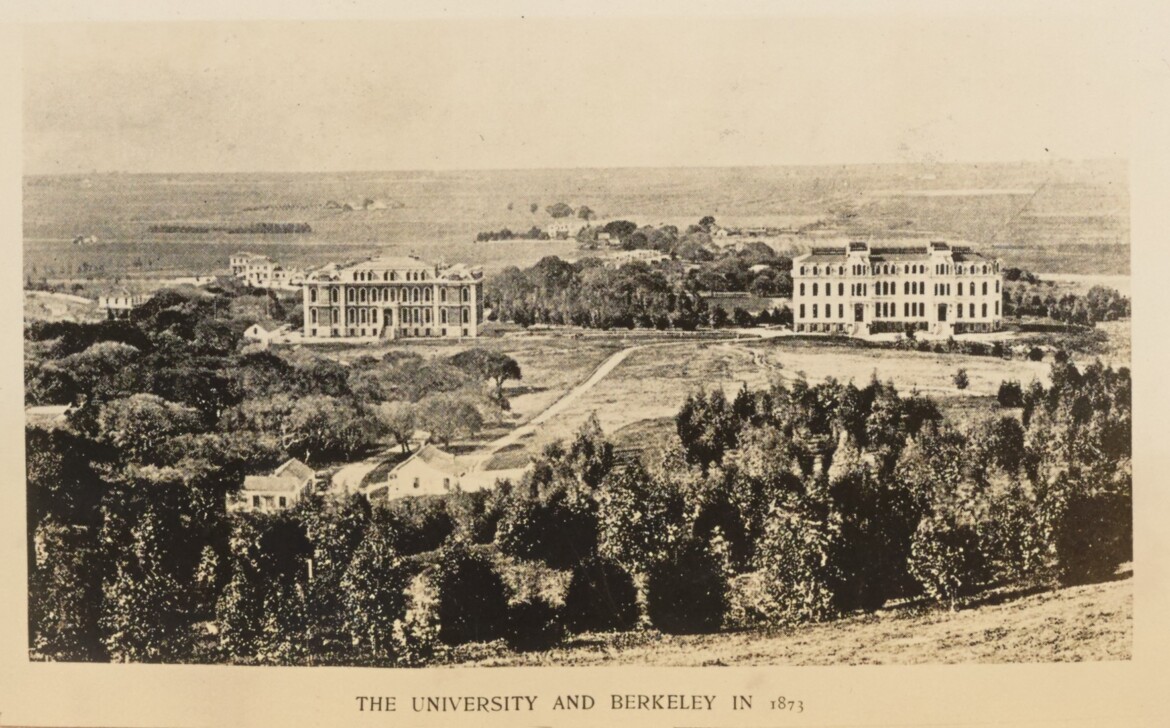
The University of California welcomed its first class in 1868, not even 20 years after the Gold Rush. Californian social structures were still in flux, so there was a big emphasis on making higher education accessible to a wide range of Californians. There was no tuition, and women were welcome almost from the beginning. Early leaders had an almost religious reverence for the power of higher education.
The most notable student she features is Clark Kerr, who would go on to lead UC through its Golden Age of rapid post-World War II expansion.
Other students include one of the first female students at UC Berkeley; a UCLA student who started an ambitious teacher training program in UC Irvine’s early days; a prodigal son who revived his family’s farm; and a Latino recruit to UC Santa Barbara in the 1980s who helped pave the way for future Chicano studies scholars.
I spoke to Pawel last month ahead of the release of her book, which is on sale now. This conversation was lightly edited for length and clarity.

What kind of force has UC been on inequality in a state that’s really struggling with it right now?
Pawel: It really is. There are a lot of battles even right now at the university, like the question of bringing back the SATs, which are sort of related to that theme.
What stands out as I got deeper into the history of the university that I didn’t know when I started was that mission that it had from its very beginning to be a university for the people of California and for the working people. In the late 19th century, the people who could afford to were sending their kids to the East Coast, to Harvard and Yale and Princeton and so on. This was for people who couldn’t afford that.
That’s not a solution, obviously, to issues of inequality, but it is a really important force. I’m sure also being in the Central Valley, that you understand and see this, too, that it is just such a transformative experience for people who would not otherwise have access to that kind of elite research university.
You write about a student, Ken Bailey, living in his car and showering in the locker rooms in the 1930s. I didn’t realize that some of the problems that we’re facing now are very old for students in California.
Pawel: That, again, goes to that mission of the university. Yale was not a place where people lived in their cars, right? It was a place where people were of a certain class.
Part of that comes from the whole way that California developed in the post-Gold Rush years when there wasn’t a preset social class and caste system. And it’s founded in 1868, so in those early years in the late 19th century, it functioned as a status-granting sort of entry into another class. So, again, that sort of social class mobility issue is there right from the start.

You focus on the story of women, namely Millicent Shinn, who were some of the earliest students at the University. That was also shocking to me.
Pawel: I think most people don’t know that UC admitted women basically from the start in 1870, which made it really unusual at that time, too. The Ivy League schools didn’t become co-educational until far later, and the schools that did admit women had separate curriculums. Radcliffe was a separate school (from Harvard), whereas you see from the beginning, Cal integrated women. It reinforced the idea that the University is a very uniquely California institution.
A question I often hear is “Why does UC start charging tuition?” Your book answers that with the history of Prop. 13, the conservative backlash, Gov. Ronald Reagan and then the rise of prisons, too.
Pawel: Reagan is the turning point at which it begins to cost money. There always were fees, but they were really minimal. Tuition, by necessity, becomes a more important source of income, as does philanthropy and fundraising. And that’s a huge change.
What a lot of people don’t realize is that the income threshold for not paying tuition is really quite low with Cal Grants. That doesn’t mean it’s not a financial burden for students. One of the bars for even transfer students in community college is not so much tuition, but the cost of living, which is a Californiawide issue. The flip side of having campuses in the most beautiful parts of the state is that housing is an enormous problem. And, the university’s behind in providing dorms in a lot of those places.
You write about how the university was wrestling with affirmative action in the 1990s, and this all still feels very relevant now.
UCSB professor Dick Flacks commissioned a survey, which found that students who had faced the least adversity in life — wealthier students whose parents had attended college — were more likely to be partygoers, have lower GPAs and were least engaged in campus life. He concludes that admitting students who had faced adversity didn’t lower academic standards, as some worried, but actually revitalized the campus.

Pawel: That’s a very relevant debate because it really goes to the heart of the fight about the SAT and admission standards. That goes to the question of who is the university for, and how should the university be reflecting the population of California?
The regents actually banned affirmative action a year before Prop. 209, which was the statewide ban on affirmative action. Dick Atkinson, who was then president, launched what is still the most ambitious effort that UC made to do outreach to more underrepresented students — which is basically Black and Latino and certain Asian groups.
Another thing I didn’t know about was the unusual shared governance structure of the university. The faculty have a lot of input into what the admission standard should be. And so that works both ways. So you have someone like Dick Flacks, who gets involved and gets himself onto the statewide board’s committee and helps to craft what becomes Eligibility in the Local Context. He and colleagues at that time recognized that there’s something wrong if half the high schools in the state are not producing any students who can qualify for admission. We, the university, have a responsibility to do something about that.
If you are at a high school, and it is not offering A through G courses, that’s not your fault. That doesn’t mean that those students are not smart or shouldn’t have access to the UC system.
You know, it sort of goes in waves, and there are backlashes. One of the problems is that the demand for UC just continues to grow. Even though there is tuition, it’s so much more affordable as college loans have exploded. So the more demand there is, the more people are getting rejected, the more opposition there is to programs that people perceive as being to their disadvantage.
At the end, the book describes what UC Merced has meant for the community and its students.
Pawel: I think a lot about Merced as a place where you see all of those videos of kids taking their diplomas into the fields with their parents. And Riverside, too. I interviewed someone who had been at Irvine and then went to teach at UC Riverside and was sort of blown away by how different the graduations were. Parents would come straight from work (in the fields).
I always think about the statistic that the applications to all UCs from students in the Valley doubled within a few years of Merced being open. Because of the reality that there was a university, that was something that they could aspire to. That, to me, is just enormously important. Merced, probably better than any other campus at this point, really exemplifies that.
I talk to a lot of people who have taught at Merced over the years, and there are lots of dissatisfactions with the location and the campus. But they all said they’ve never taught students who cared that much and just soaked it up. They were so happy to be there and did the work.

With the rise of artificial intelligence and the current political atmosphere, there seems to be more questions about the importance of going to college. I am wondering what you think, as someone who’s written about the way the pendulum has swung on the answer to this question.
Pawel: One of the things that I came away from this with is that even though we’re in a moment when higher ed is under attack and there are these enormous pressures — financial pressures, AI, and so on — the university is a very resilient institution, and that it will emerge from this probably changed, maybe change for the better, maybe change for the worse. I think it’s hard to know.
Right now, the medical and science and the health centers are half of the budget. And so, depending on all the things going on in Washington, the financial situation could change dramatically.
We’re seeing a strong pushback on the idea that the purpose of college is to learn how to think and how to write. AI runs counter to that in a lot of ways. It also seems like different campuses may go in different directions on that, too. And the faculty, I think, are going to be sort of enormously important in that. The whole power of the Academic Senate is also something I didn’t know about, and most people don’t know.
Clark Kerr, at one point credited the power of the Academic Senate with being one of the forces for preserving the university and its excellence. There are people who have different views on that at different points in time, but it seems to me that they’re going to play a really big role in determining how this all plays out. And some of that will be institutionwide, and some of that will vary a lot from campus to campus.

This story was originally published by EdSource.