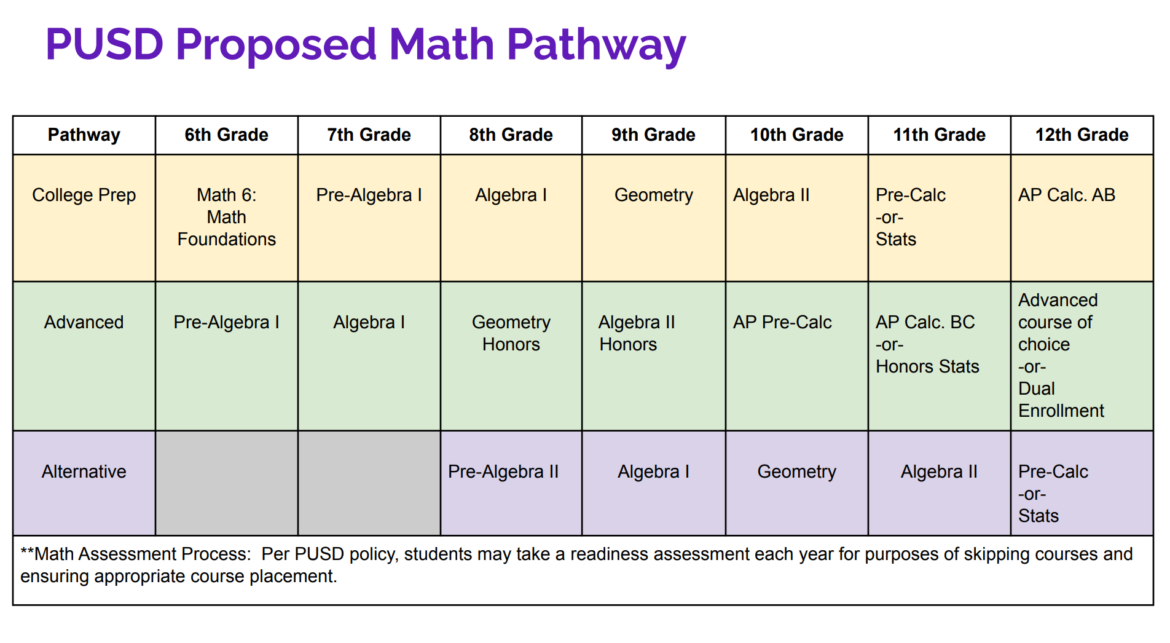
The Board of Education approved a plan on Oct. 14 to update the middle and high school math pathways starting in 2027, moving the district away from its current Integrated Math approach and returning to an “Algebra I – Geometry – Algebra II” pathway that could start as early as seventh grade or as late as ninth grade. PUSD last adopted a secondary math curriculum in 2014-15; curriculum reviews typically take place at the district-level based on a seven-year cycle, according to the district.
The move came over the objections of the district’s elementary, middle, and high school math teachers and specialists, who said in a letter to the Board last week that their professional expertise had been ignored and the new pathways plan does not reflect their input, particularly at the middle school level. The district held meetings starting last spring, throughout September with the math departments, and on Oct. 13 with the school community, according to a timeline displayed by Assistant Superintendent Ariel Dolowich. The teachers called on the Board to pause the vote and grant the PMS, PHS, and MHS math departments the opportunity to meet with the Board directly and to present their alternative proposals.
The pathways you are presenting do not reflect any of our input. Elementary math specialists strongly share these concerns and are frustrated by the lack of communication and collaboration surrounding decisions that directly impact our instruction. The proposed pathways assume additional standards are being taught in fourth and fifth grade. Changes of this magnitude have significant implications for pacing, depth of understanding, and student learning and should not be made without consulting the educators most directly affected.
Letter from math teachers and specialists to the Board of Education on Oct. 13
“We have not felt valued in this process,” said middle school math teacher Kate Waldron at the Wednesday meeting, noting she was speaking as both a teacher and parent. “I fully support the [math teacher] statement shared with the Board.”
According to the school district, the new pathways will allow most students to complete Algebra I in eighth grade and Calculus by senior year. It also calls for more rotating math specialists to provide additional math support in sixth and seventh grade and provides flexible on-ramps and off-ramps throughout the pathways for students, and gives eighth grade students an alternate Pre-Algebra II course as an off-ramp.
Despite routinely topping state math assessments in recent years (#3 in the state over the last several years) Dolowich said the numbers don’t tell a complete story about math achievement in the district, and that the current curriculum was not serving students well, particularly those with IEPs. Grade level proficiency in grades six through 11 has dropped, Dolowich said. “We want to raise the bar for everyone,” he said.
“It is really important for everyone to understand that the elementary schools are carrying those scores, said Board President Ruchi Medhekar, noting that the high schools are not in the top 10. The statistics are hiding a group of students that the district is not serving, she said.
Medhekar also acknowledged to the teachers and community that the Board has been heavily involved in math strategy, but would be stepping back and asking the district to hire a consultant to help with the math strategy going forward.
“This is not about ‘compression for all’,” said Trustee Susy Struble. “this is about appropriate rigor and accountability for all,” she said.
“We can and should ensure that every child can meet benchmarks,” said Trustee Lindsay Thomasson.
“There’s still room where things are undecided for us — the district — to figure out together,” said Trustee Michael Malione.
“I want to raise the ceiling and the floor; the [current math pathways] are great for some of the kids, but not for those who are not achieving, and we want to try to fix that, said Trustee Max Roman. Being asked to wait on a fix is not an option, he said.
Debates over how to teach math in California are as old as time, and this move by PUSD is no exception. School districts do have local control over the math curriculum even when the state creates its own frameworks that it hopes school districts will adopt. When the state developed a new math framework in 2023, then-superintendent Jennifer Hawn assured the parent community that changes to a curriculum “typically follow a lengthy analysis by teachers and administrators before a recommendation is proposed to the Board for approval.”
The district will now pilot new curriculum starting in January for final Board approval at the end of May 2027. Dolowich said the approved pathways would be further refined with staff input before then.