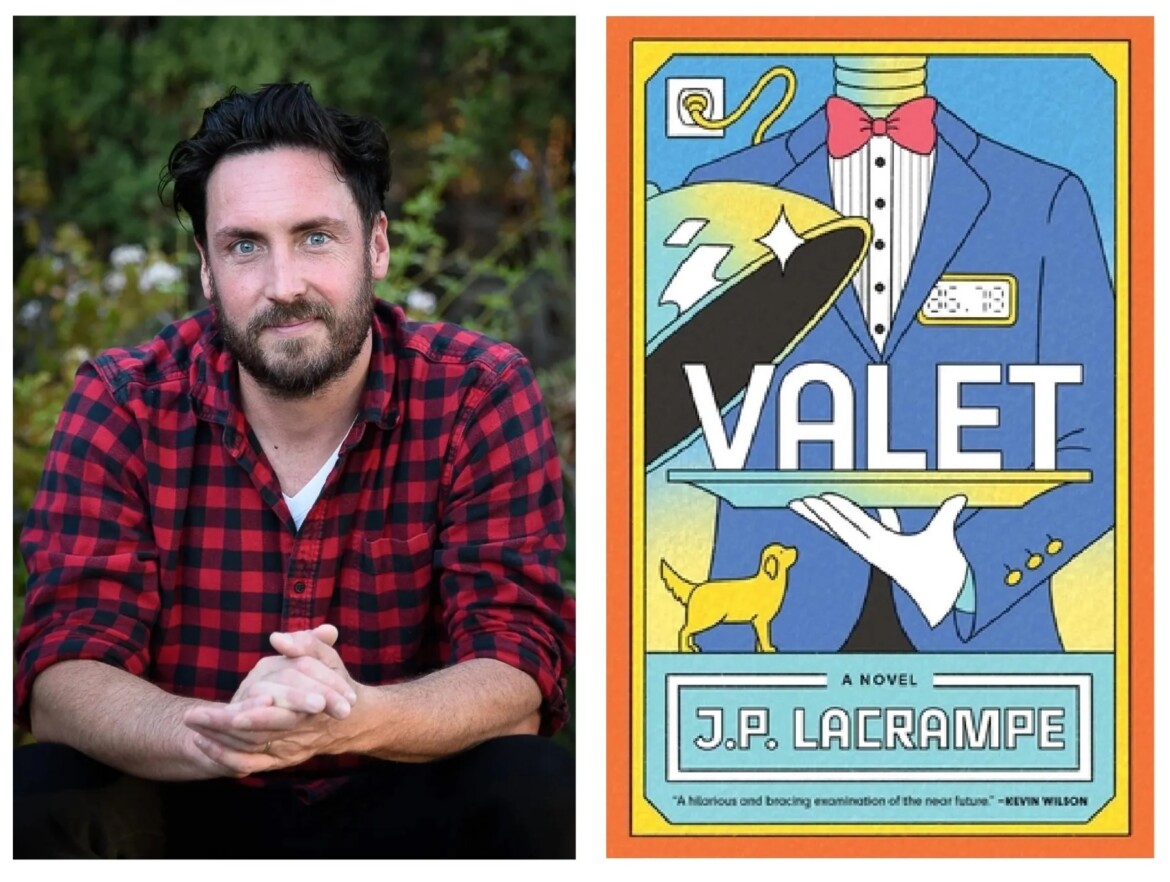
San Francisco writer J.P. Lacrampe’s debut novel “Valet” tells a humorous and hopeful near-future story of a robot that comes to the rescue of a hapless fellow.
While “Valet” (Simon & Schuster/Saga Press, 272 pages, June 2026) is being marketed as science-fiction as it delves into concerns about artificial intelligence, Lacrampe calls it satire, giving readers a “different angle to look at things.”
He explains, “Rather than just the doom and gloom — like robots are going to kill us all, or robots are going to take all our jobs — or the bright-sided optimism of ‘we need this for the future,’ satire lets us see the important stuff of being a human that might be at risk if we start to offload all of our intelligence to somebody else.”
Lacrampe, an instructor at Santa Clara University and San Jose State University, was inspired to write “Valet” by a student. He says, “I teach first-year writing, and an engineering student wrote a research project on AI, asking if it gets so developed, so human-like, will we be forced to endow human rights upon it?”
He adds, “You always hear it from the other side: How do you get AI to approximate human intelligence? The student asked: ‘When does the intelligence get so humanesque that you have to treat it like it’s human?’” Lacrampe says.
It took just a few jumps in thought for Lacrampe to make his robot the narrator.
The book follows the journey of Cy, a Verified Artificial-Learning-Enhanced Techbot (VALET) developed by deceased, not-quite-mad scientist Richard St. Claire. His widow assigns Cy to her sweet but aimless 35-year-old son Grayson to help him settle down and find a wife; meanwhile, Grayson’s high-achieving sister Charlotte has taken over the family’s robotics company and plans to sell it to an evil empire — including plans that allow robots to have feelings and make their own choices.
As Cy strives to be a good servant at all times, Lacrampe’s satire focuses on a family feud that could spell the end of civilization.
British comedy also influenced “Valet.” Lacrampe says, “My parents wouldn’t let us watch anything except PBS, noting that, along with “Jeeves and Wooster,” many shows had an idiotic aristocrat paired with somebody who doesn’t have power or the prestige, but plenty of smarts and brains.
“It’s such a great comedic premise. And I just wanted to kind of emulate that,” says Lacrampe, who grew up in the East Bay and earned his master’s degree in creative writing at St. Mary’s College in Moraga.
“Valet” celebrates creativity and the impulse to do things that might not seem rational. “There’s a sort of fumbling about humanity that I think is glorious,” says Lacrampe, adding, “Sometimes it can have very dangerous consequences, but the fact that we’re always fumbling toward something allows for discovery and insights that we don’t yet possess, rather than just regurgitating insights that we’ve already generated.”
Lacrampe believes those impulses can’t be imitated by artificial intelligence.
“That to me is so human,” he says. “And a lot of the most important moments of my life have been kind of guided by that.”
With the proliferation of AI, what’s most at risk, Lacrampe says, include “the little quirks of being a human, where you don’t totally know why you like something or why you do something, but it’s a part of you and you get to explore that part.”
Novelist Kevin Wilson, best-selling author of “The Family Fang” and most recently “Run for the Hills,” says that in “Valet,” Lacrampe “goes beyond the initial premise by looking at the universal anxiety of family, of being tied to people with whom you will rise and fall, either toward a new update or into obsolescence.”
Indeed, the book’s AI quandary is smack in the middle of a dysfunctional family fight the reader may relate to. Lacrampe says, “There’s nothing messier than a family to me, and that can be mined for comedy. It’s such a funny premise because you’re connected to these people whether you want to be or not.… But at the end of the day, there is something incredibly meaningful about that binding as well.”
He adds, “Family doesn’t make sense a lot of times, but it’s very meaningful. That’s a nice balance to AI, which is supposed to be very logical,” he says. “Family is the opposite of that.”
With its local setting, “Valet” takes readers from the heart of tech in the city over a dilapidated Bay Bridge to spots favored by Lacrampe, who wanted the book to feel like a love letter to the Bay Area.
Next up for Lacrampe is a script set in San Francisco’s Barbary Coast before the 1906 earthquake, which he has “been off and on picking away at … for years now.”
Lacrampe, whose short stories have been published in Glimmer Train, McSweeney’s, Instant City and “Howl: A Collection of the Best Contemporary Dog Wit,” also is at work on another novel that scrutinizes the dynamics of family. He says, “It’s going to be about the ability to leave your family, legally vacate yourself from your family.”
Readers can expect more satire and a certain element of the unknown.
The post J.P. Lacrampe’s debut Bay Area-set novel ‘Valet’ takes a satirical look at AI appeared first on Local News Matters.