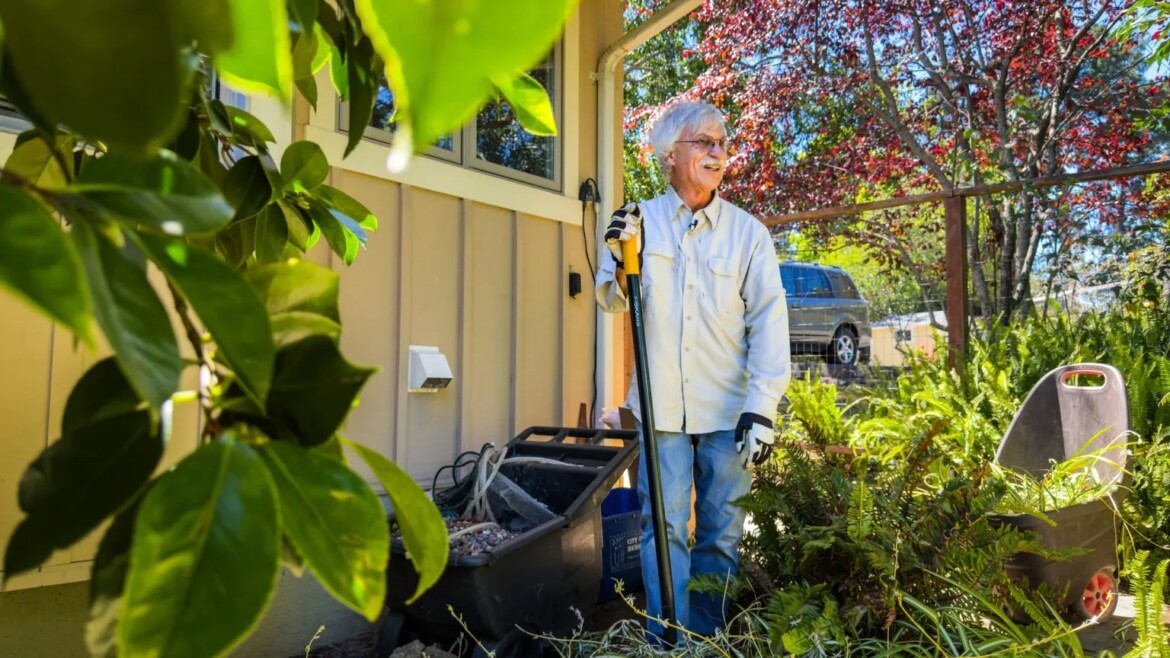
THE DAY AFTER Berkeley Fire Department inspectors identified seven wildfire safety violations at Staeppan Snyder’s property, he began clearing vegetation within 5 feet of his house.
That’s the new Zone 0 rule adopted by the city, part of the Effective Mitigations for Berkeley’s Ember Resilience initiative, known as EMBER. Inspectors at his house found plants too close to the house and vegetation beneath a redwood tree that could carry flames from the ground into its branches.
The EMBER Zone 0 ordinance, which took effect this January, requires homeowners in the Grizzly Peak and Panoramic Hill mitigation areas to remove combustible vegetation and other materials from within 5 feet of their homes, decks and stairs. The mitigation areas are city-designated sections of the Berkeley hills at high wildfire risk.
In December, the council adopted revised language clarifying that existing trees and shrubs could remain in Zone 0 if they were free of dead material and met canopy-clearance requirements.
Berkeley gets a head start on Zone 0
Berkeley adopted its local Zone 0 requirements more than a year before the California Board of Forestry and Fire Protection approved statewide standards for fire-prone areas on Aug. 19.
The standards show how state officials intend to approach Zone 0. Requirements for existing buildings would be introduced in phases over five years.
The standards would cover properties in state responsibility areas, like rural forest, brush and grassland areas outside cities where Cal Fire has primary wildfire responsibility. That includes many properties in the Sierra Nevada foothills. The standards would also cover local zones classified as Very High Fire Hazard Severity, like parts of the Berkeley and Oakland hills and hillside neighborhoods in Los Angeles.

Berkeley Assistant Fire Chief Colin Arnold, who leads the fire department’s wildland-urban interface division, said the standards would not immediately change the rules in Berkeley’s Grizzly Peak and Panoramic Hill mitigation areas because the city’s requirements are stricter.
However, they would add Zone 0 requirements for properties in other parts of Berkeley already designated as Very High Fire Hazard Severity Zones, which are areas the state classifies as facing its highest level of wildfire hazard based on vegetation, terrain and typical fire weather.
City Councilmember Brent Blackaby said property owners have a responsibility to reduce hazards, while the city and regional agencies must coordinate resources and address the financial burden of preparation.
Under the state standards approved by the board, owners of existing buildings would have five years to comply. During the first three years, property owners would have to remove firewood, dead vegetation, combustible mulch and wood chips from Zone 0 areas. Requirements to keep roofs and gutters free of combustible debris would apply when the regulations take effect.
Local governments would have up to five years to require property owners to create vegetation-free areas beneath eaves, replace combustible gates and modify fences, sheds and other outbuildings. The standards would apply to new construction when the regulations take effect.
How much difference can 5 feet make?
Jane Terjung supports wildfire preparation but questions whether Berkeley’s vegetation requirements are adequately supported by evidence. Before moving to Berkeley in 2024, Terjung lived for 30 years in fire-prone Topanga Canyon in Los Angeles. She said she spent about 13 years volunteering in emergency preparedness and helping neighbors reduce wildfire risks.
“Let’s slow down. Let’s give us three to five years for the science to catch up,” Terjung said. “Let’s do what really makes a difference, not irreversible.”
Terjung said she and her husband, Bill Naylor, launched the Ember Skeptics website in August, with about 10 active participants and a newsletter with about 400 subscribers. The coalition wants Berkeley to follow the state’s longer compliance timeline, direct more wildfire funding toward targeted home-hardening projects and reconvene the city’s wildland-urban interface vegetation code work group, a temporary panel of residents and stakeholders that reviewed the city’s vegetation rules in 2025.
For Terjung, the disagreement is financial and personal. A contractor estimated that work on two gates would cost $7,000. The garden she says she would have to alter is where her 2-year-old granddaughter plants seeds and plays.
Patricia Mapps, who lives about a block below Grizzly Peak Boulevard, said she plans to leave when extreme fire conditions are present or forecast. But she has not completed Zone 0 changes because she doubts that work on her property alone would protect it if a fire reached nearby homes.
“So, I could do 15 or 20 things and still have my house burned down,” Mapps said.
How to harden a home
Research by the Insurance Institute for Business & Home Safety, a nonprofit research organization supported by property insurers, found that vegetation within 5 feet increased a building’s exposure to heat, including when plants were well-watered.
A 2021 study of homes exposed to the Camp Fire in Paradise in Butte County, which destroyed 18,804 structures, found that homes were less likely to survive when nearby buildings burned and when they were surrounded by more trees.
Another 2025 study examined nearly 48,000 structures exposed to wildfire. The distance between buildings contributed more to the model’s predictions than any other factor.

Travis Longcore, an urban ecologist and senior associate director at UCLA’s Institute of the Environment and Sustainability, said studies have reached different conclusions and do not necessarily support every restriction on vegetation.
“It’s not that there’s not enough science,” Longcore said. “It’s that there are actual conflicting results that they haven’t resolved.”
In an analysis of 19,000 structures from the Eaton and Palisades fires in Los Angeles, building characteristics and proximity to other structures mattered more than vegetation. He cautioned that the work has not yet been peer-reviewed.
When more than 10,000 structures affected by the 2018 Woolsey Fire in Southern California were analyzed by a research team led by U.S. Forest Service scientist Miranda Mockrin, they found that choice of building materials was more closely associated with survival than nearby vegetation.
Windows with multiple panes and enclosed eaves had the strongest association with survival, while pavement, elevation, how closely buildings were spaced, and distance from roads also factored into whether a building survived.
Changing landscapes — and minds
“What we’re really interested to see is not just one home isolated to an area, but that home and their neighbors and their neighbors,” said Arnold, Berkeley’s assistant fire chief.
Compliance means residents need to clear leaves, relocate firewood, reduce vegetation or replace combustible fence sections attached to buildings. Home-hardening measures also include installing ember-resistant mesh over vents.
“But what generates that action is culture change,” Arnold said.
The department’s goal is to educate residents and develop solutions without immediately turning to enforcement, he said. Because vegetation grows back, maintaining relationships with residents is more important to long-term compliance than securing compliance in a single year.

Arnold estimated that the city had completed 600 to 700 inspections. He said in July that 30-35 homes had fully complied with Zone 0 requirements. The city had not yet issued citations or conducted billable re-inspections.
To promote EMBER compliance, the city offers scheduled vegetation pickups, neighborhood debris bins, home-hardening rebates and an assistance program that provides financial or logistical help to eligible residents to address vegetation and defensible-space violations.
It can fund or coordinate work including debris removal and branch pruning. Eligibility for financial assistance is based on age, disability or income.
Berkeley hills resident Michel Thouati believes neighborhood collaboration is essential because preparing one home in a group of vulnerable properties offers limited protection.
“If my house was the only compliant home in the middle of a sea of noncompliant homes, then it would make no difference whatsoever,” Thouati said.

His Creston neighborhood, an area of about 108 homes near Marin Avenue and Grizzly Peak Boulevard, started a group recognized in 2024 through Firewise USA, a voluntary national program that helps communities organize and reduce wildfire risks.
Its block organizers educate neighbors about risk and compliance. He said 20% to 25% of the homes across the larger Grizzly Peak mitigation area were close to meeting local requirements.
When seconds matter
During the first hour of the 1991 Oakland-Berkeley hills fire, 790 homes burned. Smoke, fallen power lines and abandoned vehicles obstructed narrow, winding roads as residents tried to escape.
Eleven people died after becoming trapped in traffic on Charing Cross Road, and eight others died on nearby streets.
The fire killed 25 people, including a police officer and a firefighter, injured 150 and destroyed more than 3,000 homes and apartments.

More than three decades later, evacuation on the narrow hillside roads could still take hours.
Arnold said evacuating everyone down from the hills, while emergency vehicles and crews are driving uphill the opposite direction, could make the evacuation take about four hours.
“You can’t solve this with another fire engine,” he said.
The city encourages residents in designated Leave Early Zones in parts of the Upper Berkeley hills and Panoramic Hill to evacuate before a fire starts when extreme fire conditions are forecast.
Neighborhood fire safety groups urge residents to prepare go bags, register for emergency alerts, and make plans for children, older relatives, pets and neighbors who may need help.

The post Zoning in on fire safety: Berkeley’s strict new EMBER rules target wildfire risks near homes appeared first on Local News Matters.