Alameda County supervisors are mulling over their legal options in the wake of a newly minted state law designed to strengthen transparency rules governing their discretionary spending.
Gov. Gavin Newsom last week signed Senate Bill 1193, which was unanimously passed out of both houses of the state Legislature earlier this year.
The law was authored by then-state Sen. Aisha Wahab, D-Hayward, and applies only to Alameda County. It defines discretionary funds as any money given by a supervisor or by “less than a majority of the board” to “community organizations, nonprofit organizations, and private entities” and requires supervisors to approve such spending by a majority vote.
“It basically says if the Board of Supervisors in Alameda County is spending our discretionary tax dollars, they need to very publicly state the who, what, when, where and why of the spend of the money,” Wahab said in a social media post celebrating the governor’s signature.
“It also highlights that every single staffer of the Board of Supervisors needs to file a conflict of interest,” she said. “There’s a lot of conversations around that space. When they’re directing policy, we want to make sure that there’s no conflict of interest.”
It also requires a description of the public purpose for the spending.
Supervisors running for reelection are now prohibited from giving out discretionary funds within 90 days of the election, and the law requires the county to maintain an online log of the spending and a link to a webpage that describes a whistleblower complaint process.
Wahab has described the supervisors’ discretionary accounts as tantamount to slush funds, and while payouts required a three-fourths majority vote for board approval, the grants were typically approved by the board with little to no discussion and were difficult to track.
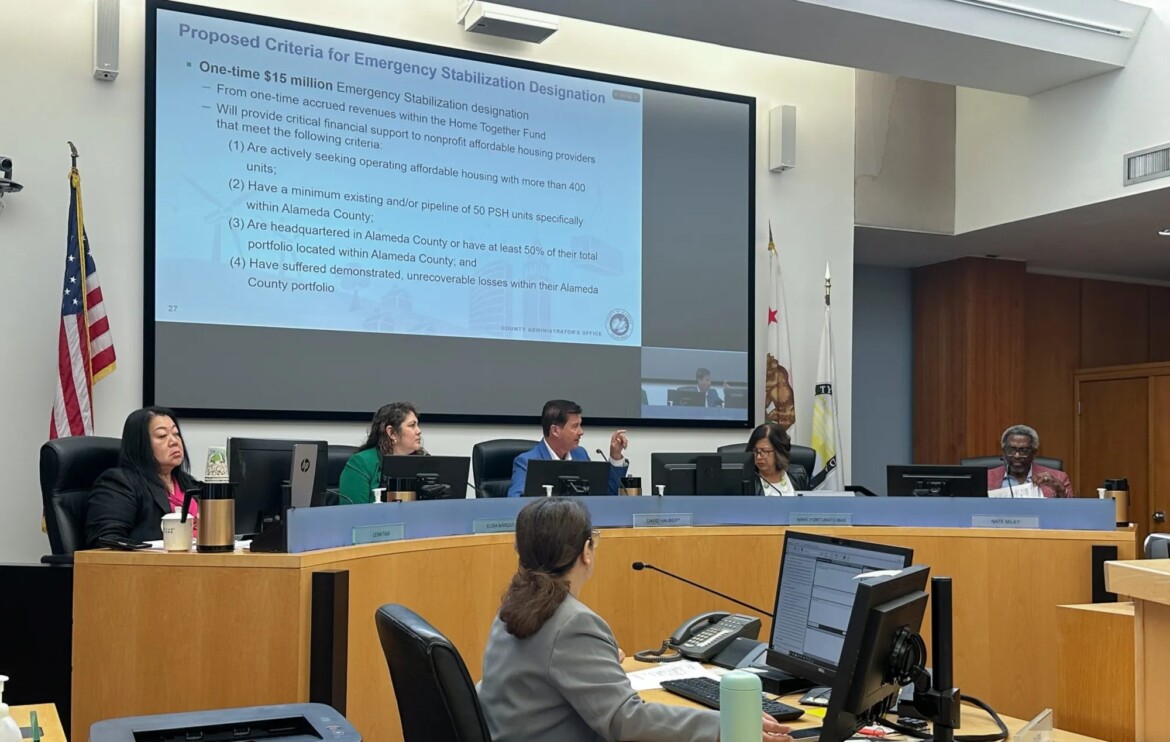
A majority of Alameda County supervisors oppose the new rules, with David Haubert and Nate Miley leading the charge, having both lambasted the proposal during public meetings and hosted a news conference to amplify their objections.
Supervisors defend current practices
They say the county was already transparent in the way it put the discretionary spending proposals on publicly available board agendas, not on the consent calendar, and required a four-fifths vote to approve them.
“Everything that Alameda County does is fully transparent, and made available to the public. In fact, we exceed transparency protocols of most counties already,” Haubert said Wednesday.
“This is nothing but political retribution, targeted at our board during an election, and Sacramento legislators went along with it to support one of their own,” Haubert said.
Wahab was shepherding the bill through the Legislature while running a successful campaign to replace Eric Swalwell as the U.S. representative for California’s 14th Congressional District. Three supervisors endorsed her opponent, BART Board Director Melissa Hernandez, who also works in Haubert’s office as an aide.
Swalwell resigned from Congress and dropped out of the California gubernatorial election earlier this year amid accusations of sexual assault. He has denied all allegations.
Supervisors have also repeatedly taken issue with the fact that SB 1193 only applies to them, and not supervisors in any other California county.
“If the honorable senator, now congressperson, if she and her colleagues are so interested in transparency, why are you just imposing this on Alameda County?” Miley asked. “It’s a burr on my butt.”
Both Miley and Haubert said SB 1193 is ultimately an overreach of state authority.
Supervisor Lena Tam, chairperson of the board’s Personnel, Administration and Legislation Committee, sent Newsom a veto request letter saying the law includes an “overly restrictive definition of discretionary funding that limits the county’s flexibility to partner with (community-based organizations), directly impeding our ability to deliver responsive, effective services and advance our shared vision.”
It’s unclear if Newsom saw the letter before signing the bill into law on Aug. 27.
Miley said that after supervisors come back from the current recess on Sept. 15, they will solicit advice about a possible lawsuit from the county’s legal department.
“I do think if county counsel gives us a legal analysis and if it looks strong, then I think the board will pursue legal action because I think it’s a slippery slope for the state to impose its will on a charter county,” he said.
The post Alameda County supes weigh legal action in wake of new law on spending transparency appeared first on Local News Matters.