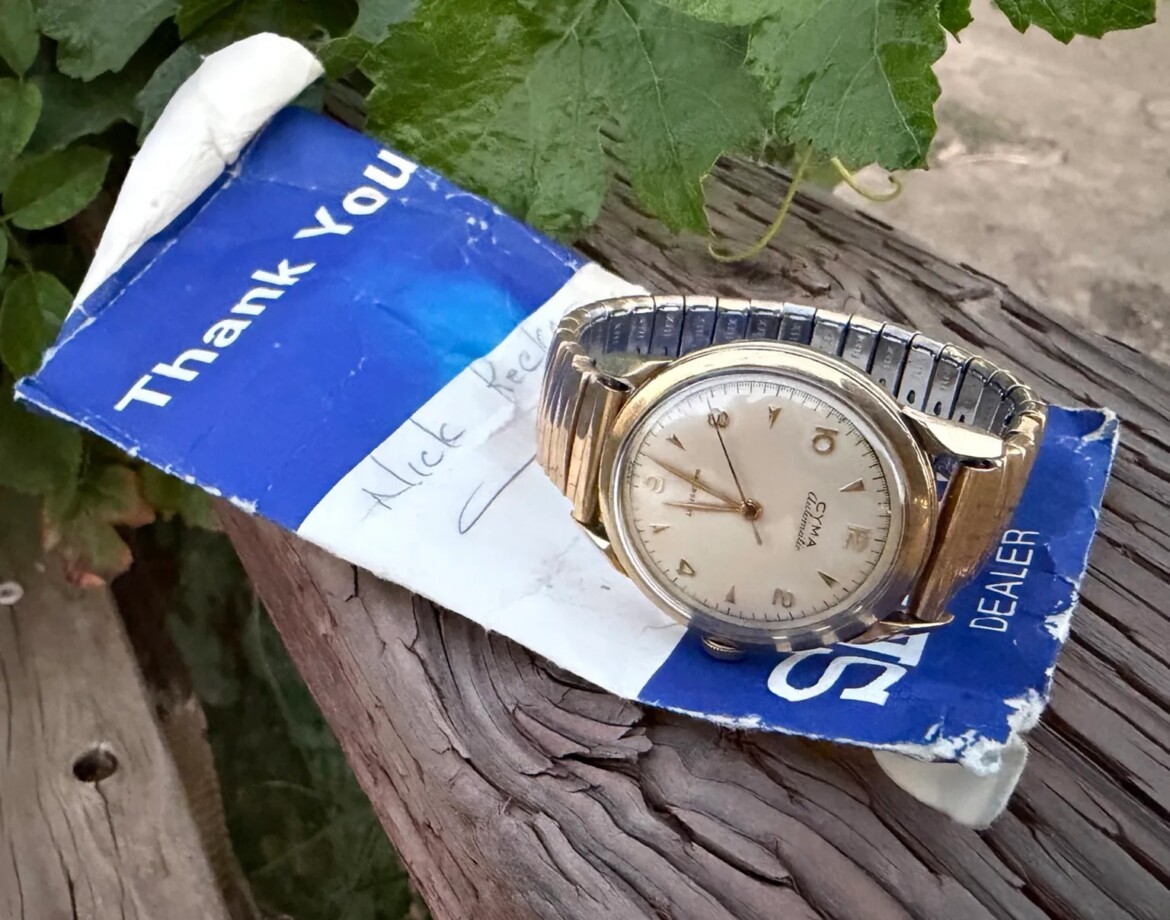
IT’S STILL TICKING, the watch Richard Yamashiro fixed for my grandfather in the early 1970s.
When Richard placed the repaired CYMA timepiece in a pickup packet for Nick Reckas, he couldn’t have known it would take over 50 years to find its way home. Or that it would bring the past alive when it finally arrived in the future, long after both men had passed away.

As much as this is the story of a World War II veteran’s returned watch, it is also one about two friends — a Greek immigrant and a Japanese American, who, after going through war and internment, carved out new lives in Albany on Solano Avenue.
It is the story of two families’ intertwining paths to the American Dream.
Let us first begin with the watch’s journey…
Sometime before my grandparents retired in the early ’70s and closed their business (Hi Fashion Fabrics of California at 1275 Solano Ave.), my grandfather ran across the street to Richard’s Jewelers to drop off his watch for repair. Between closing the shop and moving to Pleasanton, he simply forgot to pick it up before he left town. (A confession from my mother later revealed she had agreed to go back and pick it up for him but never did.)
And so the watch lived a quiet life, ticking away inside an envelope in the Yamashiros’ shop at 1272-1274 Solano Ave.
In May 2001, Richard closed his shop and retired just six months before he died, leaving his wife, Christine (Chris) Yamashiro, with an abundant inventory of jewelry he’d collected over the years.

To this day, Chris can tell you she’s still sorting through remnants of the family business — a life lived together, a place where their three girls grew up, finishing homework behind the counter between helping customers.
That excavating work is how she stumbled upon a little envelope with a handwritten name: Nick Reckas.
She embarked on an internet search for the family that once ran a fabric store across the street and found my mother, Jackie Reckas-Retelas, on Facebook. The two met in person to exchange the watch last year, and I learned about the story later.
But as a journalist, I wanted to know more, to record the history of what happened. I reached out to Chris to ask for an interview, and we agreed to meet at her daughter Amy Yamashiro’s shop, Anime Island, in El Cerrito Plaza before the doors opened at 11 a.m.
I brought my mom; Chris brought her daughters. And we laughed and shared doughnuts while sitting around a table covered with albums, old photos, framed portraits of Nick and Richard, my grandfather’s dog tags from the war, and the Cyma timepiece that brought us all together.
And the watch brought us back in time…
Richard Yamashiro was born in Berkeley on Oct. 25, 1927. After Japan bombed Pearl Harbor on Dec. 7, 1941, U.S. President Franklin D. Roosevelt issued Executive Order 9066 — a document that would effectively imprison Japanese Americans living in the military exclusion zone, or the nation’s west coast.
Along with his parents and siblings, Richard was forcibly removed from his home in the Bay Area at 15 years old and imprisoned at Utah’s Topaz War Relocation Center, in 1942.


For three years, Richard lived at Topaz where he graduated from Topaz High School. The 1945 yearbook archived in the Japanese American archive Densho Digital Repository shows Richard led an active student life. He was a member of the senior social committee and the Hi-Y club (akin to modern leadership) and also held the title of sports editor of the school newspaper, “The Rambler.” While he wasn’t named as a Choral Club member, his note on the “Senior Will” page (on 107) reads, “Richard Yamashiro leaves his soprano voice to the Choral Club.” Given that his classmate, William Takahashi, willed “some of his brains to the less fortunate ones,” it’s safe to assume our Richard was also joking.
“They were a very tight-knit group,” Chris shared. “They spent their entire day together — they would wake each other up and then go eat and go to school. Their parents had no control, really, over their lives there, so they spent all their time with their friends.”
The yearbook’s foreword captured both the sentiment of leaving high school and Topaz itself, as 1945 brought about the end of the war and the camp’s closure. “We have prepared ourselves during these years for that day of relocation. The time is here, and we are ready.”
Topaz Principal Clarence Laverne Bane’s yearbook statement highlighted the endless human cycle of war.
“The challenge to each succeeding generation is to learn how to reassemble its broken world into a pattern so firm and so fair that war cannot be possible,” wrote Bane. “All we can do is fumble and try once more — try out of the memory of our anguish — and be as tolerant with each other as we can.”
Once freed, Richard decided to serve in the Army, where he was told he had a medical issue that would likely end his life at 40 years old.
“We’re not really positive what it was, but apparently they told him that he wasn’t going to live very long,” his daughter Amy explained.
A new life
After serving, he obtained a watch-makers certificate in 1949 and started working in Berkeley — deciding against getting married and bringing children into the world, given his health condition. When age 40 rolled around, however, he went to another doctor who completely dismissed the first diagnosis. This gave him the knowledge he needed to marry Chris, the love of his life, and have three daughters: Julie Weitz (nee Yamashiro), Amy Yamashiro and Jane Yamashiro.

But even before Richard met Chris, he met Nick.
Nicias Reckas, as was his legal name, was born in 1908 in what immigration officials at Ellis Island later recorded as Sparta, though not the ancient Greek city-state that probably comes to mind. It is likely they meant Sparti, the largest nearby city to his actual birthplace, the little village of Agios Nikolaos.
My grandfather was a writer. I grew up listening to the click-clack of a typewriter as he wrote stories and I played with my toys in the next room every day after school. I would come to learn he was writing about his life. His manuscripts — a series called “The Making of an American Boy” — detailed his childhood spent malnourished and foraging for wild myrtle berries in Greece when WWI had blocked wheat berries and other imported goods from getting to his village.
They were stories of watching the war ships on the water off Cape Malea before the bloated bodies washed ashore. And stories of a child who knew from intense hardship just how lucky he was to be in America, even when some of its citizens despised the young newsboy for stealing work from them when he arrived. Were those who claimed such theft yearning to wake before sunrise to sell papers to prostitutes and gamblers on their way home and laborers and bankers on their way to work? He couldn’t be sure. But he so deeply loved his new country that he could ignore those who didn’t love him.
“When God takes me, I want the American flag on my casket,” Nick wrote. “This will mean that I was brave and worthy enough to fight for America. It will mean repaying my obligation for the new life I have found in this new country.”

He also wrote about a Japanese man, Mr. Yamasaki, who owned a drugstore and would allow his family to charge items to an account when they didn’t have enough money.
“We are all poor but honest,” Mr. Yamasaki told the young Greek boy. “Tell your mother to send me the money whenever she has it and her credit is good anytime.”
When reading through his manuscripts that captured the heart of Fresno’s immigrant community in the 1920s, I can’t help but think the kindness he found from people of all different walks of life gave him a wide sense of what being an American looked like.
And that perspective extended to his friend, Richard Yamashiro, many years later.
Going to bat for a friend
Chris recalls the two became friends while Nick was selling buttons to Berkeley drycleaners located near the small shop where Richard worked repairing watches. Nick convinced Richard he needed to open a larger store in Albany, so his business could grow.
But it wasn’t so simple. No one would rent to a “Japanese man,” even though he had known no other country but America as home.
Hate is an insidious virus, evolving as it adapts to ensnare new hosts, careful to keep itself tolerable enough to survive as it grows and spreads. By the late ’40s and ’50s, things had improved for the Greeks, especially the ones who’d lost their accents or fought in the war, much like my grandfather. The same was not true for those of Japanese descent and many other groups. I suppose where some might feel relief that the hate he once experienced had moved on to target others, Nick felt a feverish sense of justice.
Before Richard could expand his business, Nick knew he had to convince someone else. Not unlike other immigrant communities, the Greeks leaned on each other in their new country, and the word of one Greek to another Greek carried weight. He used that connection to help Richard by convincing a Greek landlord to let Richard become a tenant.
And soon, Richard’s business opened across the street from my grandparents’ fabric store. Chris said the move to Albany shaped Richard’s career, as he no longer simply repaired watches but owned a larger business that sold diamonds and jewelry as well.
“Your grandfather had a big impact on Richard and his business,” Chris said to me. “He had told me how Nick had helped him move because he knew that he couldn’t start the business on his own.”

Richard’s move was an added bonus for my social butterfly grandfather, who now had a buddy across the street. My mother recalled working in the shop with her mother and wondering where her father had disappeared to, only to find him standing outside laughing with Richard.
That memory tracked for Richard’s daughter Amy. “It still floors me that he had a jewelry store, and my dad would leave the back door open so his friends could come in and get coffee at the coffee pot on the way up to the front to see him.”
Up around the bend
Through our conversation, Richard’s oldest daughter, Julie, learned why her family had a collection of fabric bolts, and we all learned of yet another connection: John Fogerty — the creative force and lead singer of Creedence Clearwater Revival.

Chris was friends with the famous artist’s mother, Lucile Loosli, who frequented the jewelry shop and would share reports about her son’s latest musical endeavors. Chris later visited her in the hospital before she died in 1988. And when my grandparents retired — leaving behind the watch in the process — they sold their Albany home to Fogerty himself.
A picture of Fogerty in his memoir, “Fortunate Son,” on the photo insert between pages 152 and 153 shows him standing in the garden my grandfather designed. Most people will see the famous musician in that image, but I first noticed the red-brick path and plants my grandfather landscaped in similar fashion at the Pleasanton home. For a kid who always wondered where the red-brick road led when Dorothy Gale placed her ruby slipper on the adjacent yellow, those garden paths my grandfather created sparked make-believe adventures I remember to this day and a lifelong love of storytelling.
Funny how something so simple and overlooked as a garden path can help shape a child’s life — how an ordinary object, like a forgotten timepiece, can make people remember.

When asked what she would say to her husband if he were still alive, Chris expressed a desire to know more about his life in the internment camp. Then she lifted her phone, which lit up in sync with her smart watch. Both had Richard’s smiling face saved as the background.
“I talk to him every day,” she added.
As for the watch, it has become to me a symbol of friendship, hope, hard work, entrepreneurship, American dreams come true and memories that are now recorded in this very publication.

Through its story, the watch showed the beauty that is the human spirit of resilience. If it weren’t for its arrival, I wouldn’t have spent hours combing through archives of faces from the past, smiling as they made the most of living life in a concentration camp. I might have let the storage box filled with my grandfather’s manuscripts sit unread another year.
And the watch serves as a reminder that when society would have readily condoned my grandfather’s hate, he chose to see another human being who deserved the opportunity to succeed — and instead became an advocate in his own way.
And who knows? Maybe in another 50 years, that little CYMA timepiece will sit ticking on a table somewhere, telling a new story.
The post The Time-Traveling Watch of Solano Avenue: Rediscovered timepiece binds family legacies appeared first on Local News Matters.
Lovely story