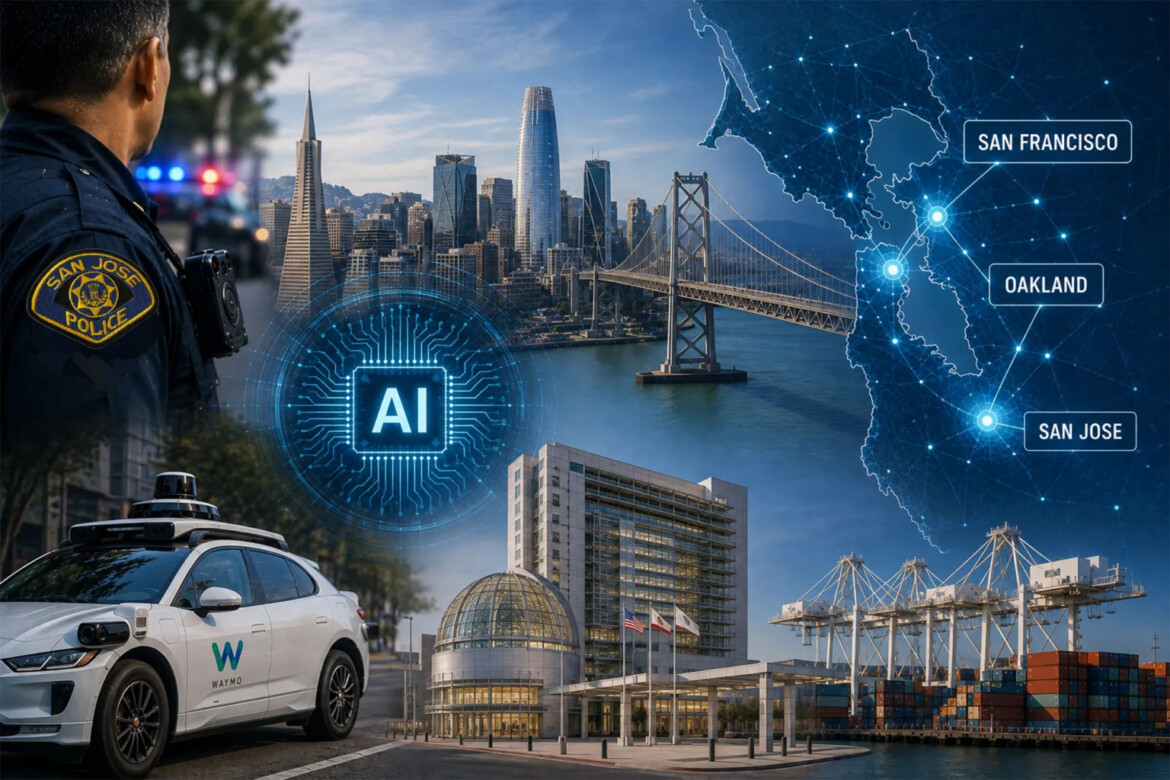
FOR THE THREE BIGGEST BAY AREA CITIES, artificial intelligence is not just coming; it’s already here.
Consider a world where police body camera footage is automatically analyzed for misconduct… street conditions are fed by Waymo to the public works department for traffic planning and control… city worker efficiency improves to the tune of five hours a week, reducing backlog in the process.
These are just a few of the ways municipal governments are exploring how using AI may change things.
With their proximity to Silicon Valley, San Francisco, Oakland and San Jose have embraced AI’s potential and have taken big steps to implement the technology across departments. All three of the Bay Area’s largest cities expect to see dramatic improvements for their local governments that translate to increased efficiency, quicker response and higher public confidence.
San Jose puts AI on the streets
“I think it is probably the apex of everything that we’ve ever seen in our lives when it comes to technology and advancements,” said Khaled Tawfik, chief information officer of the City of San Jose. “Technology is always great, it’s what we do with it that sometimes causes problems.”
Tawfik said that the city’s goal with AI is to create “seamless government services” that have the power to get out ahead of problems. The city has already started to use the technology in its 311-service delivery.
San Jose has embedded AI into city-owned camera systems to monitor street conditions, graffiti and illegal dumping, analyzing footage and alerting both public works and autonomous vehicles on the road if there are obstructions or other hazards to avoid. AI has also been used to analyze graffiti to determine whether there is criminal intent behind a tag, and if so, notify the police department to act before people get hurt.
San Jose has also participated in a pilot with Waymo and Waze, utilizing the fleet’s cameras to be the city’s eyes and ears on the ground as they roam around the city. Today, that information is being collected by Waymos on the road and input manually by a city employee into the 311 system, but the plan is to have AI take it over in the future. This is also a cost savings measure for the city.

“We’re not relying on how many cameras we can afford to buy, and we have a seamless process where the vehicle becomes a part of the ecosystem,” said Tawfik. He added that he hopes this partnership will establish how the government can use autonomous vehicles to improve mobility in the city, not just for cars but for bikes, public transit and pedestrians as well.
Oakland looks to AI to improve services
Like Tawfik, Oakland’s Assistant City Administrator Chuck Baker can already see how AI could solve some of the toughest challenges cities face.
“It’s not just to provide services, it’s to reach our economic goals, which includes growing the economy and increasing jobs,” Baker said. “A strong AI policy internally will help provide service delivery and achieve those other objectives.”

Oakland established an AI Working Group in 2024 to explore how public services could be enhanced with AI, with a focus on improving the public’s relationship with local government, especially for people who have historically been underserved. The city moved the group’s work toward implementation under Mayor Barbara Lee in late 2025.
With an eye on equity, Oakland highlighted several issue areas that AI will be used to improve, including fairness and accountability, inclusive access, transparency, privacy, and community engagement, among other things.
The working group identified 30 specific use cases for the technology that fit within this framework. Those cases are currently being turned into pilot projects, including accessibility tools like real-time captioning and translation, transparency tools like AI-powered review of police body camera footage, and autonomous drones for wildfire awareness and illegal dumping.
Tony Batilla, Oakland’s chief information officer, has been leading the city through internal implementation and sourcing companies to develop these pilot projects.
AI is “an important technology that needs to be carefully understood, for its potential uses, both good and bad,” Batilla said, “AI in particular does have potential to improve customer service and internal operations and certainly gain efficiency, but I think, we’re still in the beginning phase of that evaluation.”
Baker added that he sees a world in which highly efficient service delivery, such as quick permitting approvals or responsive 311 service delivery, will strengthen the business climate. If Oakland is able to do this, he imagines it will attract more businesses, increasing jobs and economic output.
San Francisco workers find AI saves time
San Francisco may have the data to back up government efficiency claims. The city rolled out its AI use guidelines in the summer of 2024 after a survey conducted by the Department of Technology found that 75% of the surveyed workforce had already begun using AI in their daily work.
This led to a pilot program to test how AI was affecting employees’ day-to-day workflow. Two thousand employees opted into the pilot, revealing that 75% of participants saved an average of 5 hours a week.
All together, AI is giving workers the time to either revisit long neglected tasks or take on more work, increasing efficiency in the process.
“We’ve seen a lot of interest and a lot of excitement,” said Michael Makstman, San Francisco’s chief technology officer, in relation to employee response. “As the tools get more sophisticated, we’ve seen some really sophisticated usage.”
A pilot program to test how AI was affecting San Francisco employees’ day-to-day workflow revealed that 75% of participants saved an average of 5 hours a week.
San Francisco’s AI transparency ordinance requires departments across the city to collect data showing how they are using AI, including what specific models they use and what problem is being addressed with its use.
According to the data, San Francisco city government currently employs 43 AI tools across 8 departments, with the Public Utilities Commission, Department of Public Health, and the Police Department using it the most.
Some of the use cases outlined in the transparency data include the San Francisco Sheriff’s Office using a product called Evolv Express, which uses machine learning algorithms to determine the difference between everyday objects or what may be a weapon when an individual visits San Francisco General Hospital. If the software detects something that could be a weapon, it instructs security officers to inspect further.
The Public Health Department has deployed a tool called RapidAI to help doctors guide treatment decisions for patients experiencing strokes by conducting real time analysis of MRI and CT scans to determine whether urgent interventions are needed, reducing the time patients spend in the emergency room.

The Police Department is also utilizing an AI tool called Pathfinder, made by the company Cellebrite, which assists investigators by connecting mobile devices of suspects to a forensic hardware unit that bypasses lock screens, extracts data, then uses AI to parse information and produce a report used by investigators.
As part of its disclosure responsibility under the transparency ordinance, the SFPD noted: “Law enforcement agencies increasingly face overwhelming volumes of digital evidence from mobile devices, computers, cloud sources, CDRs, and other data streams.
“Manually reviewing this information device-by-device is extremely time-consuming and can delay case progress. Identifying key insights, uncovering hidden connections between individuals, and coordinating investigative work across units is often hindered by fragmented tools and data silos. Pathfinder is designed to centralize and streamline this process.”

With San Francisco at the center of the rapidly growing AI industry, Makstman said there is pressure for the city to move quickly and remain on the cutting edge. One step the Department of Technology has taken is developing its own AI model specifically for civic use, an effort led by Director of Emerging Technologies Jane Gong.
Makstman said that due to the diversity of applications across the city — from operating the airport, a trauma center and a jail to a variety of other city government operations — the cost of using so many models has led the department to invest in its own that can be utilized for similar use cases and issues across departments. The city is beta testing its model, and officials hope it will scale across the city in 2027.
All this has given Makstman and his team a window into how AI could improve the way government functions, from everyday tasks that can be completed more quickly, to large data sets that can be analyzed and understood in record time. They hope the result will be a more responsive government able to better meet the needs of all city residents. Makstman’s team is moving full steam to train departments across the city on the power of these tools and how to use them safely.
How cities are thinking about AI safety
While the cities are excited about AI’s power to reshape how government functions, they recognize it also comes with risk. So while they want to move swiftly, they are also being methodical, taking a step-by-step approach to research, test and train before widespread deployment.
“Every time we bring something new, we do pilots, we do experiments, we do internal examination and everything is accompanied with training,” Makstman said “It’s a new tool, so there’s a lot of concerns and our goal is to engage as productively as possible … we want to be additive to the experience for our staff.”
San Francisco has also produced an open-source playbook on AI implementation for city workers that outlines a seven-part strategy for successful implementation that other cities can also use as a resource.
The playbook states that users should first ask themselves whether AI is the right tool for the job, then use a scientific method style approach for its use: defining a problem, setting a hypothesis, conducting a low-risk pilot to determine its effect, then applying lessons to refine the approach and scale its use.
“The way we’re treating [AI] is one of the tools in our toolbox for our staff, it’s a tool that is fit for some work, but honestly, is not fit for other work.” Makstman said.

In San Jose, Tawfik said that he’s keenly aware of mistakes technologists made when the Internet and social media became part of our daily lives 25 years ago. He noted that if technology leaders had better understood the risks, they might have put better safeguards in place and mitigated some of the problems that the technologies have brought, such as cyberattacks or online bullying.
“We use technology without really thinking about the potential risk,” Tawfik said. “I’m trying to think what could go wrong 50 years from now. If we invest 1% in safety today, that will have a tremendous trajectory 50 years from now or 20 years from now or even 10 years from now.”
In partnership with San Jose’s Human Resources department, Tawfik said over 1,000 employees have received mandatory training mostly focused on cybersecurity and protecting data. San Jose also has an AI Upskilling Program that helps with risk assessment and AI use procedures.
For example, tasks like writing internal emails are deemed low risk, while drafting city memos, departmental hiring decisions or legal information needs careful review due to the potential to affect people’s rights or safety.

In Oakland, Batilla said AI use can become problematic when it’s allowed to be the decision maker, especially as AI software has demonstrated biases. Batilla said city security guidelines prevent AI from making any decisions, while also preventing city workers from uploading city documents to third party platforms.
Batilla said his goal is for the city to create a “safe playground” for pilot producers to experiment with technologies while also being free to the city, creating both a low financial risk and low risk to disruption of services or privacy.
In San Francisco, Makstman’s department has mostly focused on helping city staff use AI for their day-to-day work. When it comes to public facing AI tools, Makstman believes the bar must be set much higher.
He hopes the city can experiment internally to understand the power of these tools, which will eventually reduce the friction that people feel interacting with their government.
“We don’t sell ads or make candy,” Makstman said. “The decisions we make and information we provide may affect somebody’s food for their family for the next day, or their healthcare decisions. … These are consequential decisions and we need to make sure that we understand [AI] really well before we expose this new technology to San Franciscans.”
What will AI mean for city jobs?
While budgetary concerns are always on the mind of city leaders, Oakland officials stressed that this technology will remain focused on improving the efficiency of the workforce and will not be used to automate away staff.
Batilla said there are “zero plans” for AI to be used in Oakland to replace jobs.
Baker added that Oakland uses a data-driven approach to increase job opportunities, productivity and efficiency of the current staff and that AI is a tool to help the city achieve those goals.
Sean Maher, Oakland’s citywide communications and engagement director, also noted that he’s heard nothing from policymakers, departments or staff leadership about plans to reduce staffing as AI becomes more dispersed throughout city government.
According to data collected under San Francisco’s AI transparency ordinance, which requires departments to report how AI may impact jobs, all city departments report the specific AI tools they use are not being used to replace workers, but to speed up, assist or enhance human-led processes.

In San Jose, Aram Kouyoumdjian, director of Human Resources and City Manager’s Office of Employee Relations, said that there will likely be roles that will need to “evolve” as a result of AI implementation. He said his team, along with Tawfik, has been focused on upskilling and reskilling workers while assessing which roles may be susceptible to AI impact.
“We no longer have typists and word processors, some folks are going to have to be retrained or transitioned into other responsibilities,” Kouyoumdjian said. “The other flip side of this question is, what’s the workforce we’re shaping for the future, not simply the folks who are currently employed in the city, but new employees coming in? What are the skills and attributes we’re going to be looking for, while really making sure that the city staff is primed to meet the technological opportunities that come our way?”
GovAI: Cities band together on AI
As cities and governments work through the challenges faced with implementing this technology, San Jose has launched the GovAI coalition, a collection of government officials in city, state and federal agencies that are collaborating on use cases, issues, and promoting responsible use. Oakland and San Francisco are both members.
Makstman noted information sharing has been a powerful tool for San Francisco, saying the collaborative aspect of the coalition has helped the city understand what has worked elsewhere and what pitfalls to avoid.
“It’s been good to learn from one another; also it feels like, sometimes I can breathe, we all face the same unknown,” Makstman said.
In Oakland, Batilla observed that governments share information with each other all the time and that the coalition has become another avenue to communicate and collaborate. He said the coalition’s work was helpful as the city officials first started thinking about their use guidelines.
Tawfik, who sits as the board chair of the coalition, said that it was important for cities to work together to develop the rules for responsible use. Tawfik noted that beyond just sharing information, the coalition is developing policies.
Tawfik said those policies could be a baseline for cities that lack the resources or knowledge to develop such guidelines on their own.
Cities could “copy it as is, create a couple of things that make it relevant to their agency, put their logo on it, and now they have a policy,” Tawfik said. “We’ve never seen anything like that in government.”
Tawfik said the coalition can help cities avoid the missteps of the past and share lessons they are learning as they attempt to further implement the technology across the country.
“Reflecting back 25 years ago when technology and the dot com and everything was brand new, we made a lot of mistakes because each one of us did it alone,” Tawfik said.
“AI gives us the opportunity to take a different approach. By learning from those experiences, we can put training, governance, and safety measures in place from the start, allowing us to adopt AI responsibly, securely, and in ways that better serve our communities.”
The post The Isle of AI: Tech promised a better future. These Bay Area cities think it’s already here appeared first on Local News Matters.