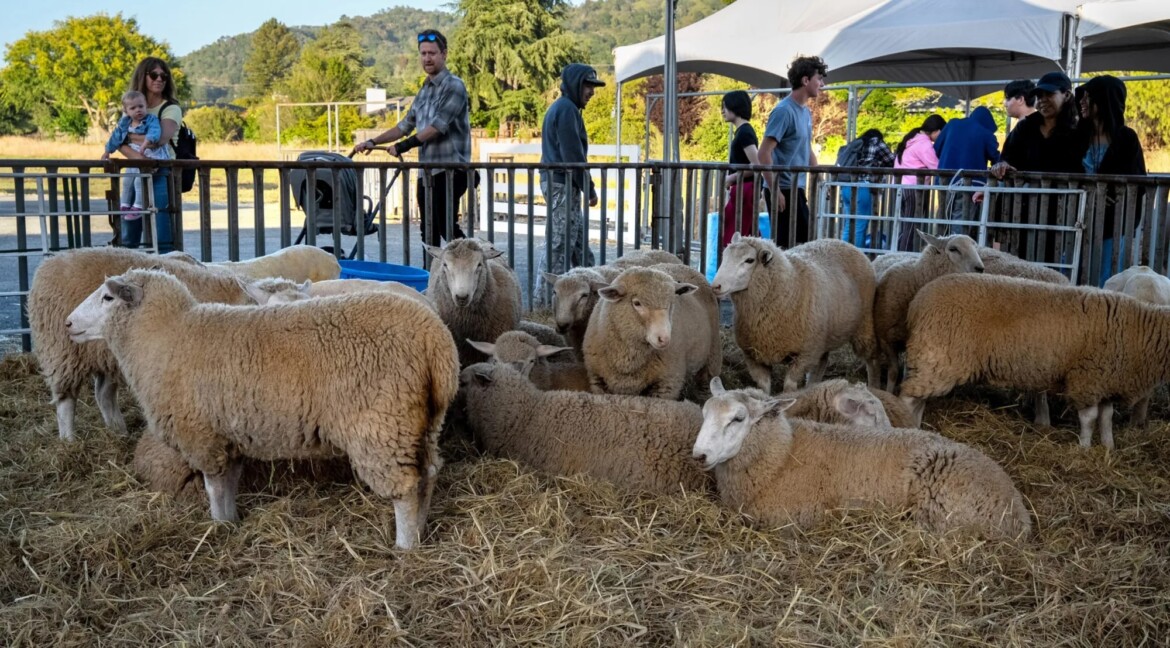
The Marin County Agriculture, Weights and Measures department introduced the idea of expanding the county’s sheep and wool industry as part of its annual crop report to the Board of Supervisors on Tuesday.
Overall, the crop and livestock report found the gross value of all agricultural production in Marin County for 2025 was about $94.1 million, an increase of 12% from 2024.
Part of the report included a special assessment of the sheep and wool industry by an economic consultant.
The U.S. produces less than 1% of the world’s wool, according to the report, and much of the country’s raw wool is exported for processing. Finished wool products are imported and have recently been impacted by trade barriers.
Duncan MacEwan, principal economist with the firm ERA Economics, said that a historical drop in wool demand was driven by consumer demand for synthetic fibers.
“But that’s reversed in recent years,” he said, “with more interest in natural fibers that supports markets like wool.”
Wool clothing presents the possibility to develop a niche local market in Marin County for environmentally sustainable material. Other sheep products include meat, dairy, and grazing services, including clearing the underbrush that fuels forest fires. Wool is also used to produce industrial products like air filters and sound insulation material.
Worth its weight in wool
According to the report, Marin’s wool industry is relatively small and is focused on fiber production, about 24,000 pounds annually, with a gross value of about $40,000. The county’s small but established wool supply chain includes local businesses and producers like Barinaga Ranch, the West Marin Wool Shed, and Brazil Ranch.
“The wool is here and the quality is wonderful.”
Joe Deviney, Agricultural Commissioner/Weights and Measures
MacEwan said the key would be coordinating supply and production with the broader regional economy. Because the infrastructure needed for production is expensive, any expansion would not view Marin as an island in the sheep and wool industry. There are other research and industry efforts going on in Lake County and other areas of Northern California, he said.
According to the U.S. Department of Agriculture, California is second only to Wyoming in the production of sheep and lambs.
“The wool is here and the quality is wonderful,” said Agricultural Commissioner/Weights and Measures director Joe Deviney.

Deviney estimates that expanding the sheep and wool industry would require 15 specially trained full-time employees among other investments.
“We were dreaming of a campus of research and development,” Deviney said. “There is a water component that you need to wash the wool, and it takes electricity, but we could do solar.”
There’s the beef
Outside of the sheep and wool industry assessment, cattle and calves were valued at $23 million and were the top grossing commodity in 2025, said Allison Klein, an inspector with the department. She said the value was 43% higher than in 2020.
“In 2025, the beef market reached unprecedented levels nationwide, driven by limited herd recovery from prior drought years, high input costs, and high consumer demand,” said Klein.

Organic milk remains the highest valued livestock product in Marin at $21.4 million. Although production dropped slightly in 2025, it was offset by higher prices.
The total gross value of field crops, such as hay and rye, increased 12% due to early season rains, Klein said. While the total gross value of fruits and vegetables decreased 13% in 2025 from $2.4 million to $2.1 million, she said that the number of acres harvested held steady due to local producers continuing to grow and diversify their products.
California continues to have an oversupply of wine grapes, so grape prices are lower, although production held nearly steady compared to 2024. As a result, the value of wine grapes in Marin County fell by 10%.

The post In sheep’s clothing: Marin looks to weave natural wool fiber into its agricultural future appeared first on Local News Matters.