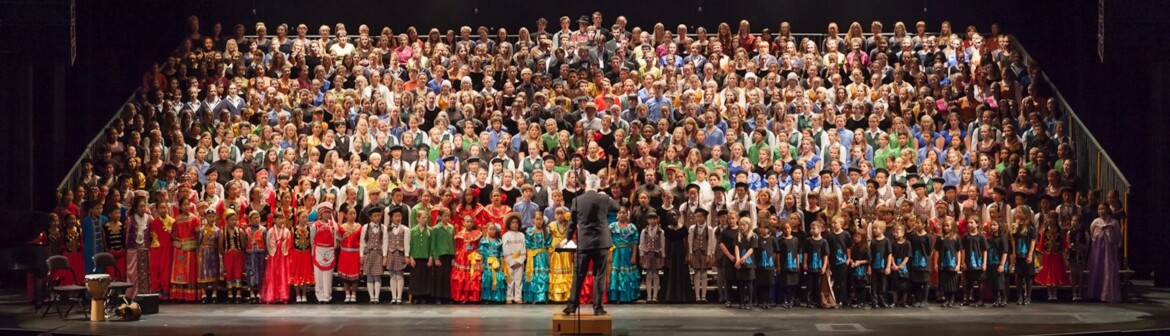
When 400 young people from nine countries participating in the 2026 Golden Gate International Choral Festival step onstage in the closing concert’s grand finale, the moment is about much more than logistics.
“These young people gather unmediated by screens, unmediated by preconceptions about each other. They’re literally synchronizing their breath and heartbeat,” says Piedmont East Bay Children’s Choir Artistic Director Eric Tuan. “They show how different cultures, musical styles, and traditions can come together in harmony. It’s a celebration of what unites us, and of the joyful diversity of our world.”
This year, PEBCC will host the week-long festival from July 13 to 18 at four venues in the East Bay and San Francisco.
The festival includes a “Sing-Off” opening concert, five “Spotlight” concerts with free admission to the public, and a closing celebration and award ceremony. Four categories establish the structure for each choir’s selected repertoire: historical music, folk music, contemporary music, and gospel/spiritual music. In 2026, the event will be guided and awards determined by a local and international panel of adjudicators: María Guinand, Dr. Maria Theresa Vizconde-Roldan, Jude B. Roldan, and Valérie Sainte-Agathe.
An unusual feature of the highly competitive event, which showcases elite choirs from around the globe, is the fact that many singers and adult chaperones homestay with local families during the festival. The host families offer opportunities for shared meals, sightseeing, and special insight into their American lifestyles, traditions, and culture.
“There are huge, international competitions with no interaction, and there are festivals that are non-competitive,” says Tuan. “Our core values have remained the same: a competitive festival that encourages choirs to reach their highest level of artistry, while also making it a relaxed environment where cultural exchange can happen. We strive to be the best of both worlds.”
That doesn’t mean Tuan has not observed changes since becoming PEBCC’s artistic director in 2019. The festival used to center on groups from Central Europe; now, it has broadened to include a more global scope of participation. There is also increased interest in presenting new works written by living composers, and active efforts to include underrepresented composers or rarely performed works in the choral canon.
The four competition categories provide distinct opportunities to showcase each country’s musical style, cultural traditions, and history. Fluency in a particular language and a country’s musical journey from the medieval period to the present are special features of the historical portion of the festival.
Choirs performing folk music repertoire are often dressed in visually stunning national costumes and sing works with origins dating back centuries. The E. Mikeladze Central Music School’s choir from Georgia, for example, perform Georgian three-part, polyphonic songs taught entirely by ear.
For PEBCC, contemporary music is a major focus year-round — the choir has commissioned over 80 pieces. New music celebrates the excellence of today’s young singers and introduces composers the choir might seek out in the future. “These are not just young people singing cute songs,” says Tuan. “They’re artists in their own right and at the top level, [and they] offer a unique sonic palette for composers. This is an opportunity to display the best composers in their region and put new music on the international platform.”
Tuan believes the spiritual/gospel category is important element because it requires international choirs learn and celebrate music that traces its origin directly to United States history. “From enslaved Africans in the South to music being molded through HBCUs, to civil rights movements, to music of today, choirs perform and receive feedback about (their singing of) this American art form. We also are seeing the emergence of gospel and spiritual pieces they find percolating in their own country’s music.”
In addition to the musical excellence on display at the festival, Tuan values the sense of camaraderie among the singers and the generosity of the local community. In his first year, he witnessed two singers who had no common language, but sat down at a piano together and “spoke with tremendous familiarity” by sharing music from their countries. That same year, when meeting one choir at the airport, an extra adult chaperone arrived unexpectedly. Tuan says he made a call and a local family immediately offered help. “In five minutes, they said they’d house them. I drove them up there and that was it. The spirit of hospitality is special to the area. We’re excited to share that feeling at a time when international visitors to the United States might have (understandable) preconceptions and be anxious about receiving a warm welcome.”
Before the “heavy lift” of Friday’s closing concert — show order is not set until Thursday night, award winners are announced during a Friday morning SF Bay cruise, 500 people must be fed, and 400 singers shepherded onstage for the final number — Tuan and the team will already have tackled the complexities of homestay, transportation, and other logistics. Even with the long hours and hard work, Tuan says the festival is “a lovely thing” and the spirit of generosity in the community is a tribute to the Bay Area.