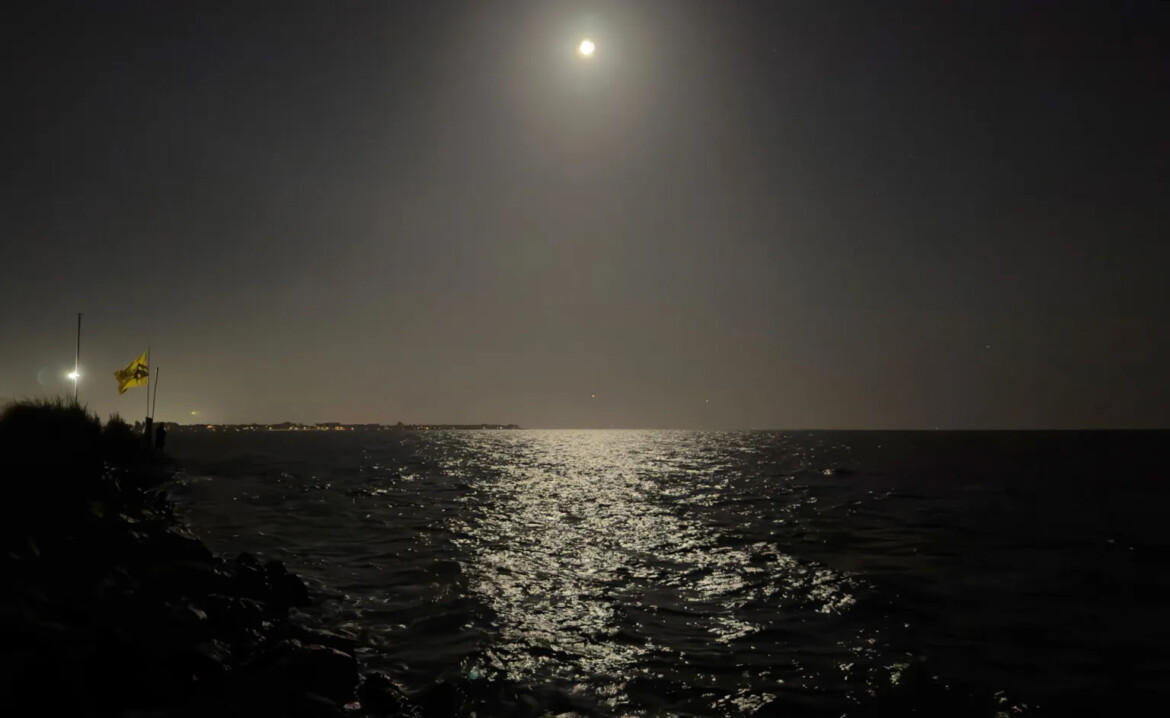
Thousands of endemic grunion fish leapt onto Bay Area shores late Tuesday night for a seasonal mating ritual, a reminder that all animals are guided by the celestial clock.
In a midnight tour organized by the East Bay Regional Park District, a few dozen drowsy spectators arrived at the Robert W. Crown Memorial State Beach in Alameda at the peak of high tide with the moon at its fullest. The crowd stirred when waves hitting the beach began to wriggle with silver fish. The first few sightings of the sardine-sized species were followed by billows carrying hundreds more. The whole event was over in a couple of hours.
Male grunion surf to shore to find the perfect spot of sand. Female grunion follow and bury their lower bodies in the soft sand to lay their eggs, while males curl around them to fertilize the nest. It takes about 30 seconds, with the female forming an anchor against the chaos of shifting waters. Susan Ramos, an observation guide and naturalist with the park district, said the eggs incubate until the next high tide, about two weeks later.
“It’s the agitation of the sand that will have them hatch out,” Ramos said to the people gathered. “They might only live two years compared to the ones in Southern California that can live three years. I believe they do come back to the same spot where they were born, and I think that’s why we’re seeing more.”

The females can spawn up to six times a season and can lay 1,600 to 3,600 eggs, she said.
The reservation-only observation happened in the East Bay, but the grunion fish likely rode the tide onto the gentlest shorelines from Baja California to Tomales Bay.
“There are a lot of sandy beaches people have never checked,” said Ramos about the fish. “I know they do it at Crissy Field, but I don’t know about Ocean Beach because it’s not as protected.”
The high tide connection was first identified by naturalist Boyd Walker, who in the 1940s went out almost every single night in Southern California for three years straight, said Ramos. She read Boyd’s instructions for counting millions of fish.
“Fish covering the beach; not possible to walk through the run without stepping on fish; run less than an hour or more over a large area,” she read.
Grunion are found exclusively along the West Coast. Historically, their migration spanned from Baja to central California. Ramos said a wave of the fish arrived in the Bay Area in 2000, then disappeared in 2007, then returned in 2014. Now she has seen them every year since 2017.
“It seems like the numbers are pretty good here, but in Southern California, the numbers are not so great,” Ramos said. “We don’t know exactly what’s going on. But we do know that this is an El Nino year, and there could be some heat going on down in Southern California.”
Viewing the grunion run
A valid California recreational fishing license is required to take grunion, according to the California Department of Fish and Wildlife, but only during open season with a limit of 30 per person.
But catching them isn’t exactly easy.
“You have to do it with your bare hands, and you can’t use a net, you can dig a hole, you just have to go out and grab them,” Ramos said, adding that in San Francisco, the park district recommends that people observe and conserve.
Runs are most likely to occur on the second, third, fourth, and fifth nights following the night of the new or full moon, according to CDFW. Generally, the third and fourth nights are best. The time of the run comes 30 to 60 minutes past high tide and it lasts from 1 to 3 hours. Viewing is best on a sparse beach. Flashlights should be used sparingly, so as not to scare the fish away.
The guided grunion searches at Crown Beach on July 15 and July 30 are already booked, but cancelations are common. Reservations and more information can be found at ebparks.org.
The post Under full moon, native fish arrive to dance on Bay shores in annual spawning ritual appeared first on Local News Matters.