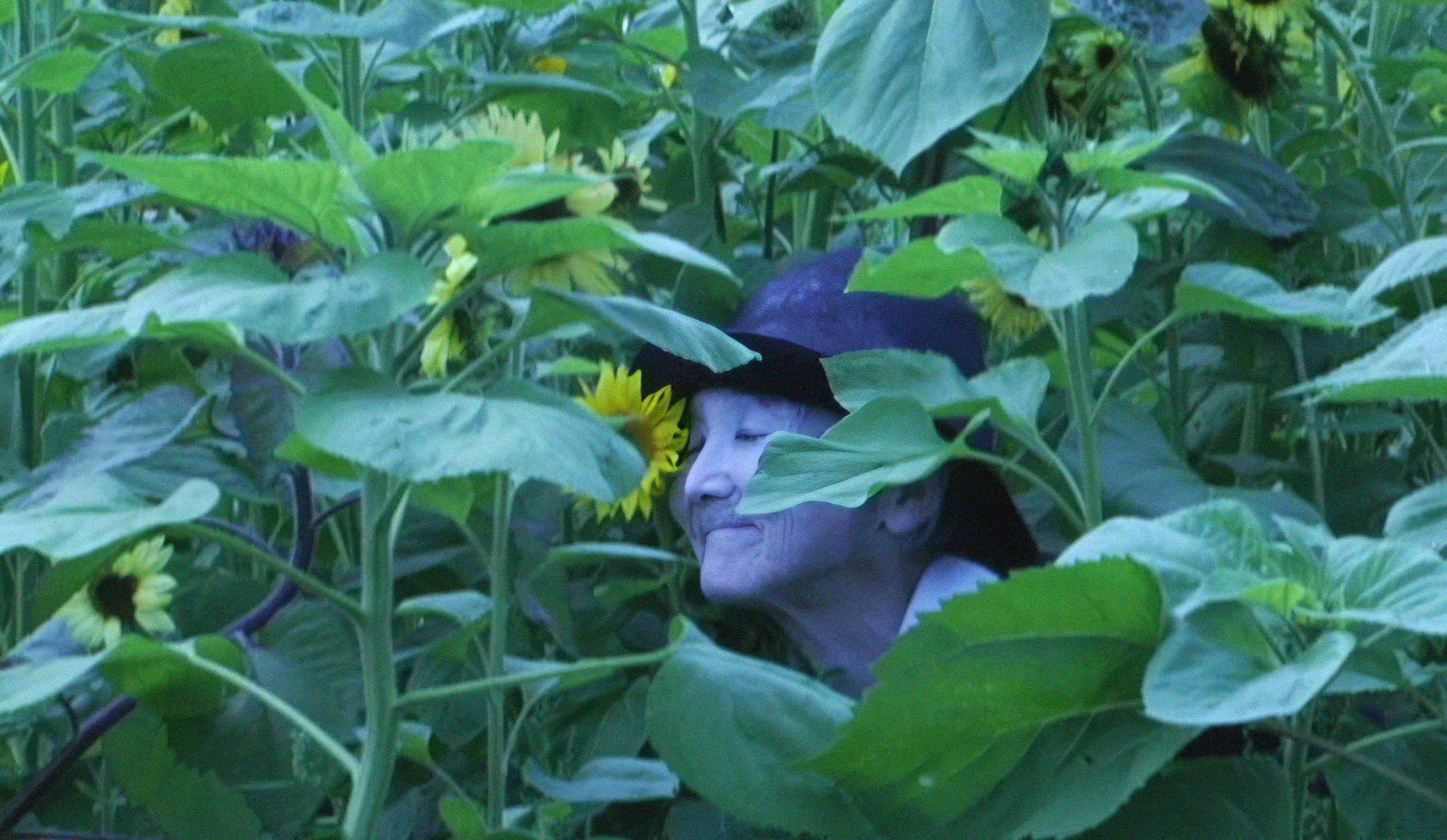
“The Tramp,” on view at California College of the Arts Wattis Institute in San Francisco through November, is a big swing of a solo exhibition in which the collaborative artist duo known as Caguiat Delacruz (Justin Caguiat and Rafael Delacruz) conjures the 1936 clown from Charlie Chaplin’s “Modern Times” to ask if our own time’s aspirational society of optimization, automated production, consumer satisfaction and material success leaves any place for the flâneur’s whim.
Upon entry, there is a large abstract painting, “Untitled” (2026), hanging on the backside of a bare wooden temporary wall, parallel to the front door. This wall marks the exterior of an inner chamber of the gallery, inside which is a discrete installation “The Voice” (2026), complete with the backseat of a car converted to a viewing couch, an old CRT TV monitor, and a dead potted plant resting on a VHS cassette tape player. The interior walls of this squat-like room are painted in a loose whitewash of abstract brushwork.
The television plays Caguiat Delacruz’s central film “The Tramp” (2026) on an infinite and randomly interrupted loop. The walksheet rather suggests this film is infinite, that each viewing is different, due to an automated, self-interrupting mechanism. Like in “Modern Times,” “The Tramp’s” sound is superficially layered onto the film: foley sounds, field recordings and music play only when the film self-cues or reviews, punctuating the space with the jumps in time.

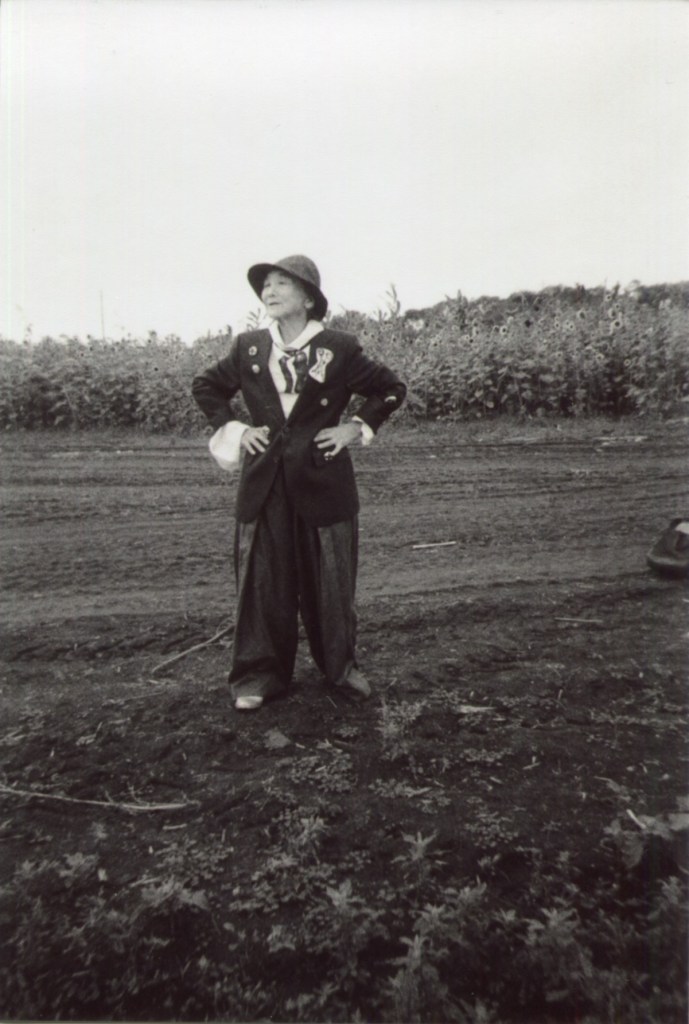
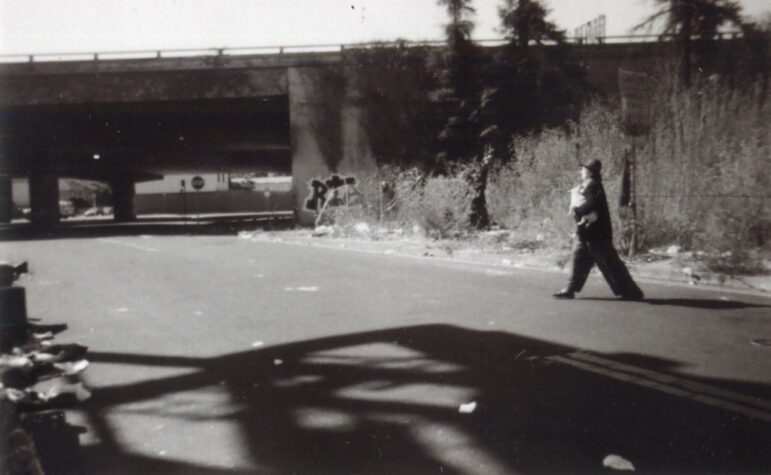
During my viewing, I saw one actor in an over-large Chaplin-like suit among yellow sun flowers. Ambient music played when the film fast forwarded, and its tracking lines, shimmering across the screen, evoked a sense of nostalgia for those once-common analogue technologies. In another black-and-white scene, another actor in another Chaplin-like suit walks ahead of the camera through a crowd on a sunny San Francisco day. The same actor later smokes a cigarette. Traffic sounds next played over the fast forward. These leaps in the film’s time, combined with my own nostalgia for bygone technologies, and the parallel narratives of 1936 and 2026, create an effective temporal anxiety: I tried to remember the appropriate name: dyschronometria or chronotaraxis, or the cognitive symptom known as time-shifting. Regardless, Caguiat Delacruz’s tramps are in a narrative purgatory. Next came a jump cut to the city’s quiet nightscape soaked in electric light and shot from a high-storied apartment building. UFO-like electronic sounds followed with the next skip.
Other works in the show include materials extracted and reconfigured from Caguiat Delacruz’s same film, including watercolor monotypes with scenes from the film arranged in a plexi vitrine called “The Long Walk” (2026); black-and-white photographs from the film or its rehearsal, also named after the film; an ink jet artist book called “Uugh…” (2026) on a provisional cardboard bench; duo-chromatic paintings of more film stills named after the film; a large orange, abstract painting called “Terminal” (2026); a high mounted clock with a faded image of the crucifixion on its face; intermittent pigment prints on metallic paper called “Untitled” (2026), and two wonderous sculptures of costumes transformed into assemblage-and-papier-mâché mannequin sets named after the movie. California assemblage was popularized after World War II, when, in a show of rejecting commercial art, artists opted instead to recycle debris, finding new possibilities in what society had otherwise discarded. Caguiat Delacruz builds on that lineage, while asking if and what new possibilities from a closed-loop.
The repetition of the title, “Tramp,” for example, applied to so many other works in the show and differentiated only by number, furthers a sense of restlessness, as though the spirit of the film is perpetually decentered through its multiple iterations. No one work is primary or fully resolved. The exhibit recycles its material in an ouroboros of mark making without either the satisfaction of a concluding coda or new material that might allow the artist-turned-clown to transcend or upend his limitations. Implicit in this pattern lies an argument about algorithmic practices that reconfigure and eventually exhaust or distort any original source.
The gesture is all the more prescient given the exhibition’s setting on the historic campus of the California College of the Arts, which, following nationwide trends of closing or sold art colleges, was sold to Vanderbilt University in January. Given the Bay Area’s recent loss of both Mills College and the San Francisco Art Institute, however, the question of where artists might find a place rings loudly.
Chaplin disrupts the assembly lines of his day, is accidentally caught up in and convicted for participating in a labor protest, daydreams through the absurdity of bourgeois life, and roller skates to the very edge of a department store under construction. Perhaps because the body is not able to perform on its own terms, subject rather to the skips and hops of rewind and fast forward, Caguiat Delacruz seems closed down, by comparison. Perhaps we might find solace in the canvas of a street and freedom of abstract marks making — a mode of production that remains untitled and therefore outside of identification.
“Caguiat Delacruz: The Tramp” continues through Nov. 21 at the Wattis Institute, California College of the Arts, 145 Hooper St., San Francisco. Open noon to 6 p.m. Wednesdays through Saturdays; admission is free. Visit cca.edu.
The post Review: Chaplin’s ‘Modern Times’ reimagined in ‘The Tramp’ in CCAC’s Wattis Institute appeared first on Local News Matters.