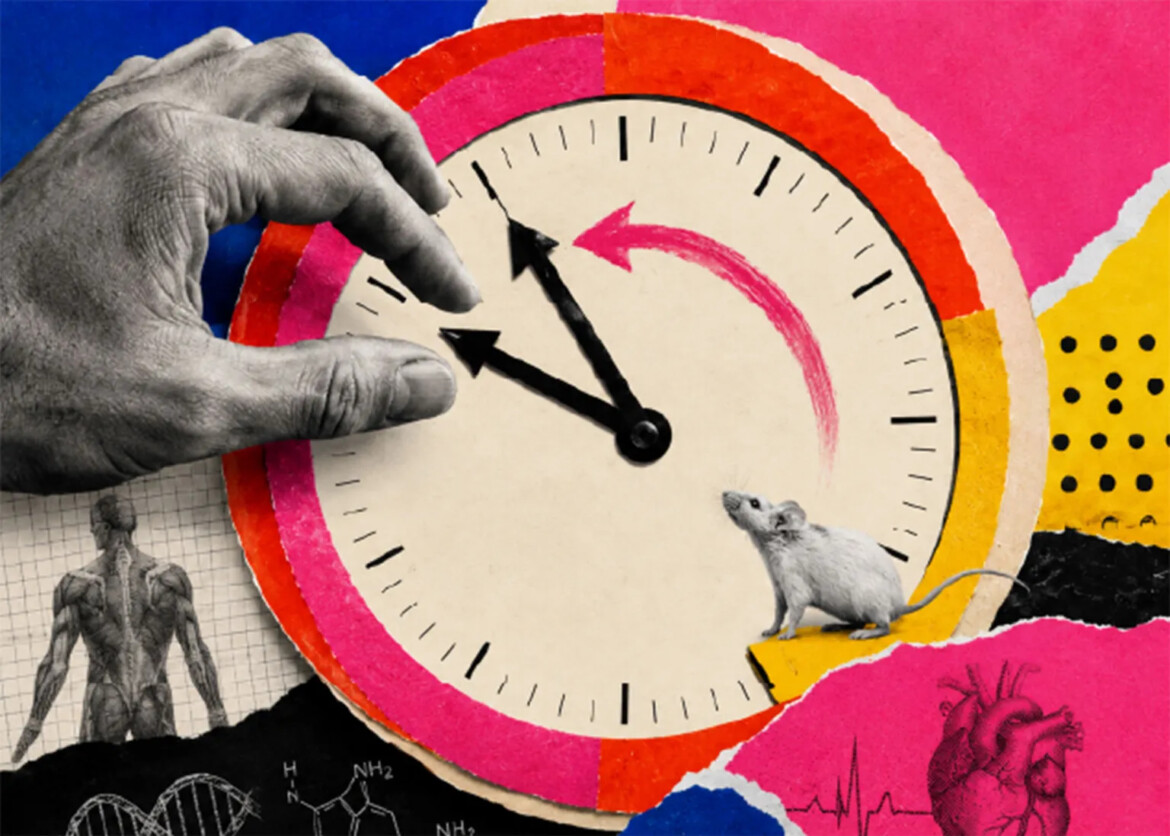
THE QUEST TO LIVE LONGER, fuller lives has captivated humanity for millennia. In lab mice, scientists have spent about a century studying the cellular damage that builds up in older animals and exploring ways to suppress the wear and tear. But around two decades ago, the goal posts changed. Rather than simply trying to slow the body’s decline, the field of “rejuvenation science” emerged to prevent age-related breakdown of cells and tissues even before diseases emerge — in essence, to rewind the biological clock.

This bold promise draws support from a set of curious experiments in mice. In one key study published in 2005, a team of Stanford researchers surgically connected a young mouse and old mouse so that the animals’ blood vessels form a single, shared circulatory system — a process known as “parabiosis.” The results were dramatic: The old mouse in these parabiotic pairs had younger-looking eyes and skin, and their tissues and cells looked youthful under a microscope and in lab dish assays.
“You could just see that [the old mice] were looking better,” says study leader Thomas Rando, cofounder of the Stanford Center on Longevity, who now leads the UCLA Broad Stem Cell Research Center. That study marked a turning point for longevity research. Rather than just extending lifespan, the research in parabiotic mice pairs suggested it was possible to reverse aging. “That’s what I would define as rejuvenation,” Rando says.
In the next few years, Rando and colleagues fleshed out molecular pathways underlying these changes, and another team, led by Shinya Yamanaka at Kyoto University, identified four proteins that could reprogram adult mouse cells back to an embryonic-like state. About a decade later, in 2016, researchers at the Salk Institute in San Diego and colleagues elsewhere published a landmark study showing that intermittent exposure to these proteins, dubbed “Yamanaka factors,” could reverse physiological and cellular signs of aging in a live mouse.
Those advances fueled a commercial market for plasma from young blood donors. Some startups charged thousands of dollars for a single infusion. Billionaire tech entrepreneurs popularized the trend for several years despite zero evidence that the fluids “would actually have any effect, let alone the kind of effects we saw in the mice — which are connected 24/7 for months,” says Rando.
The benefits and risks with young blood
Companies stopped offering young blood in 2019 after the FDA issued a stern warning, stating that the infusions carry health risks and offer no proven clinical benefits. Practically speaking, it’s very hard to prove benefits of young blood in people. The FDA is set up to evaluate disease treatments rather than life-extending products. For the latter, study participants would need to start a product in their fifties and be monitored for decades until they die, a costly and impractical proposition, Rando says.
A potential workaround would be for the FDA to evaluate the impact of an experimental treatment on a biomarker or set of biomarkers — often measured using blood, urine or soft tissues — that indicates a person’s biological age. But there is yet no such lab or imaging test that’s been shown to reliably stand in for the most relevant metrics of aging.
Studies have begun testing young blood as a treatment for age-related diseases. In a small trial of 19 people with Parkinson’s disease, patients who received two doses of plasma from young donors saw a reduction in their symptoms, relative to those who received placebo infusions. The results are preliminary, not yet published in a peer-reviewed journal, and should be interpreted with caution because the researchers who conducted the study were shareholders or consultants for the company supplying the plasma used in the trial.
In March, Life Biosciences — a Boston-based biotech company focused on rejuvenating cells and restoring their function in age-related conditions — began a safety trial of its therapy in 18 people with glaucoma. The therapy uses a harmless, lab-modified virus to deliver several “Yamanaka factors” directly into the patient’s eyes. The study attracted heavy media attention but is just the first step on the long, uncertain road toward FDA approval.
Esther Landhuis is an award-winning San Francisco Bay Area freelance writer with a Ph.D. in immunology; she covers biomedicine in all dimensions.
This story originally appeared on the Stanford Center on Longevity website.
The post Rejuvenation science: Rewinding biological clock works for mice, not yet for humans appeared first on Local News Matters.