
This story was originally published by EdSource. Sign up for their daily newsletter.
Top Takeaways
- Dozens of charter schools face renewal under the long-delayed implementation of the 2019 charter reform law.
- The State Board’s vote sent a message to the Legislature that the law laying out the charter renewal process should be clarified to avoid misunderstandings.
- Aspire Golden State College Preparatory Academy argued that Oakland Unified singled out its bad math test scores while ignoring its success in preparing students for college and careers.
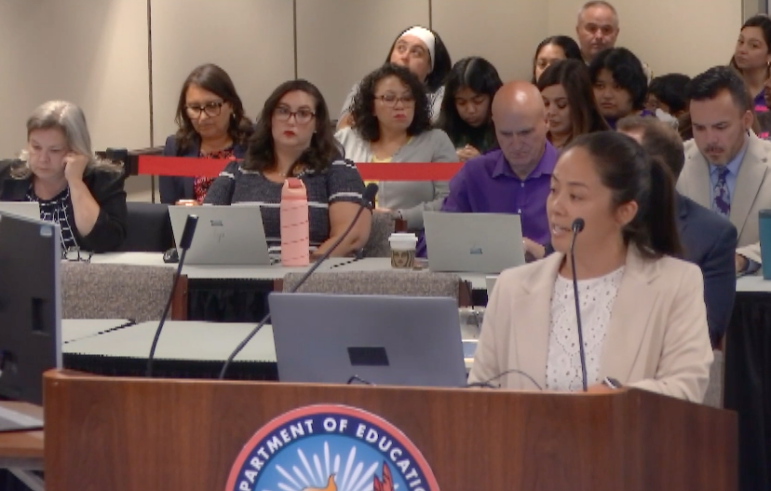
Hamstrung by a state charter school law and frustrated by its lack of clarity, the State Board of Education on Wednesday voted to take no action on Aspire Public Schools’ appeal of the non-renewal of an Oakland charter school.
By default, the inaction upholds the decisions of the school boards of Oakland Unified and the Alameda County Office of Education to deny a charter renewal to Aspire Golden State College Preparatory Academy based on their determination of poor academic performance.
For now, the state board’s lack of action dashes the hopes of parents and students in East Oakland that the school that serves grades 6-12, which is now closed, will ever reopen. Dan Soleimani, Aspire’s general counsel, said Wednesday that it was too soon to announce whether Aspire will file a lawsuit.
Aspire is among the hundreds of nearly 1,300 California charter schools facing renewal in the next few years. Eight years ago, in his first big legislative initiative, Gov. Gavin Newsom pushed through a charter reform law that aimed to bring predictability and uniformity to what had been an often litigious and messy charter school approval and renewal process.
Lengthy and contentious negotiations between charter school advocates and school districts produced uneasy compromises in 2019’s Assembly Bill 1505. But the shutdown of schools during Covid delayed renewals because schools had to restart collecting several years of performance data.
Aspire Golden State College Prep’s appeal has exposed new tensions that had been dormant in Assembly Bill 1505.
“We need to raise questions for those down the road on what is a fair, evidence-based evaluation” by charter schools’ district and county authorizers, said state board President Linda Darling-Hammond, who voted with the majority in the 7 to 2 vote, with one recusal and an abstention. “We are left trying to figure out and adjudicate these places that come to us.”
But the state board’s intentional no-decision decision also signals to lawmakers — and potentially a court — that they should reexamine the renewal sections of the 2019 reform law. Board members complained that the law is vague on how school districts and others approving charter schools should weigh student achievement in renewal decisions. That lack of guidance — or guardrails, they said — complicated the state board’s ability to determine whether the district and the county boards had treated Aspire Golden State Prep fairly.
Initial appeal reaching state board
This was the first appeal of a charter denial under AB 1505, Darling-Hammond said, and public commenters made board members aware that whatever they did would be closely watched.
In a comment made at the meeting, Nicolas Watson, managing director of regulatory affairs at the California Charter School Association, said the board’s decision would resonate beyond just one charter school renewal.
“The question today is new to this board, and one for which there is no precedent: When is closing a middle-track charter school in the best interest of students?” Watson said. “Your decision will help define what that standard means for every future renewal. It will also signal to authorizers that the procedural safeguards under the law are not merely boxes to be checked but essential protections for students and families.”
The law, reinforced by a court ruling, requires that the state board show deference to whatever the local and county boards decide. That deference appeared to perplex many members of the state board. Aspire Golden State Prep and the majority of charter schools with a mixture of strong and weak metrics fall in the “middle tier.” The law assumes those schools should be reapproved unless school districts can demonstrate that they shouldn’t be.
In denying a school’s charter, a school district must justify its decision based on academic metrics, a record of unsatisfactory progress in meeting state standards, and the determination that other district and charter schools in the vicinity with similar student demographics would better serve students.
A high bar for overriding
However, even if state board members disagree with a school district’s decision to deny renewal — and several board members doubted the Oakland Unified board’s methodology and judgment in the case of Aspire Golden State Prep — the Legislature has set a high standard for overturning it. The state board would have to prove that both the Oakland and county school boards’ decisions constituted an “abuse of discretion” that was “arbitrary, capricious, unsupported by evidence or procedurally unfair,” under the law.
“The board has articulated a lot of the concerns and a lot of the holes (in the review process), but I want to keep us in the lane we have to be in at this time,” said board Vice President Cynthia Glover Woods, in making a motion leading to the vote.
Jennifer Brouhard, president of the Oakland Unified board, insisted no abuse of discretion had occurred. “We reviewed the evidence, applied the standards set forward in the state law, and made our decision based on the record before us. Respecting local decision-making means respecting the framework that AB 1505 created. There was no abuse of discretion. There was no legal basis for overturning our decision,” she testified.
Among those disappointed in the decision was former Gov. Jerry Brown, who staunchly defended charter schools as governor and campaigned to save this charter school, in particular. In his one-minute testimony via phone Wednesday, Brown implored the board not to “kill” a successful school through “capital punishment.”
Staff of Oakland Unified and the Alameda County Office of Education did extensive analyses, with comparisons to other schools using metrics on the California School Dashboard, that pointed out Aspire Golden State Prep’s weaknesses and strengths.
But the conclusions they reached based on the data they used contrasted with the school’s self-assessment, and raised questions of methodology and process, several state board members said. Ten-minute presentations by both sides left the majority of state board members unable to say that the Oakland and Alameda County boards committed abuses of discretion — yet unwilling to say that they didn’t.
Judgment calls or abused discretion?
State school board members indicated the district’s non-renewal decision was more problematic than the county’s. The Oakland board focused on the deterioration of the school’s math scores from 2022 to 2024; it rated red, the lowest rating on the dashboard, and below-average scores on English language arts. But the board downplayed two other academic metrics on the dashboard that scored blue, the highest rating, for college and career/readiness and English learner progress. Graduation rates were also rated blue.
Should the board have given equal weight to all four academic factors? The law doesn’t say. Was it an abuse of discretion? Darling-Hammond asked, without an answer.
In 2025, Aspire hired Stacy Thomas, a veteran principal and former math teacher. By December, after the district had made its decision — but before the county board’s hearing in February — scores had already risen dramatically on the national i-Ready assessment, according to the school.
The county “never addressed in its decision to deny this is what the law means by sufficient progress, an improvement trajectory that is already underway. Closing the school now would cut off that plan just as it starts to work,” Soleimani, Aspire’s general counsel, told the state board.
Neither Ric Reyes, director of the California Charter Schools Division, nor attorneys from the Department of Education had an answer to Darling-Hammond’s question on the law’s guidance to districts and counties on how to determine what’s in students’ best interests.
“We’re on our own,” said Darling-Hammond.
The county and district used metrics and a list of comparison schools. About half of the charter and district schools had better scores, but Aspire’s attorneys said some had wait lists, and one, a French immersion school, had a language requirement. Both nearby comprehensive high schools had lower math and English language arts scores and no metrics in blue.
“While there was a statement by the district that they believed this to be in the best interest of students, there was not a way to ascertain that students would be admitted to better-performing schools,” said Darling-Hammond.
Neither the district nor the county factored into their decisions the voices of students, parents and teachers who turned up at each hearing to describe the close relationships and the trust that they built, Soleinmani and others reiterated.
“I would think that bringing in all 400 parents to say, ‘If you close this school, this is going to cause them emotional trauma and harm and destroy these communities that they created,’ by law should be given weight,” Soleimani said after the hearing in an interview with EdSource.
“But do districts (currently) think they need to? Some districts may say yes, and some may say no, and that just creates the wild west of how charter schools are renewed. And I just don’t think that’s what the Legislature intended.”
