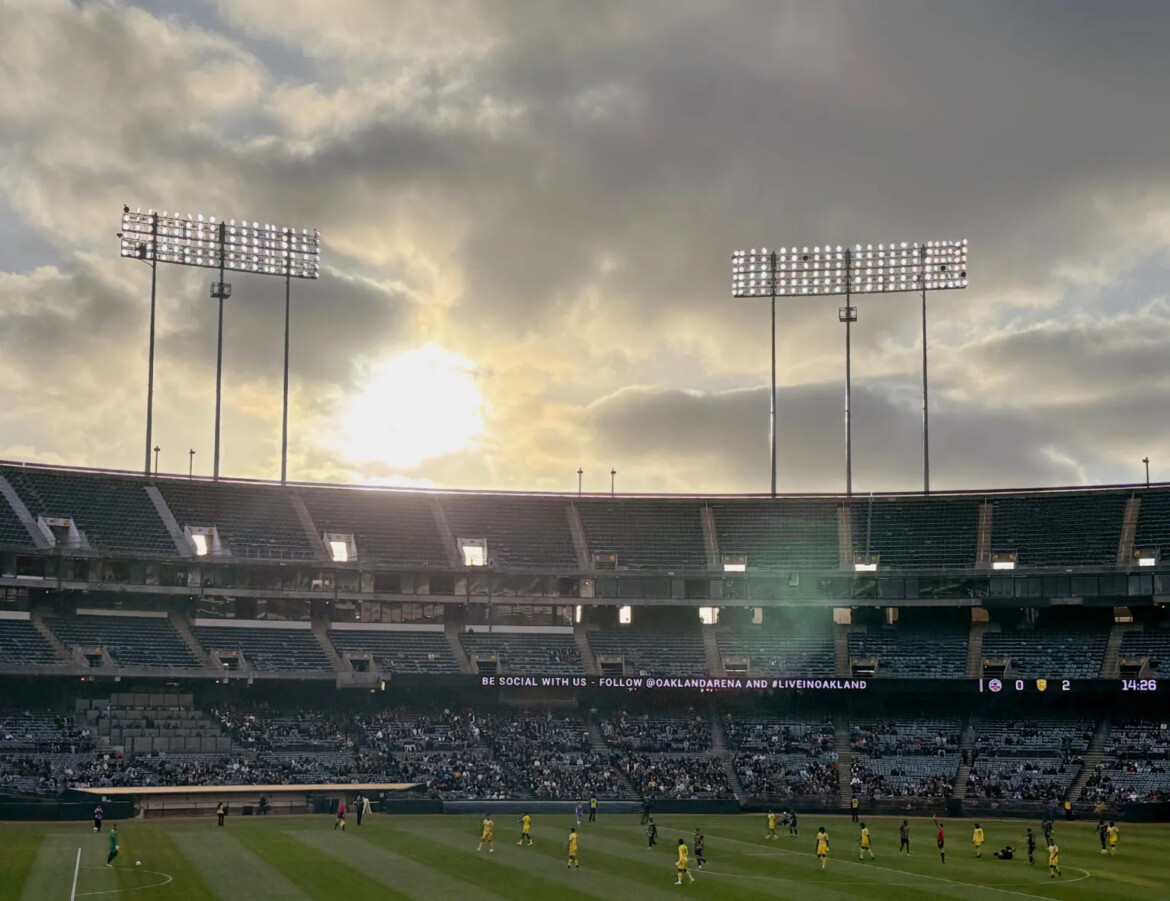
The Oakland City Council on Monday approved a city ordinance agreeing to the terms of the sale of the Oakland Arena and Coliseum Complex, sealing a deal years in the making.
In a 6-1 vote, the agreement passed with Councilmember Noel Gallo voting “no.” Councilmember Kevin Jenkins was not present for the vote.
There was a celebratory mood in the council chamber as the deal will see Oakland sell its 50% share in the complex to the Oakland Acquisition Company, or OAC, an affiliate of the Oakland-based African American Sports and Entertainment Group managed by Ray Bobbitt.
Mayor Barbara Lee praised the move, saying that it “took a village” to finally get the deal done and over the line.
“My bottom line is always what’s best for Oaklanders and the City’s ability to serve them well — and this proposal is a step forward,” said Lee in a statement. “This deal will pave the way towards creating jobs and economic opportunities, specifically for east and deep east Oaklanders.”
The deal has a fair amount of complexity and has undergone multiple revisions, but at its core, the city will receive a $110 million cash deal for its 50% share of the 112-acre complex. This includes a $50 million indoor arena and $60 million for the Coliseum complex, which includes the stadium and parking lots.
The city would also receive a 6% ticket sale royalty and expect $15 million in future revenue of building permits as development gets underway.
The funds from the sale of the arena would be given to the city on the close date and will be allocated toward paying down the city’s $2 billion pension deficit. The remainder will be received through a payment plan over the next two years. Recurring revenue for the city would be generated through the royalty obtained through ticket sales and will go into the city’s General Fund.
As noted by Councilmember Janani Ramachandran, the city currently pays $6 million in operational expenses for the stadium — money which will also be saved as soon as the deal closes.
This has appeared to be a strong motivating factor for several of the councilmembers.
“It’s a shame that we are sending a $6 million subsidy per year … it’s the taxpayers who are sending it, and it’s time for that subsidy to end,” Jenkins said before the vote. “As we’re talking about how we can do more for our seniors, how we can open our senior centers, as we’re talking about how we do more for our children in Oakland, that $6 million a year will be valuable towards fixing those issues.”
Arena’s future vision
Music industry veteran Irving Azoff, former CEO of Ticketmaster and co-founder of Oak View Group, a venue development and facility management company, will take over management of the arena.
Azoff noted during a press conference before the vote that he would be renovating the arena to turn it into a world class destination for music acts, comparable to other stadiums like Levis in Santa Clara and Chase Center in San Francisco.
“This is not a rescue mission,” said Azoff. “It’s just an opportunity to take now what I consider a ‘B’ experience and make it an ‘A plus’ experience … we remain committed, ready to go, and we will not disappoint you.”
Azoff noted that his team will also investigate the feasibility of bringing back the “Day on the Green” festivals, a long-running outdoor festival series promoted by Bill Graham and his production company Bill Graham Presents. The festival series ran from 1973 to 1991, bringing artists like The Beach Boys, U2, Pink Floyd, The Grateful Dead, Led Zeppelin, Bruce Springsteen, The Clash, The Who and many others to Oakland.
Considering Oakland has lost three major sports franchises — including the Golden State Warriors to San Francisco and the Raiders and A’s to Las Vegas — Jenkins added that the move will help the complex transition away from major sports and allow Oakland to further solidify its reputation as a “music city.”

The deal also stipulates that a portion of the funds go toward community benefit. At-Large Councilmember Rowena Brown and Jenkins will lead community sessions to articulate the best way to spend these funds. Brown and Jenkins emphasized they would be specifically focusing their efforts on East Oakland, where the stadiums are located.
“I truly believe that Oakland is doing what’s best for Greater Oakland and East Oakland,” Jenkins said. “For a long time, the East Oakland Hegenberger Corridor has been in disarray, and I believe that this will be the genesis of the comeback.”
Reaction and next steps
After the vote, Gallo said he decided to vote against the ordinance because he still felt the city and county weren’t coordinating enough on the sale of each of their shares.
“It’s public land and the city and county need to be unified,” Gallo said.
He added that he had discussion with members of the AASEG with relevant experience on real estate sales and development who had not been consulted during negotiations.
When asked how he was feeling about today’s outcome, Bobbitt said he was excited and grateful, noting that he and his organization have been working toward this outcome for the past five years. When asked about his vision for the complex, Bobbitt said that his main goal was to help revitalize East Oakland and that he was grateful to be given the opportunity to do that with the stadium complex.
While he said he has no personal experience working on a real estate development deal of this size, he will be leaning on some of his partners with experience such as Loop Capital, a Chicago-based investing firm that is financially backing the deal, he said.
Councilmember Ken Houston, who was part of the negotiating team, said that he feels the city turned a deal that started out as “lemons” into “sweet sweet lemonade.” He thanked city staff and the mayor’s office for their hard work to get the deal done and over the line.
The expected final vote on this deal is scheduled to happen at an upcoming City Council meeting.
The post City Council approves Oakland Coliseum deal, moving its sale toward final approval appeared first on Local News Matters.