
Many Bay Area residents who leave the region are finding a more affordable path to homeownership, but often at the cost of lower incomes, lower-performing schools and greater climate risk, according to a new report released Thursday by a University of California research institute.
The study by California Policy Lab found that people who move out of the Bay Area typically relocate to neighborhoods where home values are about 50% lower, and rents are about one-third cheaper than where they lived before. Residents who leave California are also 33% more likely to own a home five years after moving.
Researchers said they analyzed anonymized consumer credit data to track Bay Area households over time, examining who leaves, where they move, and how their finances and neighborhoods change after relocating.
Housing remains the Bay Area’s biggest financial challenge, according to the report. Nearly 40% of residents — including nearly half of renters — spend more than 30% of their income on housing. The median Bay Area home cost about $1.4 million in early 2026, compared with $915,000 statewide and $425,000 nationally.
“The Bay Area continues to offer tremendous economic opportunity, but it’s also the most expensive metro in the country,” California Policy Lab executive director Evan White said in a statement. “Our research shows many residents are achieving affordable homeownership elsewhere, but often at the cost of lower incomes, lower-performing schools or greater climate risk.”
According to the report, Bay Area residents who move elsewhere in California or out of state generally end up in neighborhoods with lower average incomes and, for those remaining in California, schools with lower standardized test proficiency. Those leaving the region also tend to move to areas that are more vulnerable to climate-related hazards such as wildfires, flooding and extreme heat.
Who is leaving the Bay Area?
Researchers also found that residents leaving the Bay Area are not necessarily coming from its wealthiest or poorest neighborhoods. Instead, they generally leave neighborhoods that reflect the region overall but are, on average, in weaker financial shape than their neighbors, with credit scores 23 points lower and more than twice as much student debt.
Migration is also changing the region’s demographics. White residents are leaving the Bay Area on net, while residents of color — particularly Asian and Pacific Islander households — are moving into the region in greater numbers or leaving at lower rates, making the Bay Area more racially diverse overall, researchers said.
California Policy Lab researcher Brett Fischer said the findings raise broader questions about who can afford to live in the Bay Area as housing costs remain high and demand could increase further.
“Our research strongly suggests that high housing prices are pushing people out, a trend that some fear may be exacerbated by the AI boom putting more pressure on housing prices,” Fischer said.
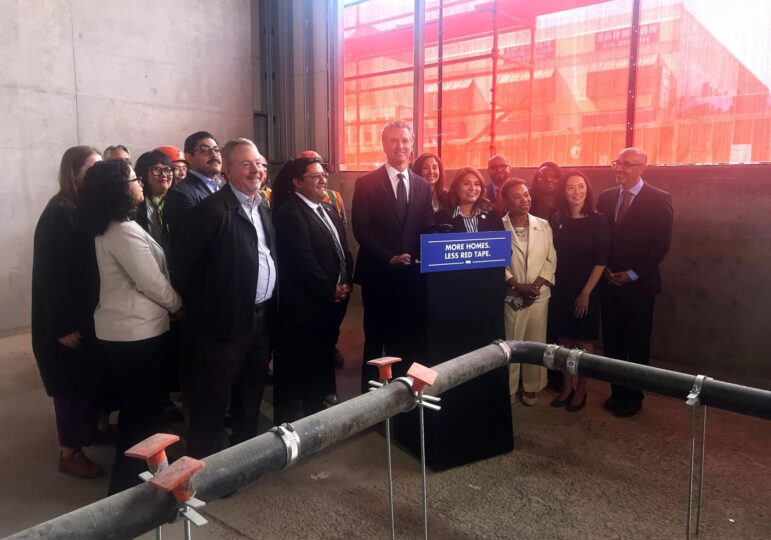
Earlier this month, Gov. Gavin Newsom was in Oakland when he signed legislation aimed at lowering the cost of building affordable housing in California. The measure is expected to reduce construction costs by an estimated $60,000 to $70,000 per affordable housing unit by streamlining financing and reducing fees, while also extending state homelessness funding and creating a disaster rebuilding fund.
Newsom lamented how the state has historically not supported affordable housing.
“We designed a system, a machine, over the course of the last half century to make it more difficult to build. It was intentionally designed, it wasn’t by chance, it wasn’t by happenstance. It was designed not to build. And that requires not just to think differently and argue for different results, but to rebuild the mission,” he said.