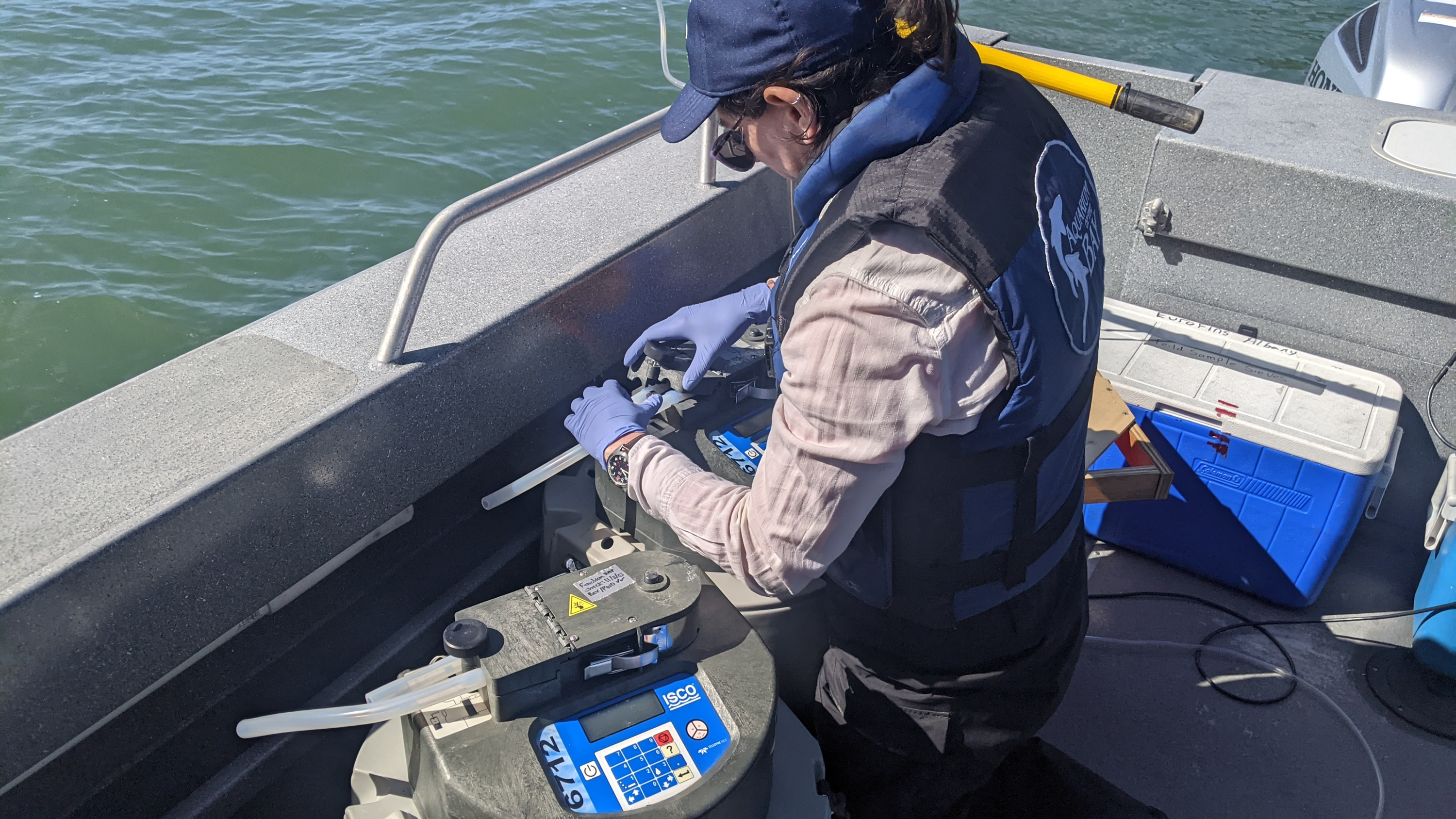
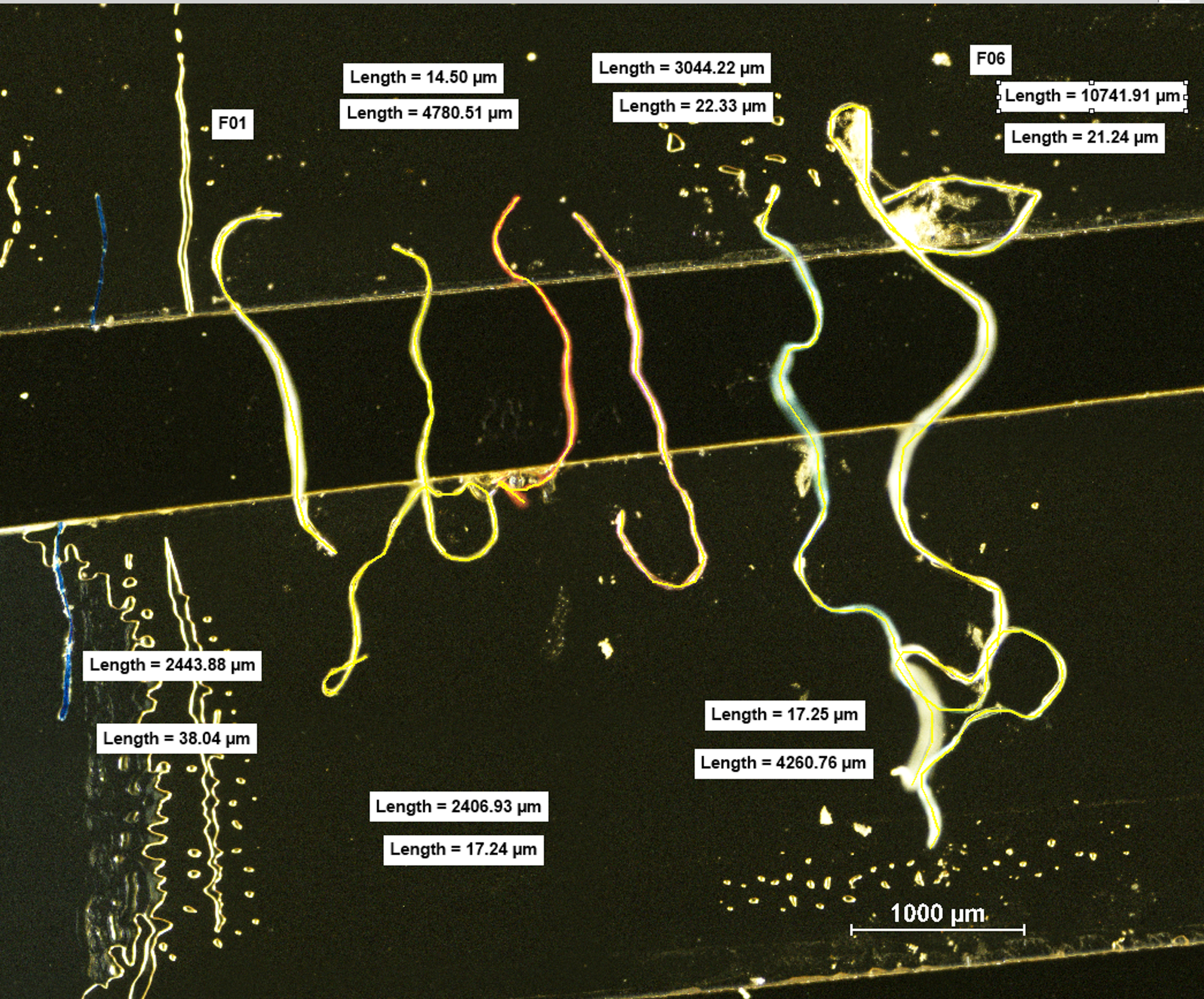
A pilot study by the San Francisco Estuary Institute captures plastic particles in the Bay that are 10 times smaller than measured before, the width of a human hair.
These smaller microplastics may account for the vast majority of those present in the water. The study could inform broader research on plastics and human health, coastal ecosystems and the ability of the sea to trap carbon from the earth’s atmosphere.
The term “microplastics” encompasses many different materials, said SFEI lead scientist Diana Lin.
“They include tire-wear particles and fibers from our clothing,” said Lin. “It’s from the food that we eat, the air that we breathe. It’s in the dust from our carpets, from ripping plastic items where little particles get threaded.”
SFEI has previously measured particles as small as 0.1 millimeter.
“Here we’re down to 20 microns (0.02 millimeters),” Lin said about the pilot study.
According to Sierra Garcia, a science communicator for SFEI, the goal of this work is to test a standardized way to accurately monitor smaller microplastics in surface waters like the Bay.
Garcia said a statewide plastics monitoring project will begin this summer under the California Ocean Protection Council, a cabinet-level state body that works jointly with state and federal agencies and organizations. Tracking super-small particles could be incorporated in monitoring efforts across the state if this work is successful, she said.
A SFEI study from 2019 found that urban stormwater runoff contains hundreds of times more microplastics than wastewater, and San Francisco Bay water and sediment contain higher levels than comparable regions around the globe.
“When it rains, all that gets flowed down storm drains and into receiving waters,” Lin said. “The San Francisco Bay drains a large part of California, so there’s the potential for a lot of transport through urban stormwater runoff.”
Microplastics have flowed through the Golden Gate and entered the base of the food chain in the Greater Farallones and Cordell Bank National Marine Sanctuary.
“We have been using seabirds as our samplers and evaluating particle incidence in the fish/krill they eat,” said Jaime Jahncke, director of the California Current Group a Point Blue Conservation Science, a nonprofit research organization based in Marin County.
Jahncke’s team of researchers has worked with the National Oceanic and Atmospheric Administration for over 20 years, monitoring the health of the sanctuary, which spans from San Francisco to Point Arena. He said about 69% of the northern anchovies and over 90% of the juvenile rockfish the research group sampled had plastic microparticles in them. The particles they find are only visible under a microscope, he said, not visible to the naked eye.
According to data from NOAA, the ocean is the largest carbon sink in the world, accumulating 20% to 35% of atmospheric carbon. Phytoplankton, microscopic plant-like organisms that drift in the ocean’s sunlit upper layers, absorb carbon through photosynthesis. Globally, phytoplankton populations capture the equivalent of 40% of annual global carbon emissions. Krill eat phytoplankton, and fish eat krill. When the animals defecate or die, the carbon in their bodies drops to the bottom of the sea, where it can be stored for millennia. Think trees, capturing carbon from the air and returning it to the soil as fallen leaves.
A 2020 study published in the Marin Pollution Bulletin found that microplastics ingestion can have toxic effects on krill and other fish at the base of the food chain, by impacting their ability to develop and reproduce. A 2024 study conducted at the University of New Hampshire found that microplastics can attach to carbon-loaded phytoplankton, making them more buoyant and slowing their descent to the sea floor.
Citing concerns about plastic pollution, California Attorney General Rob Bonta in 2024 sued the world’s largest producer of plastics, Exxon Mobil. The suit alleges the corporation engaged in a decades-long campaign of deception that caused and exacerbated the global plastic pollution crisis. The corporation filed an appeal for the case to be brought to federal court, but in May a federal judge agreed with the state that the case should be heard in the U.S. District Court for the Northern District of California.