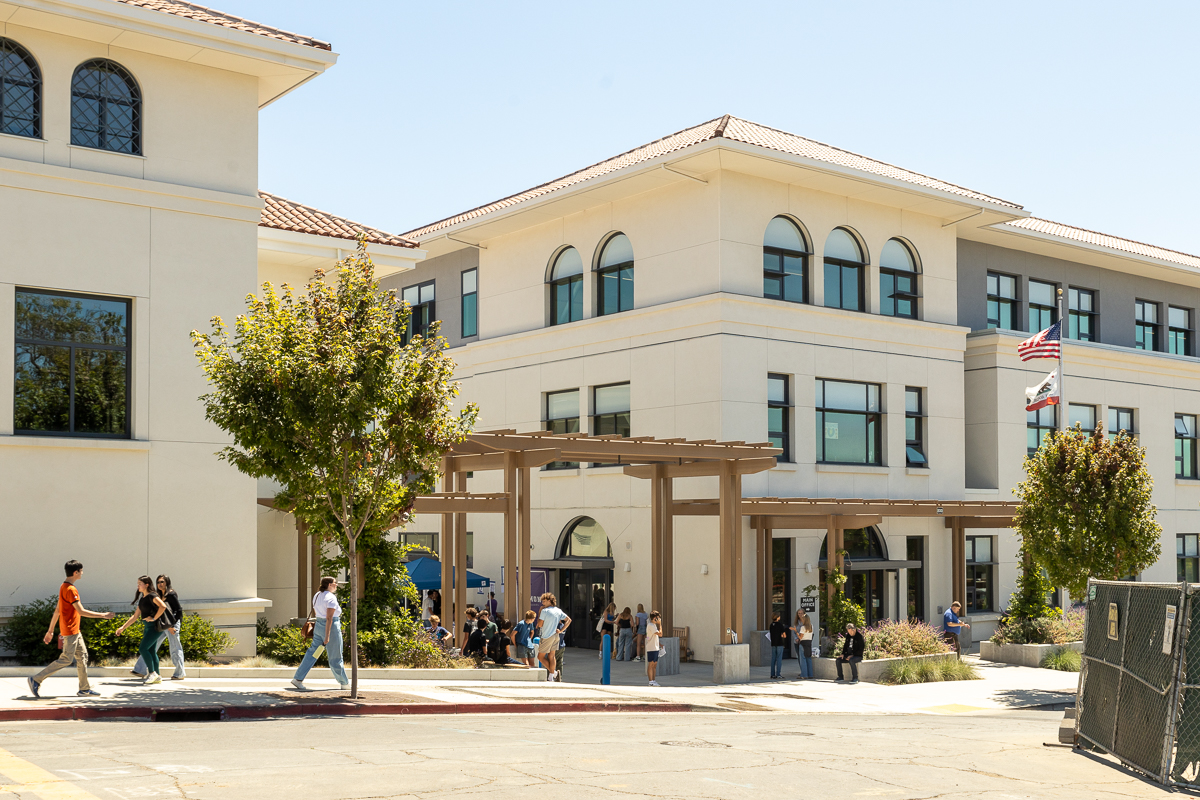
The Board of Education on Wednesday night directed the school district to tighten its mobile device policy on Piedmont’s high school campuses. What was a “phones away except at lunch” policy for 2025-2026 is set to move to a bell-to-bell policy while on campus starting next year. Students in TK – eighth grade already operate under what is essentially a bell-to-bell cellphone ban.
The logistics of how to store the phones — whether to invest in lockers or fall back on student back packs — remains under discussion. The Board will take up the issue again on May 20; schools have until July 1 to adopt a policy.
PUSD adopted a “phones away except at lunch” policy for PHS students this year in response to a 2024 California directive that required school districts to establish a policy restricting the use of mobile communications during instructional time. The California legislation mirrors a trend across the country.
Politico examined the effects of the law in an April 23, 2026 article:
California’s prolonged battle over phone bans is a predictable byproduct of how the state’s “Phone-Free Schools Act” was designed.
The 2024 law, authored by Muratsuchi and Republican Assemblymember Josh Hoover with backing from Newsom, was left open-ended to balance tech restrictions with safety and local control concerns. It ordered schools to pass “a policy to limit or prohibit” phone use by July 2026 but included few details about what those policies should look like. Instead, it told districts to conduct vigorous public outreach and craft rules that incorporated community feedback — an approach that placated school boards and administrators.
California tests limits of school phone ban movement, Politico, April 23, 2026
Superintendent Jennifer Hawn said that vagueness and a provision in the state’s language that “cell phones must be accessible to students in an emergency” was making it confusing for school districts to plot a course. Hawn also said that Piedmont’s open campus plan — where students can go home or eat lunch in Piedmont Park — made policing digital device usage during a school day more of a challenge. She presented the trustees with several approaches to consider and included an estimated cost for each option:

Trustees were in agreement that smart phones were detrimental to attention and learning and that school campuses during the school day should be phone-free. “There is no other topic more impactful to students,” said Board President Ruchi Medhekar.
Students who spoke at the meeting were opposed to the further restrictions, saying the current policy was working. PHS English teacher Elise Marks said she also supported the policy as is, especially given the extra costs associated with stricter enforcement which she believed would have a marginal effect on students. She said she rarely sees kids abusing the policy in her classrooms.
Piedmont Unplugged parent representatives and other parents who spoke at the meeting were passionate in their call for a bell-to-bell policy and said their group would raise funds to offset any costs.