Is the diversity movement purely ideological? Does it arise out of partisan political ambitions, a Trojan horse in the hands of ethnic minorities and the dispossessed as part of a selfish quest to seize greater power, wealth, and status? Or is it a nuanced socio-political perspective with deep academic and historical roots, and aspirations reaching toward some universal social good?
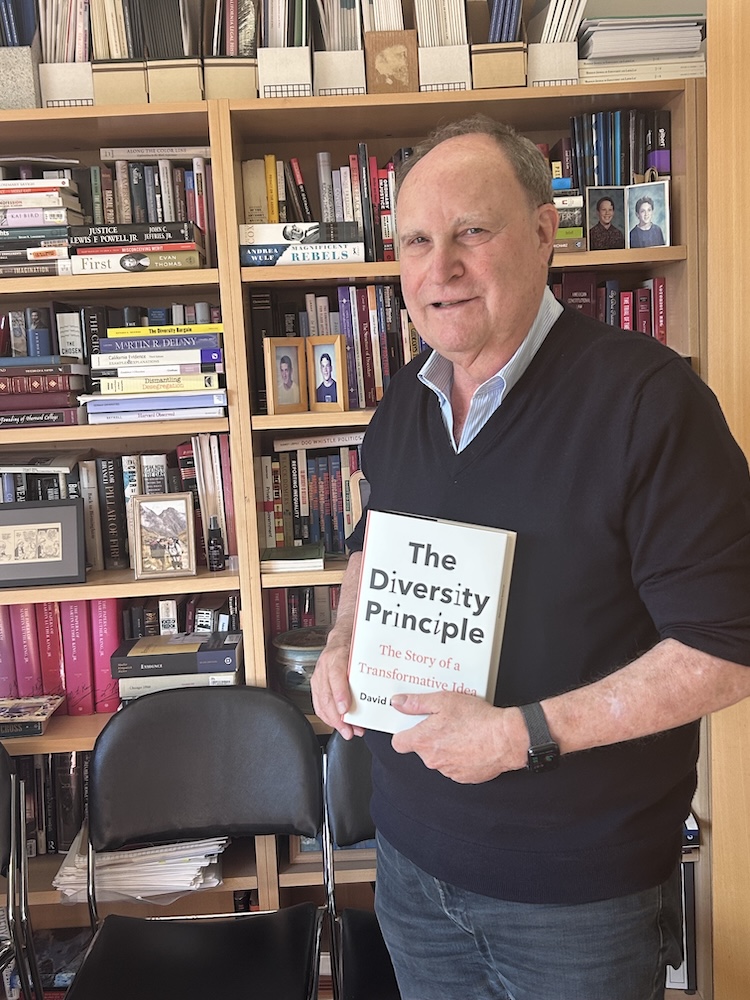
These and many other such questions are some of the issues preoccupying Piedmonter and UC Berkeley Law professor David Oppenheimer, whose recently published book, “The Diversity Principle: The Story of a Transformative Idea”, traces the intellectual history of diversity back 200 years, showing its development as a motivating idea in legal scholarship, business, education, and more. The book lands at a time when modern views of diversity — sometimes referred to by the catchall phrase “DEI” — have become tightly intertwined with contemporary politics and are under continuing siege by conservatives.
Oppenheimer (no relation to the famous nuclear physicist) describes his view of the value of diversity this way: “The diversity principle believes that if we bring people together of different backgrounds, and give voice to those who for age, religion, race, class, gender are considered outsiders, that having them engage with each other will produce better problem-solving. People will learn from each other and come up with more innovative ideas.”
Far from a fad or a skewed outgrowth of fringe liberal politics — what fuzzy-minded critics often call “woke politics” — diversity is not simply a reaction against racism and discrimination, Oppenheimer argues. Nor is it the same as a quota. It is a philosophy of human interaction that has been grasped and successfully put into practice by a long chain of prominent public thinkers going back to Wilhelm von Humboldt, the early 19th century linguist who founded the University of Berlin, to British philosopher and economist John Stuart Mill, to long-serving Harvard president Charles Eliot, 20th-century Supreme Court Justices Oliver Wendell Holmes and Felix Frankfurter, and Pauli Murray, a largely unheralded legal scholar whose work drove landmark cases including the 1954 Brown v. Board of Education Supreme Court case. Some of these ideas found their way into mainstream American life, informing federal civil rights initiatives.
Oppenheimer’s tracing of these ideas led The New Yorker magazine to nickname him “the diversity detective.” Despite the political and social backlash to diversity sweeping the U.S. now, Oppenheimer believes “public views on diversity have not changed a lot — except for a loud few. Most people don’t accept that DEI is a code word for anti- white discrimination.” That said, there are discouraging signs out there. Many of the remaining brick-and-mortar bookstores will not host readings or events on books related to diversity out of fear that it will make them targets of hostility. Generally, corporate leaders remain committed to diversity as a hiring practice but prefer to stay quiet about it in the present hostile climate, Oppenheimer says.
For his next project, Oppenheimer is working on a bio of Pauli Murray, the stunningly brilliant and exceptionally productive African American legal scholar and civil rights activist whose pioneering work has never received much recognition. “She had so much insight about how to address discrimination and inequality under law,” says Oppenheimer. “She’s still not widely known, but she should be. She was at the foundation of our civil rights law.”
When Thurgood Marshall was an NAACP lawyer and still a future Supreme Court Justice, he once described a 1950 study of segregation written by Murray as “the Bible for civil rights lawyers.” Marshall leaned heavily on Murray’s work in his successful 1954 argument to the US Supreme Court in the Brown v. Board of Education case, a landmark decision which overturned school segregation. A key part of Murray’s contribution to the success of the case hinged on her argument that segregation deprived African American students from the benefits of a diverse environment.
Murray, who graduated first in her class at Howard University Law School (after being denied entrance to Harvard because of her gender) is also credited with writing the first law review article on why gender discrimination should be illegal. Murray coined the term “Jane Crow” to describe the intersectional discrimination faced by women of color. Later, while working as a staff attorney for the ACLU, Murray recommended they hire a young Harvard Law grad named Ruth Bader Ginsburg.
Oppenheimer expects his research into Murray’s life and work will take at least three years to complete. In the meantime, he will discuss “The Diversity Principle” on May 6 at the Kansas City Public Library in Kansas City, Missouri, and on May 27 he and media pundit Van Jones will join for a discussion of the book at the New York Public Library. Both events will be available online.