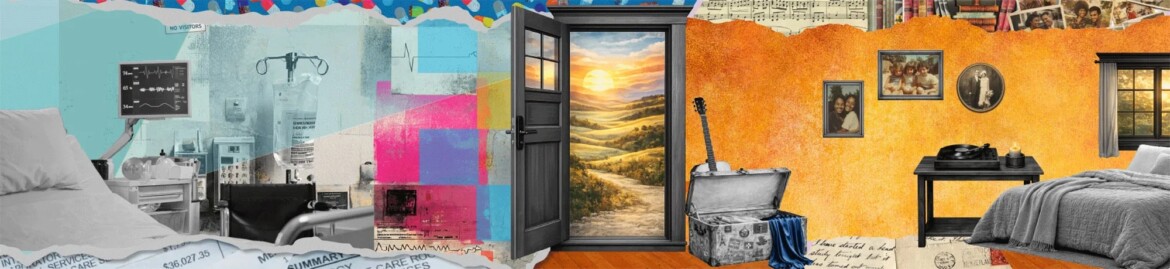
To hear Francesca Arnoldy tell it, birth and death have striking similarities. A community doula and death literacy educator based in Vermont, Arnoldy spent years guiding expectant mothers through the arrival of new life. In 2015, however, she shifted her focus to help people face their final days. The change came after a period of personal loss when, in short order, her grandfathers, father-in-law and her favorite Labrador died.
Arnoldy’s practice has expanded dramatically since she attended her first hospice volunteer training program in 2016. Over the past decade, she has trained other death doulas and published four books on death, community and grief, with a fifth on the way. She created a curriculum for a death doula certificate program at the University of Vermont. And she teaches students at Middlebury College to use storytelling as a way to talk about death and the vulnerability of being human. Death, like birth, is a mysterious passage, she says, one with its own rhythms and uncertainties that asks those present “to meet the moment.”

Even as lifespans grow longer, no one — neither the data-driven wellness influencers nor the technologists seeking to conquer biology and become immortal — has managed to hack life’s ultimate truth: It comes to an end. Arnoldy is one of the growing number of death doulas and others who have tapped into a desire among people seeking guidance through life’s final passage. Their ranks have grown sixfold between 2019 and 2024, from 260 to roughly 1,600, according to industry reports, reflecting a larger cultural shift around what it means to have a good death; that is, a peaceful passage not dominated by pain or fear that gives the dying person more agency over their last days. “Medicine has long held to a sort of Enlightenment point of view that death is a problem, and if we work hard enough, we can solve it,” says BJ Miller, a palliative medicine physician and coauthor of A Beginner’s Guide to the End. He advocates for changing the prevailing medical culture that contends “death is a thing that takes life, not part of life.”
Arnoldy and Miller agree that accepting one’s mortality can bring about a more meaningful life. And scores of people are choosing to explore death, or to sit with the grief that follows, at death-themed cafés and open mic nights and through writing end-of-life letters. “This might be what helps us gather back together, to recognize our shared humanity, our shared mortality, our shared common struggles, so we find our way back to connection,” says Arnoldy of the cultural shift.
The guides
The 1969 publication of On Death and Dying, written by Elizabeth Kübler Ross, is widely regarded as a seminal work in the modern history of end-of-life care. But to understand how attitudes about death have changed over time, it is helpful to take a look at history. In the late 1800s and early 1900s, dying was a tangible aspect of home life. Hospitals were frequented mostly by wealthy patrons, while the rest of the population died at home with family. Advances in the mid-1900s in medicine, sanitation and food safety led to longer lifespans, while care for the sick moved from the home to medical facilities. By 1980, nearly three-quarters of deaths in the U.S. occurred in hospitals, institutions or nursing homes, according to a report by the Institute of Medicine. Then, too, the hospice movement, which prioritized holistic comfort over medical cures, was challenging popular notions of death. Now, the pendulum seems to be swinging back to more people choosing to die at home.

This 20th-century march toward medical preeminence hastened a feeling of alienation among dying patients, beleaguered caretakers and overburdened doctors. Shifting cultural norms, and the easing of medical policy, has made it easier for patients, who in the judgment of a physician have less than six months to live, to control their end-of-life plans. Medical Aid in Dying, or MAID, which allows terminally ill, mentally competent individuals to self-administer drugs to hasten their passing, is now legal in 13 states and the District of Columbia. Even more states are considering legislation this year. MAID is not to be confused with euthanasia, though, where a doctor actively assists in administering lethal medications to a patient, a practice illegal in the U.S. but permitted in some countries, including Spain and Australia.
Miller has counseled more than 1,000 patients and their families and is familiar with death. He narrowly escaped his own in 1990, while a sophomore at Princeton, when he and some friends climbed atop a commuter train where an 11,000-volt electrical current arced out of a power line, entered through his arm and exited from his feet. Miller lost his legs below his knees and his left forearm, an experience detailed in a TED Talk “What Really Matters at the End of Life,” which has been viewed more than 13.5 million times on YouTube.
Now 55, Miller has strong views about how the medical field has failed dying patients. He says doctors have gotten out of step with what it means to be a human and what patients need from their doctors. (Hint: it’s not prolonging life indefinitely.) First, there is the physical and social toll of conventional end-of-life care. Patients and their families, too, often suffer needlessly, he says, especially when end-of-life medical interventions prove futile or costly. People thinking they will live forever is a lost opportunity according to Miller. “Not only is it problematic because it’s futile and exhausts resources,” he says, “but it also cuts people off from the lessons of being mortal.”
To reframe how doctors approach the inevitable death of patients, Miller in 2020 cofounded Mettle Health, a palliative care practice focused on the physical, emotional, social and spiritual needs of patients and their caregivers as they confront the end of life. This work requires listening. “A lot of what we’re talking about is not the stuff of easy language,” he says. Still, end-of-life care professionals have shown they can adapt. Palliative care and hospice care, which is inherently interdisciplinary, is expanding. And practitioners with specialized skills are filling the gaps. “With 80 million baby boomers, it can’t change fast enough,” Miller says.
Among those stepping up is Frish Brandt, a “letter midwife” who helps people write end-of-life letters to loved ones. In 2014 a doctor asked her to help a 34-year-old mother of two with cystic fibrosis. “I made a beeline to this woman’s house, and we wrote a letter she wanted to write about kindness,” Brandt says. So far, Brandt has written about 700 letters with people, and she holds workshops to meet growing demand. She teaches a class at Stanford’s School of Medicine that explores letter writing and the healing process. “People just have something they want to fess up to, resolve, apologize for,” Brandt says of patients facing death. “They don’t want to carry it forward.”
The mentors
Young people are leading today’s conversations about death. They belong to a generation whose distrust of authority is fueled by a failure of political leaders to respond to climate change, social instability and a job market that for many is devoid of economic opportunity. Further, they have grown up in an increasingly secular society; a 2025 Gallup survey found that about half of Americans say religion is not an important part of their daily life. People rely on religion, along with science, family and popular culture, to make meaning of their lives, according to the Harvard Divinity Bulletin. “It’s of no surprise to anyone that these generations have a lot of political skepticism,” says Mary Pauline Diaz-Frasene, executive director of The Dinner Party, a secular nonprofit that enables peer-to-peer conversations about loss for adults between 18 to 45.

Millennials and Gen Z, for their part, have faced school shootings — and society’s inability to stop them — since they were tots. Because of this, Diaz-Frasene says they are mentoring each other. “There’s something very different about being with another person in their twenties or thirties who’s navigating a death loss,” she says. The Dinner Party began in September 2010, when Carla Fernandez, whose father died from terminal brain cancer, invited a few friends over and served her late father’s favorite dishes. Guests, too, had lost parents, and the dinner led to more.
By 2013, Fernandez and her cofounder, Lennon Flowers, turned their loose network of friends and dinner acquaintances into an official project. More than 18,000 people across the U.S. have participated in secular, peer-led gatherings. “We know what it’s like to grieve, and we’re not afraid to talk about it,” says Diaz-Frasene. So much so, their website sells T-shirts that challenge strangers to ask about dead relatives.
Dinners focus on social connection, she says, but “in a way that includes both the levity and the heartache that is rooted in the present.” Potlucks often begin with a prompt — What has your grief looked like this week? — so people aren’t forced to rehash old stories.
More recently, the COVID-19 pandemic loomed large over The Dinner Party as it exposed young people early on to the specter of random death. Headlines tallying the sick and dying dominated the media; more than 7.1 million people have died worldwide since 2020. “We couldn’t avoid it at that point, right?” she says. Once again, participants turned to one another. The organization started a buddy system to match newcomers into virtual pairs. Within months, they noticed a shift. More men participated, Diaz-Frasene says. So, too, did people who lost loved ones to suicide, addiction and substance abuse. “People are recognizing that it’s not just experts who can hand us down tools,” she says.
Miller, the palliative physician, cautions that not all individuals scarred by a death during the pandemic found comfort in the company of others. Some, he says, became even more afraid of dying.
The cultural connectors
Hollywood is rife with entertainment that explores death and its related topics. There are television shows about cleaning your house before you die (The Gentle Art of Swedish Death Cleaning), hospital drama (The Pitt) and terminal cancer (Dying for Sex) and movies about grief (Train Dreams) and the undead (Sinners). Oscar winner Chloé Zhao, the director of Hamnet, a 2025 film about the death of William Shakespeare’s only son, says she is training to be a death doula. “I have been terrified of death my whole life,” she told The New York Times.

These projects are a boon for practitioners seeking to recalibrate people’s fear of dying. End Well, a nonprofit that wants to normalize conversations about death, commissioned the Norman Lear Center Media Impact Project at the University of Southern California to conduct a study about how end-of-life storylines affected viewers’ attitudes. The results were promising: Viewers were more willing to discuss end-of-life issues and participate in planning after watching shows with death-related themes.
Laura Wittman is an associate professor at Stanford who primarily studies 19th- and 20th-century Italian and French literature, film and culture. She has conducted research on near-death narratives through the study of Lazarus stories in modern testimonies and literature. She contends these narratives have become a window into changing attitudes toward a “good death.”
In the Bible, Lazarus is a figure brought back to life by Jesus. Wittman says that understanding these stories gives humans an opportunity to rethink what makes a good life. It also helps them prepare for death. “I think people are afraid of being alone,” says Wittman, “or of feeling that they look back on their life with regret.”
Much of Wittman’s work explores religion and culture and reflects curiosity about death and the search for life’s meaning. She says memoirs like Gratitude, a series of essays by the neurologist Oliver Sacks published in 2015, shortly after his death, are part of a growing genre of people writing about their terminal illness. Grief, she says, is a powerful force often unacknowledged, especially in dark times. “There’s so much tension now,” she says. “But death can be the one thing we all have in common.”
About the author
Laura M. Holson is an award-winning writer and founder of The Box Sessions. She worked at The New York Times for more than 25 years, receiving a National Magazine Award for public service reporting.
This story originally appeared on the Stanford Center on Longevity website.
The post Why the ‘Good Death’ Is having its moment: Candid conversations are reshaping life’s end appeared first on Local News Matters.