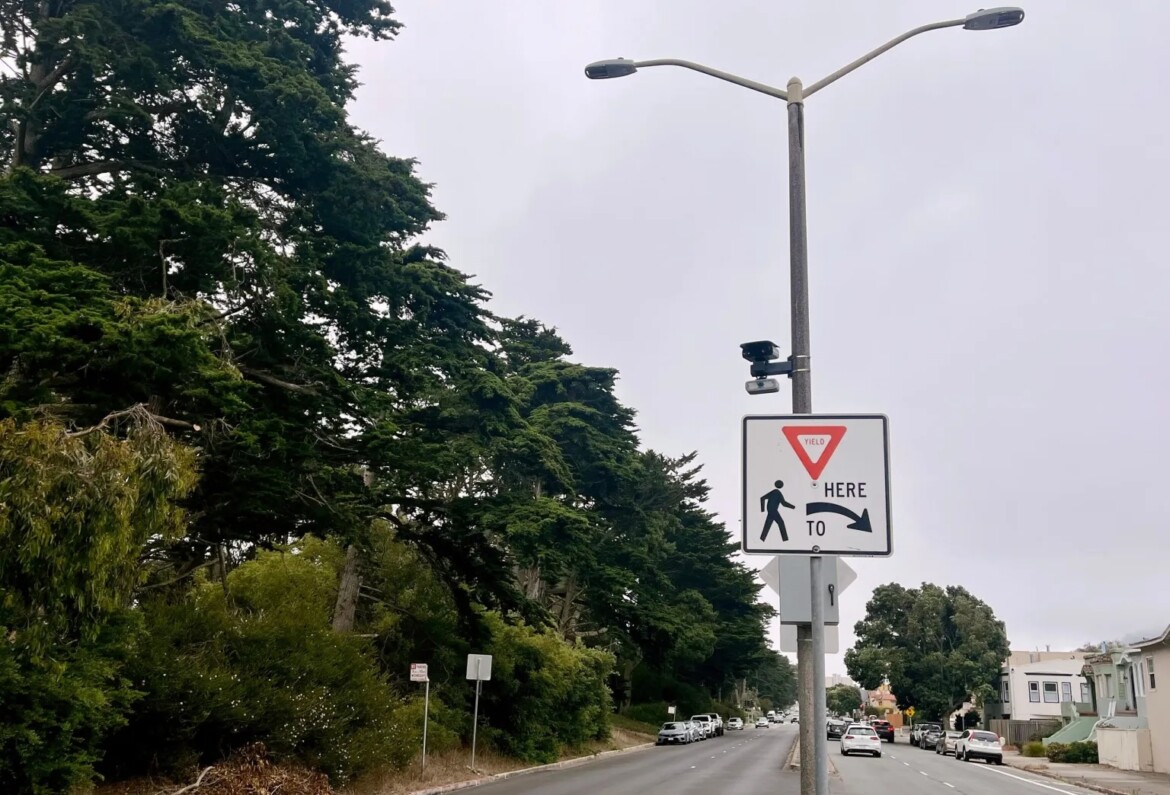
SUPPORTERS OF AUTOMATED speed cameras in San Francisco marked one year on Wednesday since dozens of the devices were installed there, which advocates credit for reducing speeding and traffic collisions.
Mayor Daniel Lurie, District 6 Supervisor Matt Dorsey, representatives from the San Francisco Municipal Transportation Agency, and two community street safety organizations celebrated what they said was an 80% reduction in speeders going more than 10 mph over the limit where the cameras are located, many of which are in the South of Market neighborhood.
The cameras detect speeding vehicles and capture an image of their rear license plate, which is then reviewed by a human being before a citation is issued. They do not use facial recognition and are distinct from Automated License Plate Readers that can be used to track vehicles from point to point, according to the SFMTA.
Last year, the city became the first jurisdiction in the state to install automated speed cameras following the passage in 2023 of Assembly Bill 645 that greenlighted a trial of the technology for six places in California, including San Francisco.
The city selected the company Verra Mobility, formerly called American Traffic Solutions, as its vendor. The company installed 56 cameras at 33 locations with the highest rates of injury collisions in the city, which are categorized as the city’s High Injury Network by the SFMTA.

The cameras will operate as a pilot program for five years, during which time data will be collected, and their impact will be evaluated, according to the city.
Lurie said the city’s pilot would provide valuable data for other cities to follow San Francisco’s lead in using the technology in California. It is currently being used in 20 other states.
“We are leading the way for the entire state, with proven strategies and data to hold us accountable,” Lurie said in a statement. “And the results are clear: Drivers are changing their behavior to drive more safely, keeping children, seniors, and families all safer in our city.”
Dorsey will introduce legislation expressing the city’s support for keeping the technology next week, according to Lurie’s office.
“Speed enforcement cameras are proving themselves to be highly effective in reducing dangerous driving behavior and making streets safer for all of us,” Dorsey said in a statement.
Representatives for the transportation safety advocacy organizations Walk San Francisco and San Francisco Bay Area Families for Safe Streets said the cameras had the effect intended, which they said was to deter speeding before citations were even necessary.
The cameras have been shown to reduce collisions involving injury or death by between 20-40% where they are used, according to the National Highway Traffic Safety Administration.
Jodie Medeiros, executive director of Walk San Francisco, said the cameras serve as a deterrent that is already impacting driving habits where they are present.
“Speed cameras are a game changer, dramatically changing driver behavior to make everyone safer,” Medeiros said. “San Francisco is leading the state in piloting this powerful, life-saving technology.”
Jenny Yu is a founding member of the nonprofit San Francisco Bay Area Families for Safe Streets whose mother was a victim of a speeding collision and now requires full-time care. Yu said in a statement she was glad the city was taking advantage of the new law.
“Because of speed cameras, fewer families will experience tragedies like what happened to mine,” said Yu.
Revenue from citations written during the pilot period will be reinvested in the city’s traffic safety programs, according to the legislation authorizing them. That could include a range of investments as part of Lurie’s Street Safety Initiative launched in December, which includes a range of reforms and investments in pedestrian and bicyclist safety.
The post Traffic safety advocates hail automated speed cameras in SF 1 year into 5-year pilot appeared first on Local News Matters.