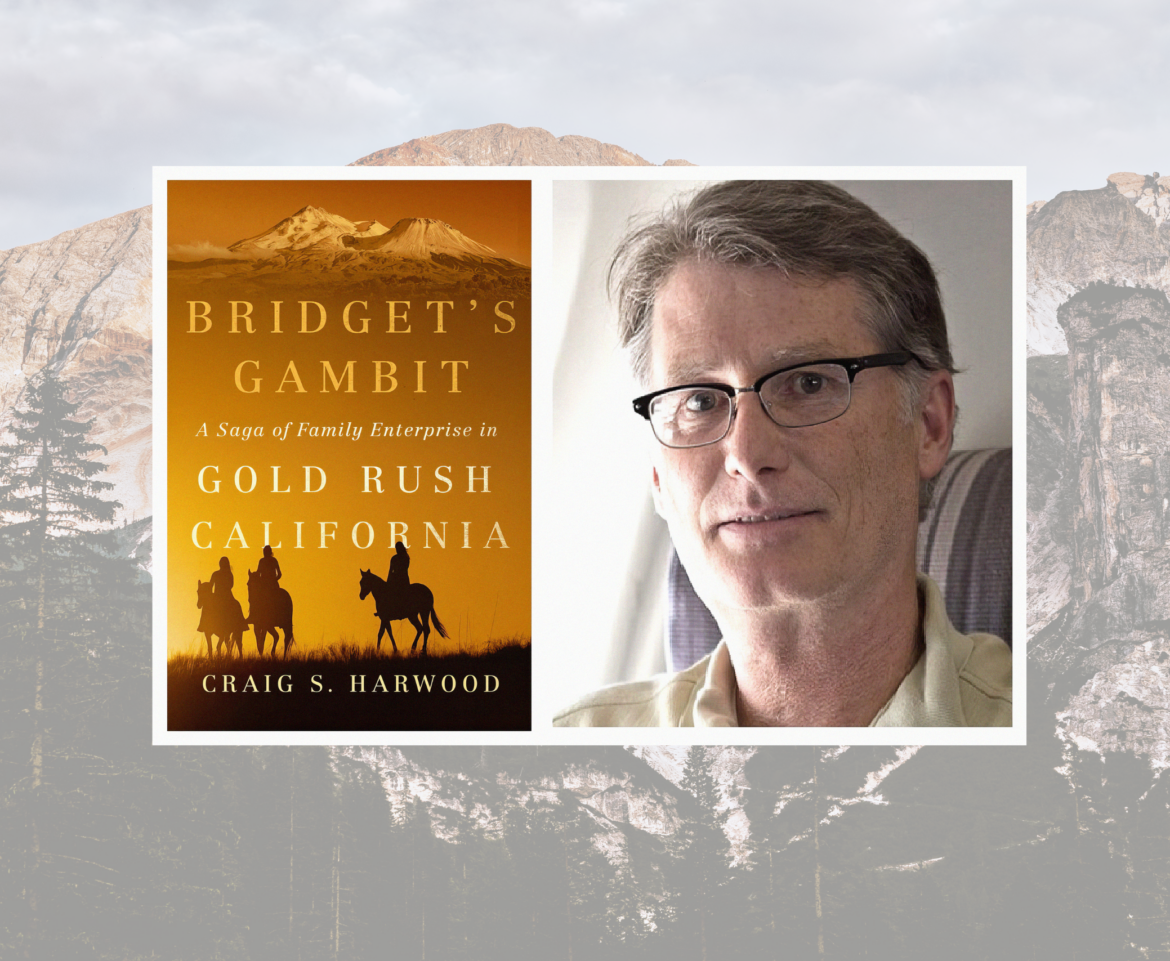
While Bay Area engineering geologist Craig S. Harwood is a descendant of the primary character in his new nonfiction history book, he doesn’t emphasize the family connection or offer cozy personal anecdotes.
But he does provide plentiful facts in “Bridget’s Gambit: A Saga of Family Enterprise in Gold Rush California” (University of Oklahoma Press, 212 pages, $34.95 hardcover/$21.95 ePub, Feb. 10, 2026).
The immaculately researched semi-scholarly title describes the extraordinary life and times of his great-great-great grandmother Bridget Miranda Shannon Evoy, who was born to a rural Irish family in 1791 and died a successful California businesswoman and matriarch in 1867.
In 11 clearly written chapters, Harwood tells the remarkable story of how tenacious Bridget and her daughters in particular fled hardscrabble living and made a fortune in America, continually defying Victorian-era norms that placed women as second-class citizens.
Harwood, whose full-time scientific job takes him to some of the sites where Bridget and her family settled, details how Bridget and her daughters Ellen Montgomery (his great-great grandmother) and Margaret McCourtney quickly prospered after reaching Northern California. Instead of trying to hit big by obtaining gold, they cleverly went into myriad businesses in the Feather River/Yuba River region (Marysville today) serving the miners seeking fortunes.
Not only were they proficient at buying and selling land; they also set up a toll bridge, and established and ran a farm, boarding house, lumber mill, general merchandise store and blacksmith.
Among the most fascinating parts of “Bridget’s Gambit” are the chapters Harwood devotes to the family’s epic journey westward in 1849. (Upon arriving in the U.S., they settled in Missouri in 1829, where Bridget was widowed in St. Louis in 1830; she never remarried).
Harwood, whose primary resources include journals from travelers on the same path, goes into almost excruciating detail about the dangers facing the Evoy/McCourtney parties on their winter Overland journey crossing the Sierra Nevada mountains in November, only two years after the Donner Party tragedy. In an online interview, Harward mentions how the tough, resilient Bridget, at age 59, went 1,800 miles on horseback on the “brutal” Overland Trail.
East Bay readers also will be intrigued by the book’s sections detailing Bridget and her family’s move to “Contra Costa” (“other coast”), today’s Oakland. In 1853, Bridget, who already had owned residential property in Santa Clara and San Francisco, purchased some 100 acres (in today’s Temescal area) with $3,000 in gold dust, from the Peralta family, becoming a pioneering resident of the town. In 1860, that property was worth about $10,000.
Harwood, who cowrote 2012’s “Quest for Flight: John J. Montgomery and the Dawn of Aviation in the West,” about the California scientist/inventor (1859-1911) whose flying experiments pre-date the Wright brothers (and also his ancestor), has said his family’s oral tradition was a starting point in writing “Bridget’s Gambit,” but that he treated his process in developing the book as “very much a detective story.”
While it includes little dialogue and is perhaps a bit drier than a popular thriller, “Bridget’s Gambit” is indeed a fascinating story of a tough, exceptional woman (and her family) who thrived in business, paved her own way and defied convention, seemingly with ease.
The post Review: ‘Bridget’s Gambit’ a remarkable story of a pioneering California businesswoman appeared first on Local News Matters.
An important part of this story plays out in the Oakland area where the primary character, Bridget Evoy established a ranch as early as 1853 and became a prominent citizen.
I will be giving a talk based on the book at the Lafayette Library on March 26 at seven in the evening.