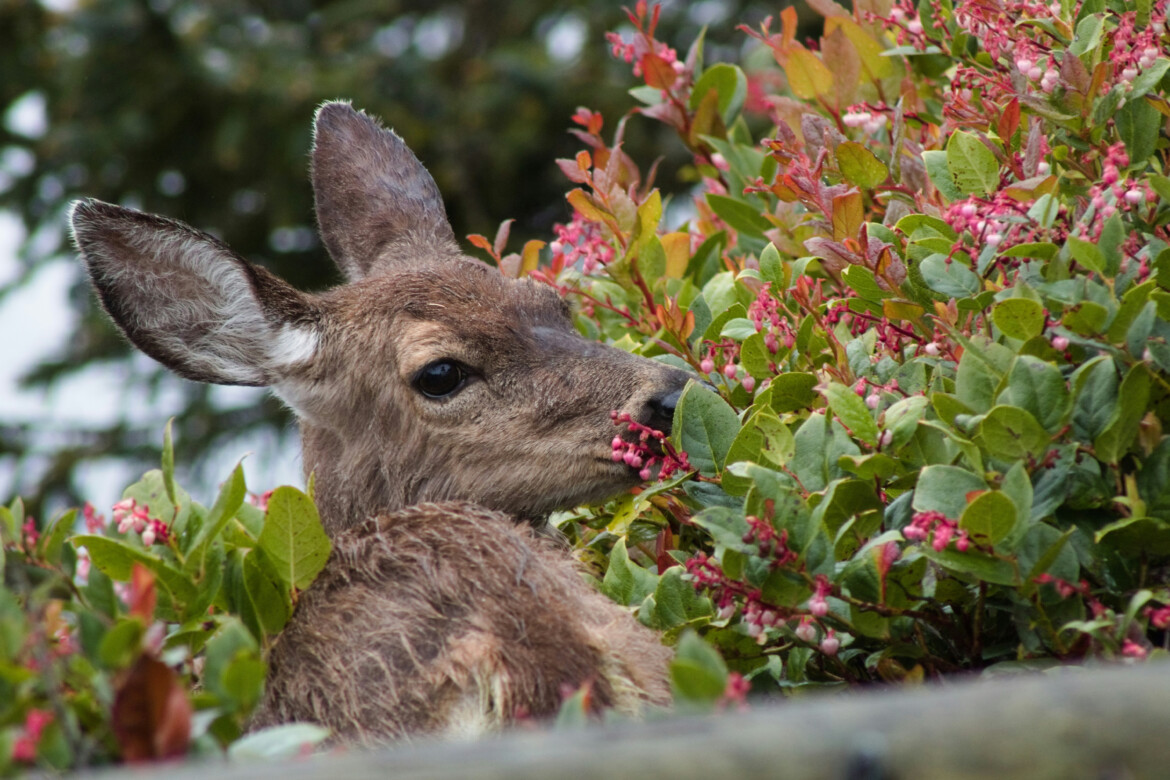
Gardens — like our homes — are an ongoing lesson in humility.

[SPONSORED]
The personal stories of one realtor’s battles and triumphs in the highly-competitive Bay Area real estate market, seeking to illuminate and humanize the very real ups-and-downs of homeownership.
The sun is shining, the days are getting warmer, and the trees are beginning to leaf. In other words, spring has sprung.
Alas, so have the deer!
With no natural predators to cull the population, both doe and fawn are in ample supply, and they seem to love our block in particular. As soon as evening sets, they’re wandering the street in small groups of two or three, freely munching on everything they can find . . . .Last year these elegant creatures discovered how to hop my garden fence, and spent the better part of every late night or early morning chowing down on the buffet they’d recently discovered . . .
With close to 20 white rose varieties in my garden, there was nary a flower to be found unless it was climbing on the arches or up the walls, well above their heads. Anything at ground level was quickly consumed in bud form, which was discouraging, to say the least. (Where’s my dog when you need him?)
Luckily, the damage in my garden beds was primarily limited to the rose bushes, although my neighbor hasn’t been as fortunate. A high-end contractor by trade, he and his family moved in a few years ago, completely and beautifully transforming both the grounds and the house across the street, finishing off with a sprawling lawn and flowering beds.
The deer don’t care.
Irrespective of his heroic efforts, they have been merciless. He’s now placed protective netting around many of his plants – an example I’ll probably have to follow – but let’s be real, deer netting is ugly, and it changes the focus from the plant to the plastic itself. It’s akin to putting a cage around the Mona Lisa.
In response to the unwelcome invasion, I’ve tried coyote urine spray, but the stench is so horrific, that I’m not sure it’s worth the trouble, and since it requires repeated applications, it’s a short-term solution at best. Unfortunately, Bambi (and her clan) are ruthless, and clearly, very hungry! What were once abundant blooming shrubs, are now little more than bare stems, struggling to survive.
So what’s the solution?
Deer-resistant plants are probably the best bet, as is hardscape, along with thoughtful planting. Fortunately, there are some fantastic succulent gardens around town that lead the way – I just haven’t gotten there yet. So while I’m not wholeheartedly embracing a purely native California garden, I’m definitely replacing some of the “tastier” fare with less “succulent” dining.
A garden party deer won’t love
Per “Claude,” here are the top AI suggestions for deer-resistant planting in the Bay Area:
- Anchor Shrubs (Structure & Height)
- Ceanothus ‘Dark Star’ or ‘Julia Phelps’ – stunning deep blue spring flowers, evergreen, forms a dramatic backdrop
- Lavender ‘Phenomenal’ or ‘Hidcote’ – classic, tidy, fragrant hedge-like look
- Rosemary ‘Tuscan Blue’ – upright form, great as a low hedge or border
- Mid-Layer Flowering Plants
- Salvia ‘Amistad’ or ‘Hot Lips’ – long bloom season, hummingbirds love them
- Agapanthus – clean, architectural look with blue/white flowers in summer; works great lining a path or driveway
- Penstemon – tall spires in red/pink/purple, native-friendly and showy
- Kniphofia – bold statement plant, low maintenanceFront
- Border / Edging
- Lavender (dwarf varieties like ‘Thumbelina Leigh’) – tidy edging along walkways
- Society Garlic – neat clumping grass-like foliage with purple flowers
- Yarrow – low, spreading, comes in yellow, white, and pink
- Ground Covers (to reduce weeding & water)
- Dymondia margaretae – silvery-green, very low, great between stepping stones
- Baccharis pilularis ‘Twin Peaks’ – native, very low water once established
- Lantana ‘Gold Mound’ – colorful, spreading, carefree
A Sample Front Yard Layout
- Back/foundation: Ceanothus or tall Rosemary for height
- Middle: Salvia + Agapanthus + Penstemon for color all season
- Front edge: Dwarf Lavender or Society Garlic along the walkway
- Ground cover: Dymondia or Baccharis to fill gaps and suppress weeds
Practical Tips for Front Yards
- Choose evergreens (Ceanothus, Rosemary, Agapanthus) for year-round curb appeal
- Layer bloom times — Ceanothus in spring, Salvia/Agapanthus in summer, Lantana into fall
- Most of these are low-water once established, which fits Bay Area water restrictions well
- Mulch heavily the first year to retain moisture and reduce weeding
The moral of the story is that English gardens probably belong in England. That being said, I’m still a fan of beautiful, abundant blooms, so I’ll double down on what works, and begin to edit what doesn’t. That’s the nature of a garden; it’s an ongoing lesson in humility. The simple truth about most thriving gardens (and gardeners) is that success often arrives on the the heels of a series of failures. (It’s a lot like buying a house.) Gardens are the perfect metaphors for life.
Still, I’m about ready to adopt a mountain lion.
How can we help you?
Julie Gardner & Sarah Abel | Compass Realty
Not just Realtors, but consultants in all things house and home, we’re here to educate, explore, examine and refer . . . In short, you may count on us to take care of your home as if it were our own and anyone who knows us, knows we take pretty darn good care of our homes.
Learn MORE