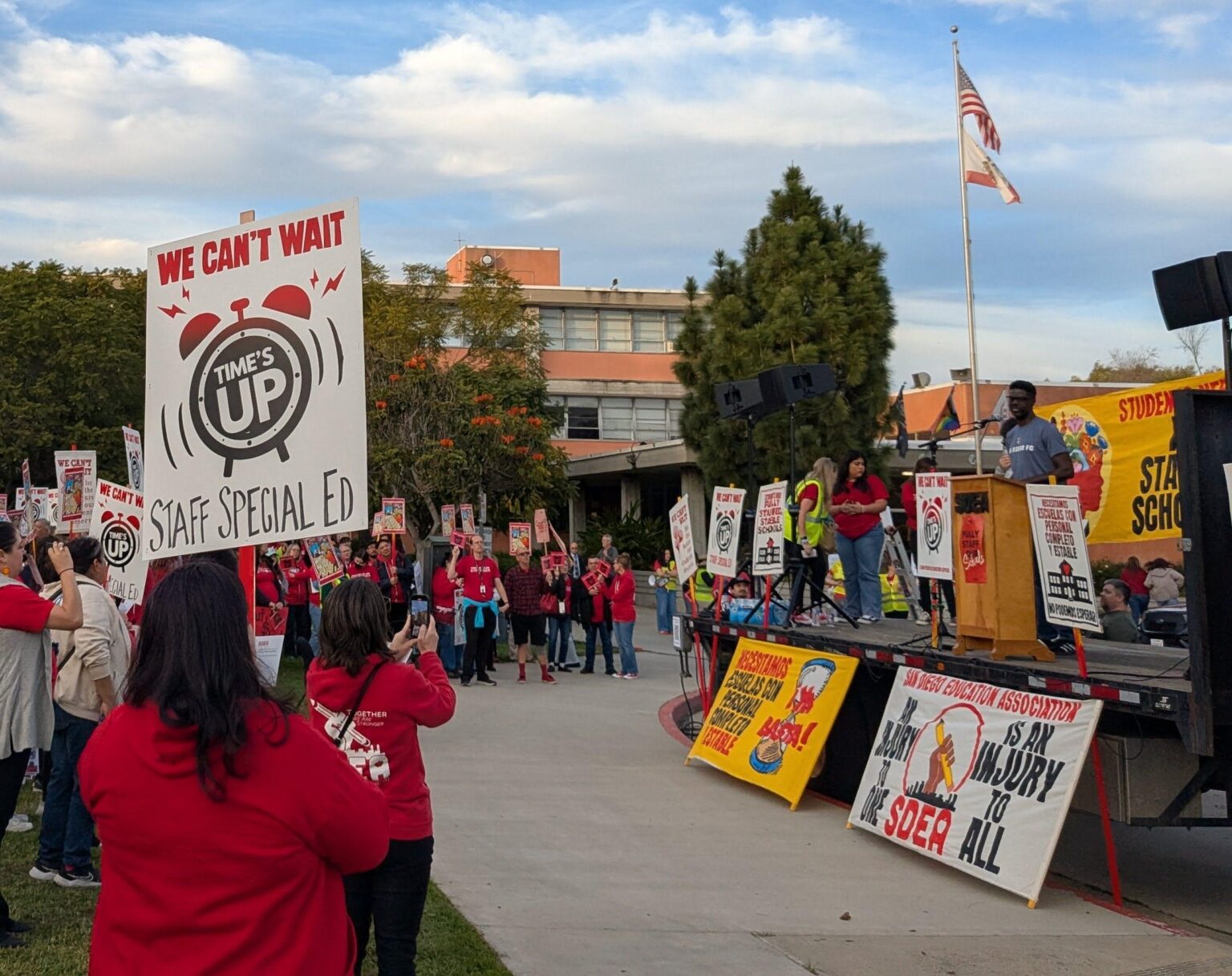
When more than 90% of San Diego Unified School District teachers voted to authorize a strike, it wasn’t just about pay increases or health care benefits — it was about special education caseloads that some teachers say are pushing them out of the profession.
Salary and health care are still central at the bargaining table, but the working conditions of special education teachers have become a major point of friction in labor negotiations with teachers this school year. It was also a sticking point for high-profile teacher strikes in West Contra Costa and San Francisco.
The role of special education at the bargaining table is different in every district in California, said Naj Alikhan, senior director of marketing and communications for the Association of California School Administrators (ACSA).
“While issues at the table are different around the state, it is fair to say that the cost of serving our students with special needs is a cost pressure that is impacting everyone,” said Alikhan.
The friction over special education comes as a growing number of students qualify for special education. In California, 15% of students qualified for special education in 2024-25, up from 13% in 2018-19. Special education caseloads are emerging as a major bargaining issue as districts try to reconcile rising student needs with diminishing funds.
“Special education staffing shortages are a statewide and national challenge at a crisis level,” said Veronica Coates, chair of SELPA Administrators of California, in a statement. Schools have been struggling to hire staff to serve “increasing numbers of students with complex needs, while the pipeline of credentialed professionals, including candidates coming through higher education programs, has not kept pace.”
In addition to their instruction duties, special education teachers may be assigned as case managers who oversee the education of students with disabilities. As case managers, they routinely assess students’ educational needs, write an individualized educational plan — a legally binding educational roadmap for students with disabilities — and attend meetings with the student’s family and other educators.
“That’s a lot of work to try to fit into a six-hour and 35-minute day on site,” said Monique Barrett, a special education teacher and vice president for the San Diego Education Association. “And then us being teachers, we take it home.”
The caseloads of special education teachers were a part of agreements reached after teachers in the San Francisco Unified and West Contra Costa Unified school districts went on strike. In San Francisco, some special educators will have their caseloads reduced and others will receive pay when their caseloads exceed contractual requirements. In West Contra Costa, where teachers argued that the district relied too heavily on outside contractors to provide special education services, special education teachers will see an additional pay boost and a retention bonus as a result of their contract.
The San Diego Education Association averted a strike planned for Thursday. The impetus for the strike authorization — the union’s first in 30 years — was the filing of an unfair labor practice charge last December over special education teachers’ caseloads.
Those caseloads were “unsustainable and causing special education teachers to leave the district or even leave the profession due to being burned out,” said Kyle Weinberg, union president.
The tentative agreement offers monthly stipends to teachers whose caseload exceeds contractual limits — and settles grievances from prior years. The agreement gives special education teachers of students with less extensive needs five days a year to catch up on caseload management, while a substitute teacher covers their classroom. Special education teachers whose students have more extensive needs will be given $4,000 annual stipends. It also offers a pathway to free credentials for teachers, so that special education vacancies can be staffed internally.
Overall staffing levels are a key issue in the California Teachers Association’s statewide We Can’t Wait campaign that involves over 30 local unions, some of which have chosen to focus on the growing caseloads of special education teachers because they can see the effects of it in their own classroom, said Sarah Darr, a speech and language pathologist and campaign organizer for San Diego Unified.
“It didn’t take a lot to get members to connect those dots,” said Darr. “They saw the impacts when those students were not getting the behavioral and academic support they needed. It was impacting the whole class.”
A district struggling to hire and retain qualified special education teachers will often rely on substitute teachers or teachers without a special education credential.
Barrett said this increases the pressure on veteran teachers, who are often assigned caseloads well above San Diego Unified’s cap of 20 students. At times, she said, she had as many as 25 students, and her department chair had even more. These veteran teachers would also offer support to teachers who are new or may still be in the process of getting their special education credentials.
“Not only do you have your casework that you’re doing, you also wind up supporting your newbies and your interns and helping them do their work, as well, to hopefully keep them in the field,” said Barrett.
Coates said she believes that ultimately solving this systemic workforce and funding issue will “require coordination across K-12 education, higher education and state and federal policymakers.”
Educators and advocates for students with disabilities say that the federal government has never fulfilled its promise of providing 40% of the funding for students with disabilities as a part of the Individuals with Disabilities Education Act (IDEA), a landmark 1975 law that requires schools to offer students with disabilities the support they need to learn.
“This is an opportunity for labor and management to come together and press lawmakers to fund federal programs that support special education students,” said ACSA’s Alikhan.
San Diego Unified’s superintendent Fabi Bagula said, at a press conference in December, that special education costs the district $400 million annually, but it only receives $125 million a year from state and federal governments.
“It’s not enough money. It’s not enough money to provide all of the resources that our students and families need,” said Bagula, who went to Sacramento with board vice president Sabrina Bazzo to advocate for more funding, particularly for students with disabilities, according to a release from the district.
David Goldberg, president of the California Teachers Association, said what is happening in special education is a symptom of an underfunded education system.
“Students with special needs need more resources, which they deserve, and in a whole education system that’s already kind of in survival mode and pushed to the brink, it’s very easy for those students’ needs to not get met,” said Goldberg. “And it’s just heartbreaking for educators.”