PART 1
I DECIDED TO GO to Minneapolis to see for myself what was happening. You can read all the news stories and see all the video clips, but it is different to be there, breathing the same air, feeling the same vibrations. I was in San Francisco last Wednesday when the idea took hold, but it took hours before I decided to do it. I had to get over the cold.
ABOUT THIS SERIES

At Local News Matters our mission is to provide our readers with news of, and from, the Bay Area. There are times, however, when national events have such relevance to our readers that we venture further afield. In 2024 we covered both the Republican and Democratic Conventions, with the goal of giving our readers a feel for what was happening on the ground in Milwaukee and Chicago. In this story we take the same approach to current events in Minneapolis. Many of the same issues are playing out in the Bay Area and in cities across the country — including, very much, the matter of a free and independent news media.
I am 74 and spend winter in San Francisco where it is mild. I don’t think that my age gets in the way of setting off on a spur of the moment trip; I am veteran of many, but I have become a weather wuss. Cold bothers me, and extreme cold, well I don’t do extreme cold. I could hardly watch that Jody Foster series — “True Detective” — set in the far and frozen north. Watching people in the cold makes me tremble. And Minneapolis in January is seriously cold.
But the cold was an essential part of the story. It is one thing to go to a No Kings protest on a sunny Fall afternoon in San Francisco when street vendors are selling burritos and the organizers are gifting bottles of water. In January in Minneapolis a bottle of water would be a cylindrical brick of ice. And yet every day, from what I read, people are on the streets for hours at a time, yelling and telling ICE troops to go back to the hole they crawled from. They weren’t expressing their opinion by clicking on an internet poll or answering questions on an opinion survey. They were expressing their political opinion in a far harder way. No pay, no glory, just speaking out loudly from the midst of brutal conditions. Of course, that didn’t make their opinions right, but no one could ignore that opinions expressed under those challenging circumstances meant something of consequence to the protesters.
I wanted to see that, and if it meant swaddling and shivering, I was willing to try.
Bravely into the blizzard
There was another reason to go to Minneapolis.

I am no stranger to protests. I went to college in 1969 and was there for the protests in the aftermath to Kent State and the bombing of Cambodia. I remember in those days we would always look for the men taking pictures of the crowd. The FBI was building dossiers on us, that’s what we thought; the corrupt Nixon government was trying to identify us and gather information about us so they could come after us, so they could round us up. We were — at least I was — naïve and vainglorious about it, but we thought there was real risk, and because of that we — at least me — thought there was something noble, something vaguely heroic, in showing up and joining the chanting and marching and sign-painting. We were standing up for what we believed, we were making our voices matter, we were going to change the world, because we believed — even in those ancient times before mobile phones with cameras and social media, and YouTube and the Internet — that the whole world was watching.
One thing that was clear about Minneapolis in January, the whole world was watching.
***
When I boarded my flight to Minneapolis on Thursday, the first thing I saw when I settled in was the screen behind the seat in front of me. It welcomed me cheerfully to the flight and provided the helpful tip that in Minneapolis it was “Mostly sunny with highs of 4°F.” I wondered if it was a typo; maybe it meant that it got down to 4°F, but got up?
From the airport into downtown Minneapolis, I rode in an Uber with Abdifatah, called Abdi, who was born in Somalia and has been in the US for 32 years, almost all of his life. He has been a U.S. citizen since 1996. I asked him what he thought about everything that was going on.
He said, “I never would have believed in this country that I can’t go out of the house without carrying my passport.”
Abdi studied Criminal Justice in school and, until this year when his work commitments got too much, he served as a member of the police reserve. Reserve officers are called to handle non-criminal issues that come to the police like medical emergencies. He served for 17 years as a volunteer, without pay.
He asked if I was going to see the places where Renée Good and Alex Pretti were killed.
I said I probably would.
He said, “you can also see where Geoge Floyd was killed; it isn’t that far.”
He said that he loves the Constitution. He has a copy at home and he reads it. He said, “I came here from a civil war country. People come here from all over the world because of the Constitution. And now this.”
He made a point that I had not heard before in quite the same way. He said he was not against deporting people who were in the country illegally. “George Bush deported millions. So did Obama. Obama deported 3.5 million, but he did it right. He did it respectfully.”
I said it was colder than I was used to.
He laughed and said the last four days were very cold, “We were in house arrest. 10, 20, 30 degrees below. Today was summer. First day that it was positive. People were out riding bikes and wearing shorts.”
Warmish
When the sun rose Friday morning, I donned the warmish outfit I cobbled together at Sports Basement in San Francisco in the hour before it closed. I walked out onto the street and headed toward the Target Center where a march was going to convene in the early afternoon. I was impressed with how present the cold was proving to be, like it was a hiking partner. I walked down South Fourth Street passing between the Diane Murphy U.S. Courthouse on one side and the Hennepin County Government Center on the other.

I looked in the lobby of the state building, saw a clutch of people gathered around an enormous marble statute on the inside, and I wondered if it was warm inside. I went in to check — it was — and was immediately drawn into a clutch of video cameras on tripods and burly reporters with multiple cameras hanging from their necks. They were there for a hastily called event — a cross between a rally, press conference, protest, and community meeting.
Turns out that early Friday morning — just a few hours before — federal agents arrested the local reporter Georgia Fort at her residence and took her away. At that very moment she was in federal custody, pending an arraignment at the federal courthouse across the street still to be scheduled. There were a plethora of speakers, most representing news and media organizations, but also family and friends of Fort.
Fort was known to everyone. She’d been reporting in Minneapolis for at least 15 years and had a reputation as a total pro, one with a special concern for Black and Brown and Indigenous communities. She reported extensively on the murder of George Floyd. Speaker after speaker mentioned the three Midwest Emmy Awards she’d won and the power of her independent TV news program.
According to the event organizers, On Jan. 18, Fort was reporting on an anti-ICE protest at The Cities Church in St. Paul. The pastor of the church was affiliated with ICE and a group planned to show up at the church during a worship service to protest ICE’s conduct. Fort and Don Lemon, formerly with CNN and now an independent reporter, entered the church with the protesters and were there as the protesters chanted and shouted and reportedly disrupted the service.
After unsuccessfully trying to get a federal magistrate to sign off on arrest warrants for the journalists, the Department of Justice took the matter to a grand jury and was able to get indictments against nine of the people at the church, including Fort and Lemon. Fort and Lemon were indicted for crimes under two federal statutes: “Conspiracy Against Right of Religious Freedom at Place of Worship” and “Injure, Intimidate, and Interfere with Exercise of Right of Religious Freedom at Place of Worship.”
The indictment specified 29 “overt acts” in furtherance of the criminal conduct. Most were directed at the protesters. Fort was mentioned in four.
First, she was allegedly advised of the “operation” in advance and was briefed on how it would be conducted.
Second, she, along with all defendants, ”oppressed, threatened, and intimidated the church’s congregants and pastors by physically occupying most of the main aisle and rows of chairs near the front of the church, engaging in menacing and threatening behavior.” The indictment adds that “some” chanted and yelled loudly.
Third, Fort, Lemon and one of the protesters “largely surrounded” the pastor as Lemon “peppered him with questions.”
Last, outside of the church, Fort interviewed a protester while standing in front of a minivan that was leaving the church.

Cities Church in St. Paul, Minnesota. Activists shut down a service at the church on Monday, Jan. 19, 2026, claiming the pastor was also working as an ICE agent. (AP Photo/Angelina Katsanis)
The local community of news organizations was outraged by Fort’s arrest, which they saw as Fort simply doing her job. A core part of the First Amendment’s freedom of the press is that reporters are able to report on conduct by others that is in violation of the law. Reporters cannot break the law in doing so — for example a reporter can’t break into someone’s house to report what is going on inside — but there was no allegation that Fort broke into the church, and in any event that wouldn’t be a federal matter.
One organization after another spoke about the importance of a free press to democracy and the dire implications of the Trump administration targeting journalists for prosecution. Fort’s husband spoke about the type of caring person that Fort has been through her adult life and the devastating shock of seeing her taken into custody just a few hours before.
Dr. Yohuru Williams, a local academic, spoke near the end of the speaker list.
Williams holds the title of Distinguished University Chair and Professor of History at the University of St. Thomas in Minneapolis. In 455 words he put the controversy in context.
Beginning with the statement, “We are here today because something fundamental is at stake” Williams explained the role the press plays in our constitutional democracy.
He said, “In a democracy, the press is not a nuisance. It is not an inconvenience. It is not an adversary to be neutralized. The press is a constitutional safeguard.”
A free press is not a luxury. It is not ornamental. It is essential infrastructure for democracy. If we care about truth, we must protect those who pursue it.
Dr. Yohuru Williams
He noted that freedom of press is explicitly protected by the First Amendment because “the founders understood something essential: power left unexamined becomes power abused.”
As a historian, he said that he knows there are times when those in power don’t like what is being reported and they decide to go after the reporters rather than address the substance of what is being reported.
He said that when the government goes after journalists for doing their job, “it sends a chilling message — not just to that individual, but to every reporter considering whether to show up, every editor weighing whether to publish, every citizen wondering whether to speak.”
He said, “Democracy depends on friction. It depends on challenge. It depends on individuals willing to question authority and institutions willing to withstand that questioning.”
He ended, “A free press is not a luxury. It is not ornamental. It is essential infrastructure for democracy. If we care about truth, we must protect those who pursue it.” (Williams’ full speech is in the sidebar.)

Journalist’s day in court
After the speeches I walked over to the federal courthouse to see if I could see Fort’s arraignment.
The courthouse was in full security mode. The federal marshals advised that it had been designated an “enhanced security day.” I had to lock up my phone and give up my devices, but I got into the courtroom.
The room was packed with supporters, friends and family members. Fort was one of the five indicted individuals brought into the court. Lemon was not present; he had been arrested in Los Angeles that morning and would be arraigned there.

U.S. Magistrate Judge Dulce Foster presided. There were several government prosecutors, assigned to the different defendants. The Assistant U.S. Attorney handling Fort’s case was Robert Keenan, a senior lawyer in the Civil Rights division of the Department of Justice.
Fort was represented by a local criminal defense lawyer, Kevin Raich, and Leita Walker of Ballard Spahr LLP.
The Ballard law firm is a national powerhouse with a large First Amendment and media practice. Not all large firms are keen to line up across from the Trump administration. Prior threats against large firms resulted in a number of the largest and most venerable law firms in the country making settlements with the Trump administration and agreeing to provide millions of dollars-worth of pro bono work for causes aligned with the administration’s agenda.
After determining that Fort was present and understood the charges against her, the judge asked Keenan whether he was requesting that Fort be detained. Keenan said she should be detained because she had committed a crime of violence and “her conduct was outrageous.”
Raisch responded. He said the day was “a sad day for criminal justice in Minnesota.” He described his client as “honorable, ethical, and professional” and someone who “has the guts to speak truth to power.”
He described her prosecution as “sinister.”
The judge denied Keenan’s request.
Keenan was not deterred. He asked the magistrate judge to condition Fort’s release on a court order that Fort “stay away” from the church and make no contact with a list of parishioners that he proposed to put together.
The judge said she saw no reason to do that. She said that there was no evidence that Fort needed any conditions beyond the standard ones for her to be released.
The courtroom erupted in applause and cheers.
***


I left the courtroom and was immediately swept into a stream of protesters converging into the river that was marching through the city. The mood was upbeat, vigorous and angry. The prevailing chant — though there were many — was a call and response.
Call: “Ice Out!”
Response “F*ck Ice!”
I took photos of signs as I walked with the protesters.
You can’t characterize with any exactitude the demographics of a large surging mass of people, many with scarves and hats and hoods, but from my limited scope I could have been in Scandinavia — so many white men and women — many, perhaps most, in their middle years, waving homemade signs and chanting with their breath billowing vapor into the frigid air.
***
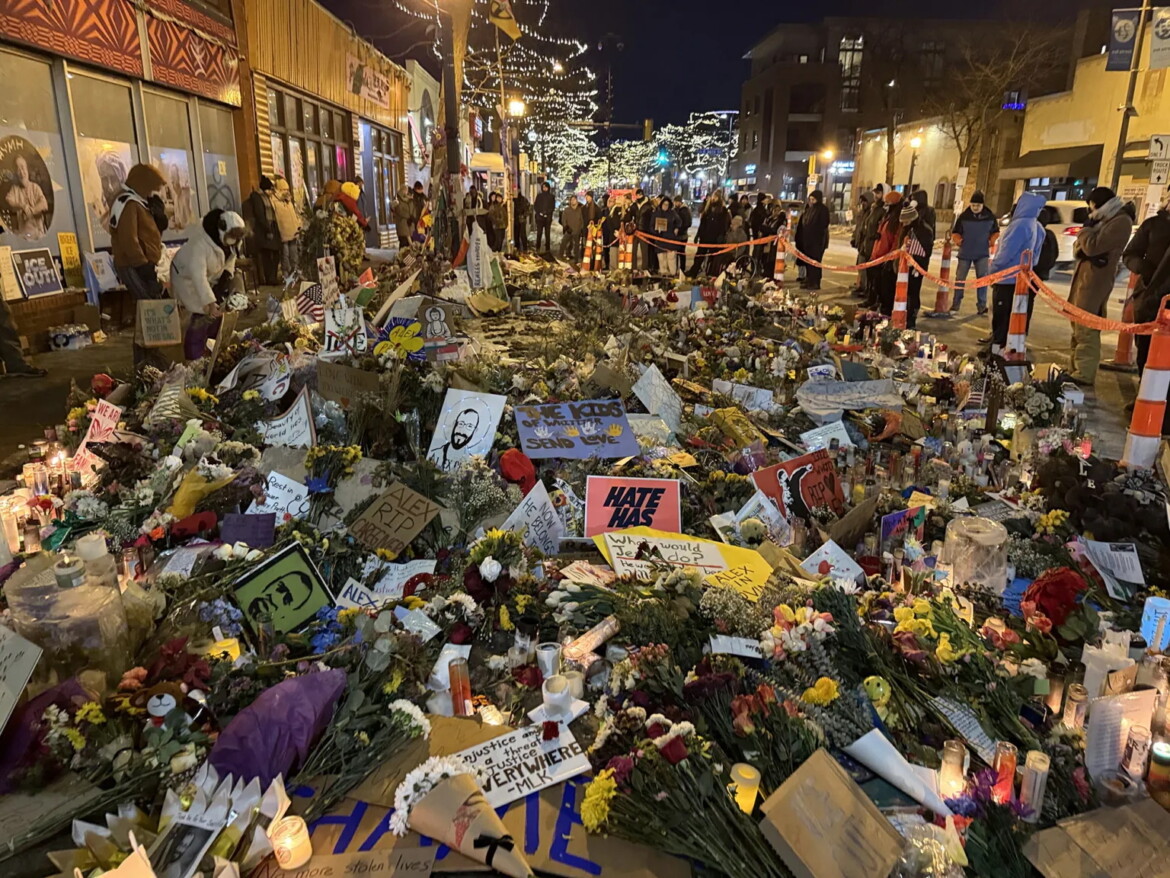
On Friday night I put on my heaviest gear and headed out again. After dark fell most of the marchers had cleared the downtown area. I decided to go to the place where Alex Pretti had been killed.
The area was cordoned with police tape but there was a crowd of people — 50, maybe more, in a rough semi-circle. Some had candles and were softly chanting. Others milled respectfully and took in the sight.
There was a large message written on a black sign in the center of the impromptu memorial: “Rest in power Alex. Any righteous person would have done the same.”

SPEECH BY DR. YOHURU WILLIAMS
Full Text of a speech by Dr. Yohuru Williams, Distinguished University Chair and Professor of History at the University of St. Thomas in Minneapolis, read at Hennipen County Government Building on Jan. 30, 2026, at a media event to share information about the arrest of Minneapolis journalist Georgia Fort by federal agents that morning.
Good afternoon.
We are here today because something fundamental is at stake.
Let’s be clear about what this moment represents.

In a democracy, the press is not a nuisance. It is not an inconvenience. It is not an adversary to be neutralized. The press is a constitutional safeguard. It is one of the few institutions explicitly protected in the First Amendment — named alongside speech, religion, and assembly — because the founders understood something essential: power left unexamined becomes power abused.
As a historian, I can say without hesitation that when governments begin to treat journalists as threats rather than witnesses, we are entering dangerous territory.
In moments of crisis — whether during the Red Scare, the Civil Rights Movement, or the protests against the Vietnam War — authorities have too often responded not with transparency, but with suppression. They have labeled dissent dangerous. They have framed scrutiny as subversion. They have sought to control the narrative rather than confront the truth.
History does not look kindly on those moments.
The pursuit of truth is not a crime. Bearing witness is not incitement. Asking questions is not obstruction.
If an independent journalist can be detained for doing their job — without clear and compelling evidence of wrongdoing — then we are not simply talking about one case. We are talking about precedent. And precedent is how erosion happens.
It does not happen all at once.
It happens incrementally.
First, it is the independent journalist. Then it is the credentialed reporter. Then it is the protester. Then it is the citizen with a camera phone. And before long, the line between public safety and suppression becomes blurred.
Democracy depends on friction. It depends on challenge. It depends on individuals willing to question authority and institutions willing to withstand that questioning.
When the state uses its power to detain a journalist engaged in lawful reporting, it sends a chilling message — not just to that individual, but to every reporter considering whether to show up, every editor weighing whether to publish, every citizen wondering whether to speak.
But silence has never made us safer. Silence has only made injustice more durable.
We cannot allow malicious or overbroad prosecution — whether by intent or effect — to become the tool through which scrutiny is discouraged. The Constitution does not protect comfortable speech. It protects contested speech. It protects inconvenient speech. It protects the kind of inquiry that unsettles power.
If we allow the detention of journalists to become normalized, we risk hollowing out one of the core pillars of democratic accountability. And once hollowed out, institutions do not easily recover. A free press is not a luxury. It is not ornamental. It is essential infrastructure for democracy.
If we care about truth, we must protect those who pursue it.
The post On frozen ground in Minneapolis: Why I went — and what I saw as press freedom is tested appeared first on Local News Matters.