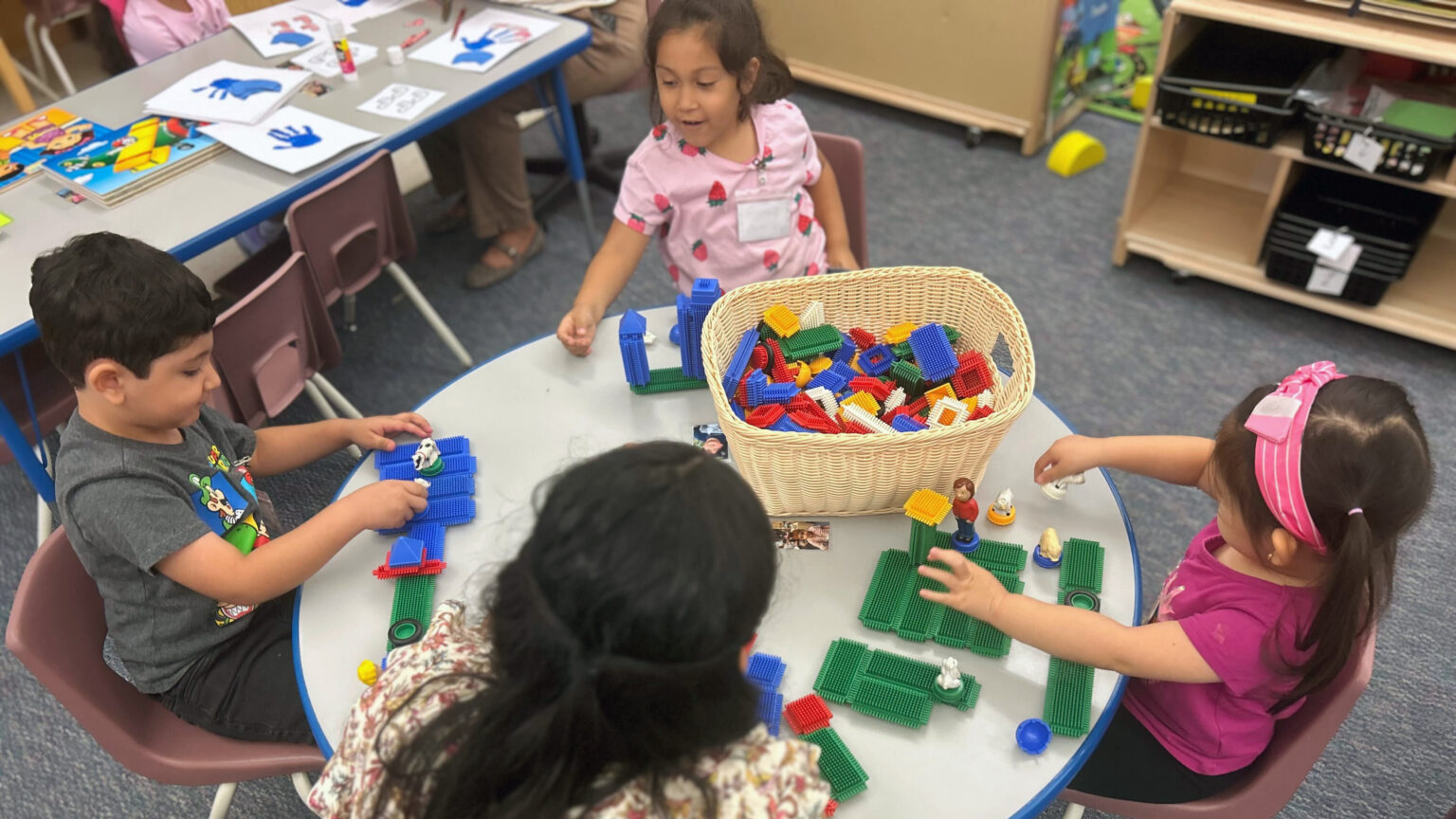
California’s transitional kindergarten instruction should remain developmentally appropriate and prioritize play as a form of learning, the state emphasized in a proposed clarification of the transitional kindergarten definition.
The updated definition is 145 pages into Gov. Gavin Newsom’s education trailer bill, which was released earlier this month and would strike out the use of a “modified kindergarten curriculum,” which allows for shifts in instruction. That would include pacing the day’s schedule for younger children and prioritizing the development of skills transitional kindergarten students may need as they move into elementary school.
In practice, educators say this has meant that some transitional kindergarten, or TK, classrooms appear designed for kindergarten and higher grades rather than accounting for their different developmental needs at such a young age.
“The difference between talking about a watered-down kindergarten curriculum and developmentally appropriate is game-changing, as far as I’m concerned,” said Michael Olenick, president of the Child Care Resource Center, a California-based advocacy organization.
The “modified kindergarten curriculum” would remain a “curriculum that is age and developmentally appropriate,” which, according to the governor’s office, would “prioritize play as a form of learning and is reflective of the cognitive, social, emotional, and physical abilities of a four-year-old child.”
“This is not a change in policy, and the use of developmentally appropriate TK curriculum has long been prioritized,” a spokesperson for the governor’s office said. “This definition emphasizes the expectation that LEAs should be continuously considering the developmental appropriateness of instructional practices, environment, and curriculum.”
Early education researchers have long recognized the critical role of play as a form of learning for very young children, yet they have reported seeing some transitional kindergarten classrooms continue to implement activities that require sitting quietly for extended periods of time, such as filling out worksheets.
“What we’re seeing in a lot of classrooms is very highly academic, not developmentally appropriate,” said Bernadette Zermeño, program manager and curriculum designer with Great First Eight, about the proposed change. “There’s a lot of worksheets happening and research shows over and over again that play is how young children learn.”
The proposed clarification closely mirrors the definition for a “developmentally appropriate” curriculum outlined decades ago by the National Association for the Education of Young Children, said Jorge Ramirez, an early education professor at Pacific Oaks College in Pasadena.
“We want children to have this higher order of thinking, which includes problem-solving, critical thinking, peer interactions. To get there, you can’t just throw them or give them these concepts that they’re oblivious to,” said Ramirez, who has also taught preschool.
“You have to introduce it in a way that it’s appropriate for them, so understanding where their brain is — their executive functions, their ability to problem-solve — then as a teacher, we know how to scaffold that thinking that will provoke further interest that gets them ready for those academic skills that are going to be taught in kindergarten class.”
Ramirez provided an example of what play as a form of learning has looked like in his classroom. A former student was fascinated by cars, so Ramirez introduced to the class a colorful set of toy race cars in various sizes, each with a variety of words and numbers on them. During a designated time of the school day, Ramirez sat alongside his students as they built a racetrack with blocks.
First came the literacy lesson. “Before your child can pick a car, your child needs to find a car that has at least three letters in that car of your child’s name,” he recalled telling a parent who was concerned about the amount of playtime in the classroom.
A basic math lesson followed, with Ramirez telling his student to “find your age in your mind, and then you’re going to take away two, and you need to find that number in the car.”
Science came next, with Ramirez encouraging the children to figure out how they might stack blocks to better balance a toy car or to change the angle of a certain set of blocks to develop more speed.
Zermeño noted that a play activity like the one Ramirez modeled clearly requires several skills, including critical thinking, math, engineering, spatial awareness and language. If a student took two of those toy cars, for example, a teacher could ask them to either draw or write about what happened with the toy cars as they went down the racetrack.
She was quick to add that a student in transitional kindergarten does not need to know how to write a paragraph or full sentence. The concept of writing something down, regardless of how accurate the writing might be, is preliteracy and establishes a foundation for children to connect actions with the words to describe it.
Whether the updated language is approved “is debatable,” said Olenick from the Child Care Resource Center, “but at least somebody’s paying attention” to the specific needs of 4-year-old children.
“A child doesn’t really care about what is on the wall and letters if they don’t know how to have friends and make friends,” Zermeño said. “And you learn how to make, create, and keep your friends through play-based learning. It’s so hard for a child to say, ‘Can I play with you?’ And that’s something that they need to learn to do and it’s possible in preschool and TK.”
With a developmentally appropriate curriculum, transitional kindergarten could provide the foundation for the social-emotional learning that children need so they are equipped to properly respond to challenging situations as they grow older, Ramirez said.