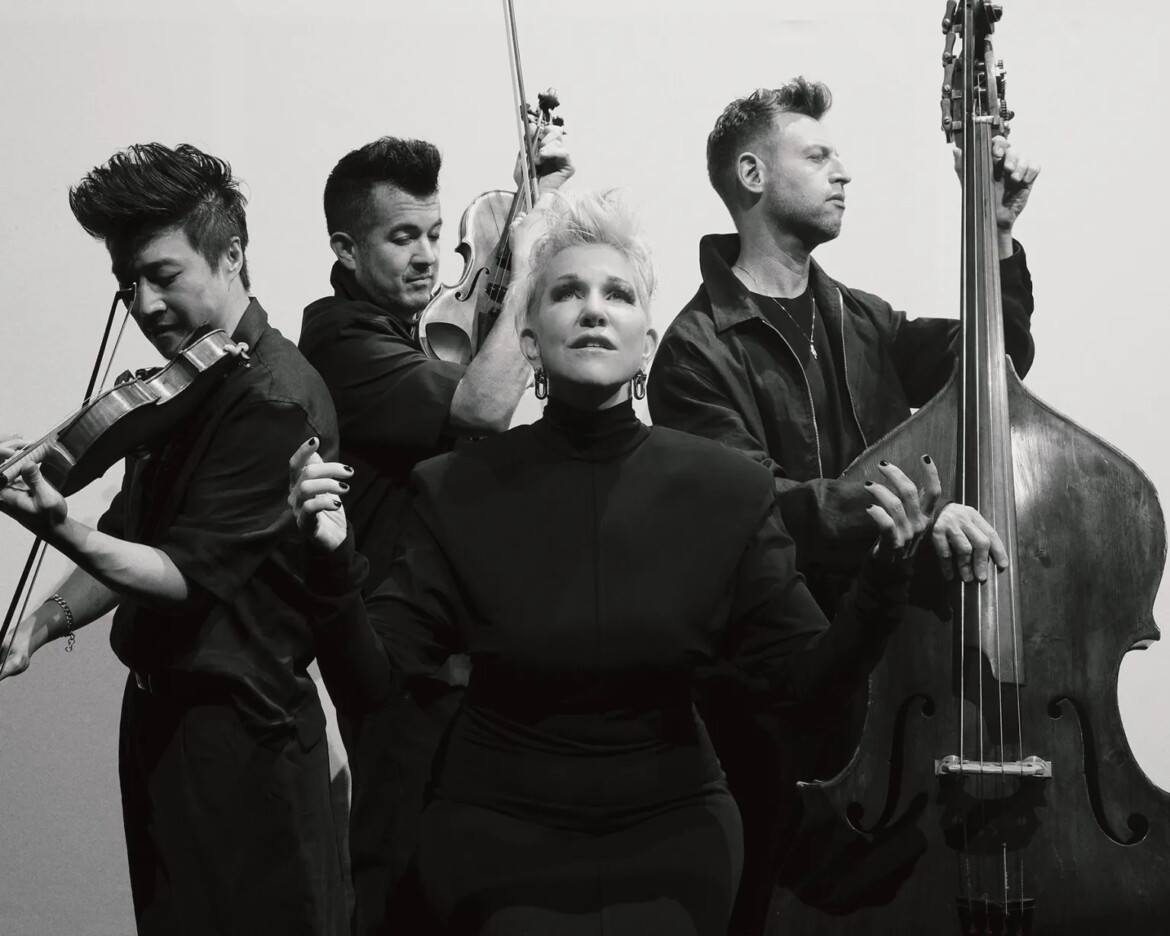
Coloratura mezzo-soprano Joyce DiDonato jumped at the chance to sing a song cycle based on Emily Dickinson’s poetry by Pulitzer Prize-winner Kevin Puts.
“‘No’ was never an option for me,” says the opera star, who was portraying Virginia Woolf in Puts’ premiere of “The Hours” at New York’s Metropolitan Opera in 2022 when the composer approached her about a new piece pairing her with the string-vocal trio Time for Three.
“I saw and felt immediately that this would be something truly special,” adds DiDonato, who premiered “Emily — No Prisoner Be” in 2025 at Bregenzer Festspiele, a music festival in Austria. The singer and ensemble, both Grammy Award winners, bring the 24-part song cycle with instrumental interludes to Zellerbach Hall in Berkeley this weekend.
Though Puts, who won the Pulitzer Prize in 2012 for his opera Silent Night,” began composing “Emily” without a commission, he found support for it from Bregenzer Festspiele and Cal Performances. An album was released on Jan. 30, its North American premiere was Feb. 1 at the Green Music Center at Sonoma State University, and it will tour to venues including New York’s Carnegie Hall.
“No prisoner be” is the final line from one poem by Dickinson (1830-1886), the innovative, unconventional Massachusetts writer whose nearly 1,800 poems were not published as a set until 1955.
DiDonato describes Puts’ composition as musical time travel: “He can follow the dramatic pivots of Emily’s world in a flash. The opening number, for example, is rebellious, larger than life, defiant and resistant — Emily as one has likely never heard her — and then within a single sustained note in the strings holding into the next song, we are catapulted into the total isolation of her room for ‘I was the slightest in the House,’ where we leave the rebellion and find a small, poignantly thoughtful and tiny, questioning Emily.”
She adds, “His understanding of the poetry means he can find her world, galaxy or corner with staggering ease.”

Directed by Andrew Staples, who also designed the lighting and sound, “Emily — No Prisoner Be” is a blend of music and theater that’s ripe for interpretation. DiDonato finds it at times cinematic, at times like indie rock, with bursts of contemporary, classical and “mind-blowing” elements.
“With this bold, innovative piece we feel completely free to present it in a way that helps the audience truly enter the mind and heart—at times isolated and solitary, other times spanning the edges of the galaxy — of Emily Dickinson’s poetry,” she says.
Time for Three violinist-violist Nicolas “Nick” Kendall says the group, which had known Puts for a while, solidified its relationship with the composer when he was writing music for the trio’s concerto “Contact.”
“It was almost like he was spending the time to study us—how we work and make our unconventional instrumentation sound the way it does, which, of course, includes vocals. Two violins and upright bass and we sing? How does that work?”
The collaboration between Time for Three (also featuring violinist Charles Yang and bassist Ranaan Meyer), DiDonato and Puts “organically developed,” says Kendall, who adds, “Kevin did the lion’s share of the work by creating the show’s ‘bible,’ but we have all been closely involved in almost every part of the show—even weighing in on the order of the poems in some cases, to album art design to what we all might want for dinner. It’s become a very close and loving family.”
Time for Three players, making their Cal Performances debut, aren’t vocalizing throughout “Emily.” They’ll be playing their instruments only on the work’s scherzos, “appropriately named ‘Bee Scherzos’ because of Dickinson’s love for bees,” Yang says, adding that they “fly with virtuosity and exuberance.”
Yang notes that concert’s immersive experience begins as soon as patrons enter the hall: “Audiences are cast into this world of contrast through lighting, staging, set and sound design that completely puts you inside the world of Dickinson’s poetry.”
Meyer echoes the sentiment: “As musicians we hopefully grow and learn to focus less on the technical and more on becoming the music,” he explains. “Staging … helps us get into character and prioritize the emotion into our performance … and to enhance the voice and spirit of Emily Dickinson. It resonates love, joy, sadness, defeat and loneliness. The audience will experience the four performers in various pods working together to share each poem while creating the story.
Dickinson famously faced oppression while she was alive; Meyer feels “Emily — No Prisoner Be” offers a different view: “Her works were barely celebrated during her life, but have been a reflection for the rest of time and humanity, and all set to gorgeous not ‘new music’ but music that happens to be new,” he says.
For DiDonato, Dickinson’s work remains potent in the 21st century: “She was creating not to be published or to go viral or to methodically check algorithmic boxes. She created to navigate a world that fascinated and terrified her, and in finding this power within her, she made herself completely free. If I could impress onto each audience member one thing, it would be to nurture the creative, free spirit within themselves. It aligns perfectly with my favorite quote of Jonathan Larson: ‘The opposite of war is not peace, it’s creation.’”
Cal Performances presents “Emily — No Prisoner Be” at 8 p.m. Feb. 7 in Zellerbach Hall on the University of California, Berkeley campus. A free artists’ talk with UC Berkeley English professor John Shoptaw, DiDonato and Time for Three follows the show. Tickets are $36 to $86 at calperformances.org.
The post Cal Performances’ multimedia ‘Emily—No Prisoner Be’ brings Dickinson’s poetry to life with music appeared first on Local News Matters.