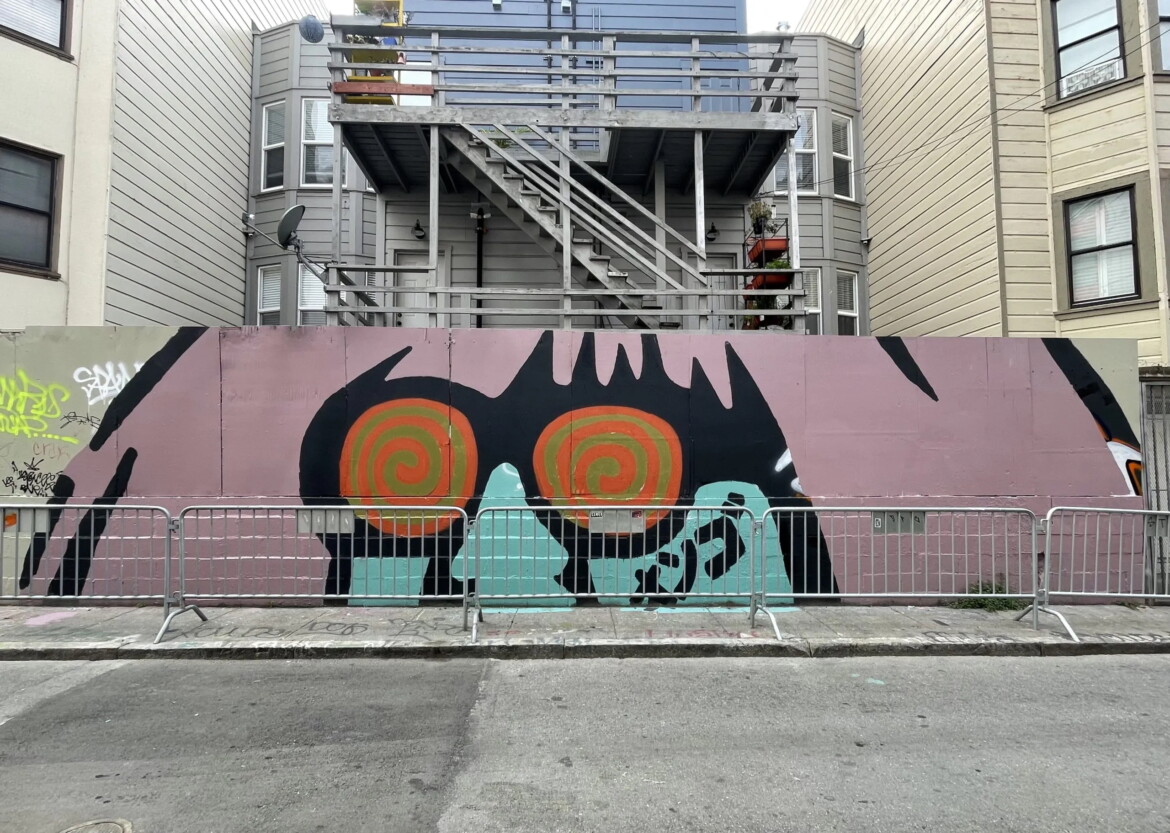
If you live or work in San Francisco, you may have encountered Ongo — underfoot, on a building or on a sign. He has a bob-length wig, sunglasses with hypnotic swirl lenses and a body like a Lego figure.
While his size, location and colors vary, Ongo has become a fixture across the city.
The Ongos are a playful take on bombastic art collector Ongo Gablogian, a persona of Frank Reynolds (Danny DeVito) in the show “It’s Always Sunny in Philadelphia.” In one episode, Gablogian derides art in an exhibition as “bull—-” and “derivative” while fawning over an air conditioner: “I want it. It’s everything.”
The Mission-based artist behind Ongo, who prefers to remain anonymous, is having fun with the project.
“It’s just become part of my routine. It’s kind of who I am and what I do,” he says.
Largely self-taught, he began painting during the pandemic as a way to connect with people, drawing inspiration from street artists like Banksy and San Francisco’s Jeremy Novy, whose koi fish abound citywide.
In 2020, he painted the first public Ongos, heads only, on a pillar outside All Star Donuts in the Inner Richmond. Before that, he gave the image a test run on a wall of his nearby living space.
“Once I did it, and I was like, ‘Oh yeah, this works,’” he says. He hopped on his bike, rode down Clement Street with his stencil, spray paint cans and mask in a messenger bag, and selected the inaugural spot.
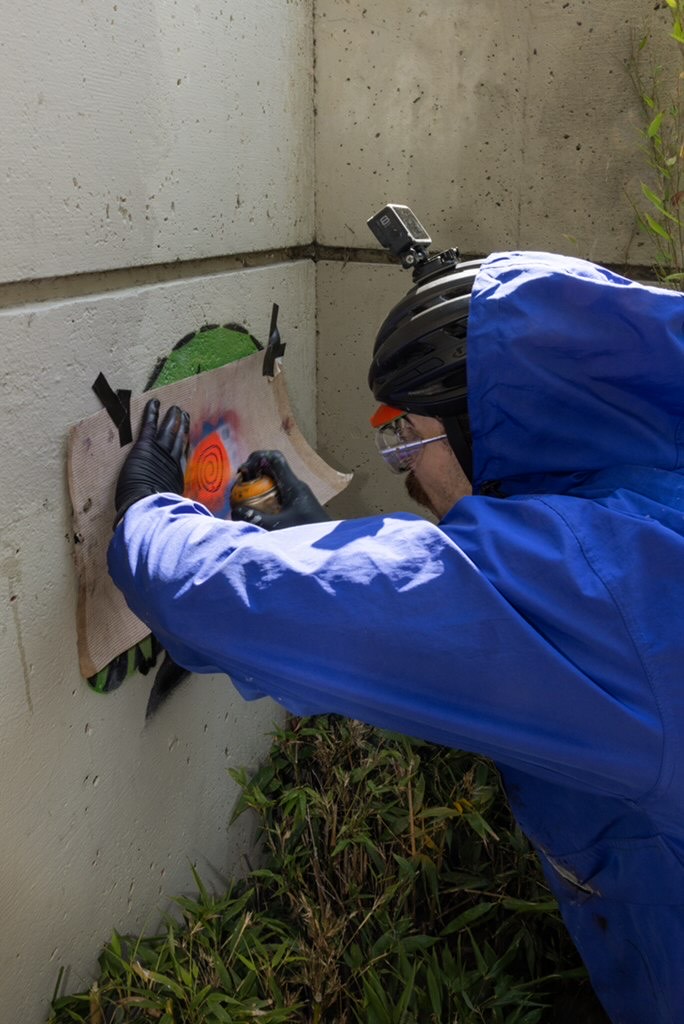
The anonymous artist behind Ongo prefers to keep a low profile. (Photo by Justin Guile/courtesy of the artist) 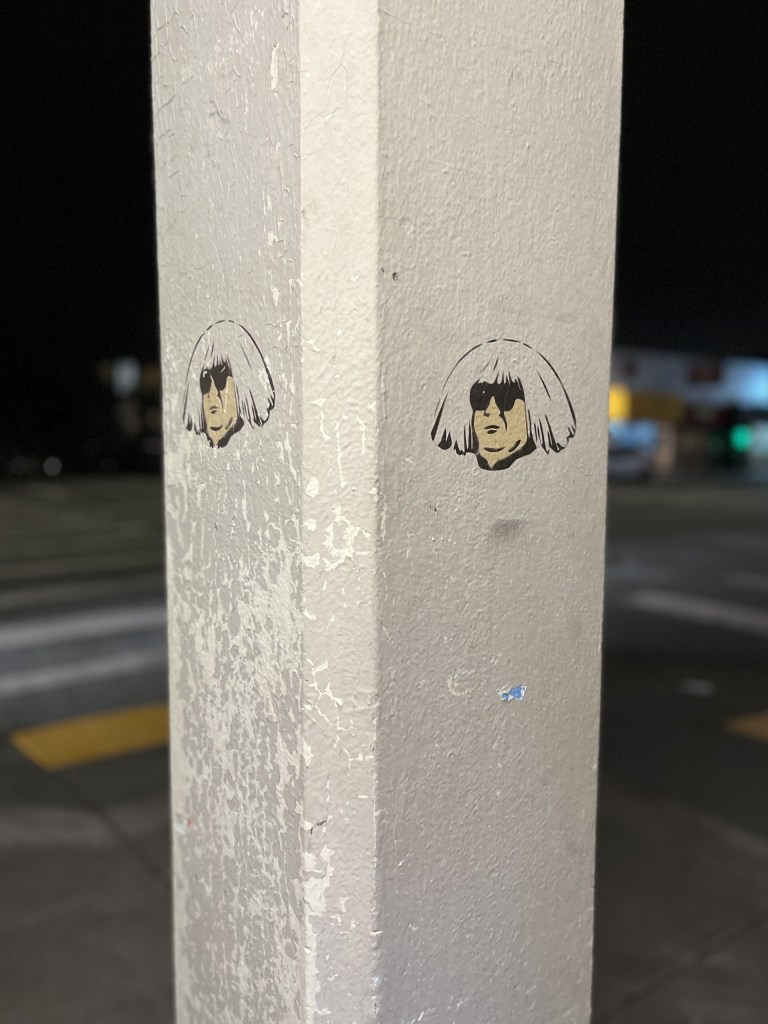
The first public Ongo appeared in 2020 on a pillar outside of All Star Donuts at Clement Street and 10th Avenue in San Francisco. (Photo courtesy of the artist)
The All Star Donuts’ pillar eventually was repainted, after several years.
“I just popped in there the other day when I was riding home, and you could still faintly see them,” says the artist.
Over the years, Ongo has gained a torso, arms and legs, taken on different color palettes and multiplied in Mogwai-esque fashion, showing up in Noe Valley, the Sunset and other districts on vent covers, sidewalks, utility boxes and street signs.
You might spot Ongo while waiting in line for a pastry at Arsicault on Arguello Boulevard, or at Home Coffee Roasters on Clement Street, Other Avenues in the Outer Sunset, or walking through the Mission or Castro.
Many Ongos are unsanctioned. When property owners leave the murals untouched for an extended period, it speaks to their perspective of the artist’s work.
For example, the Ongo on the side of a beige residential building on 21st Street near the Muni train tracks in Mission Dolores has been there since one memorable evening in 2022. It was pitch-black outside, except for the streetlights’ glow. The artist had to take an unexpected break from painting when someone reported him to the police.
“I threw everything in my backpack and grabbed my bike, ran up the street as far as I could go up the hill, and then squatted down behind a car,” he says.
Once the patrol cars left, he returned to the Ongo-in-progress. He says, “… I walked back down there, finished it and then got out of there.”
He assumed the property manager would paint over it the next day, but that never happened. It’s been there for about four years.
“I guess they find value in it — they don’t see it as an eyesore,” he says.
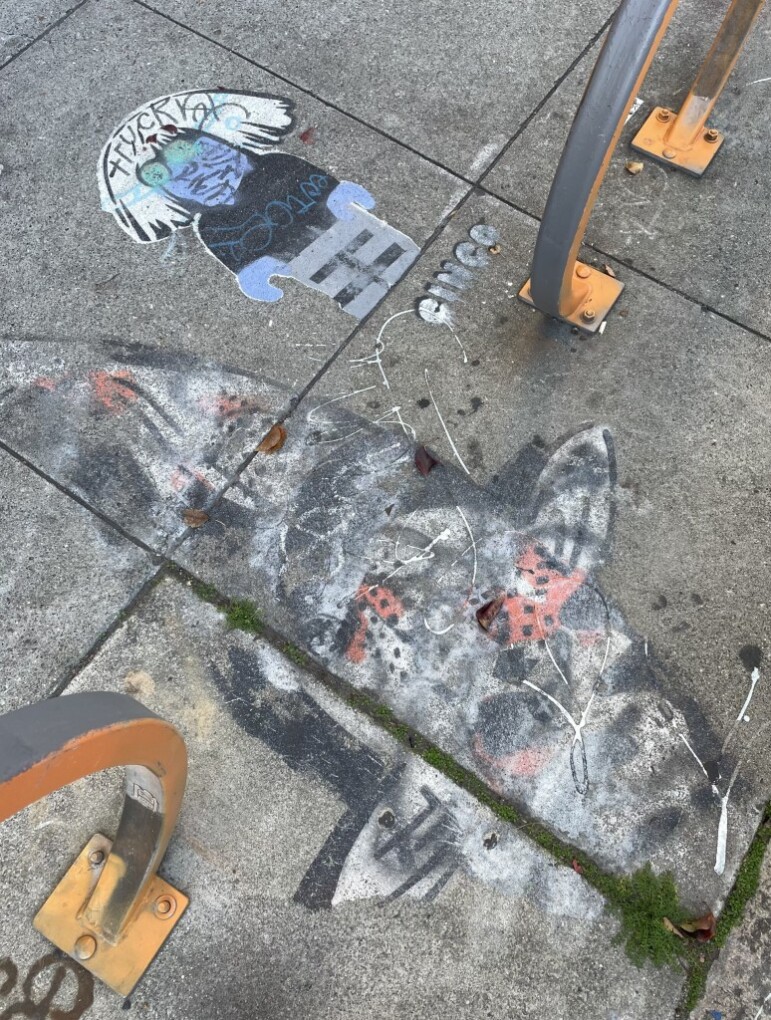
On a Duboce Avenue sidewalk, an Ongo is next to a koi fish mural by Jeremy Novy. Ongo’s anonymous artist says Novy is one of his inspirations. (JL Odom via Bay City News) 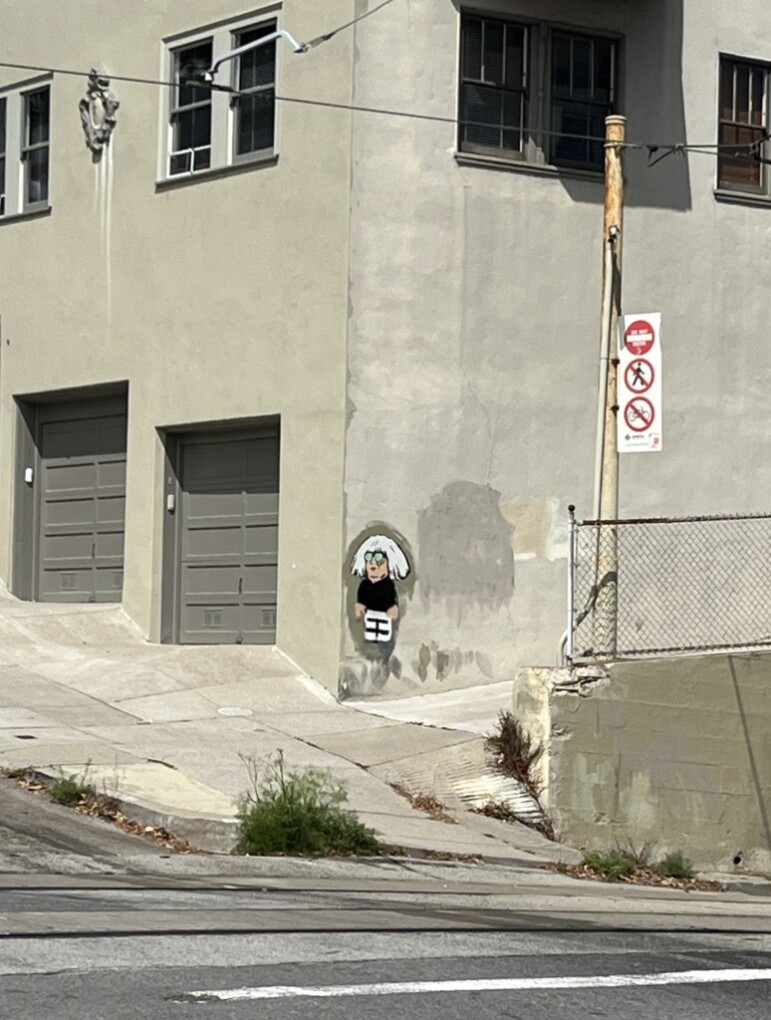
An Ongo has been the side of a residential building on 21st Street in San Francisco near the Muni J Church line tracks since 2022. (Photo courtesy of the artist) 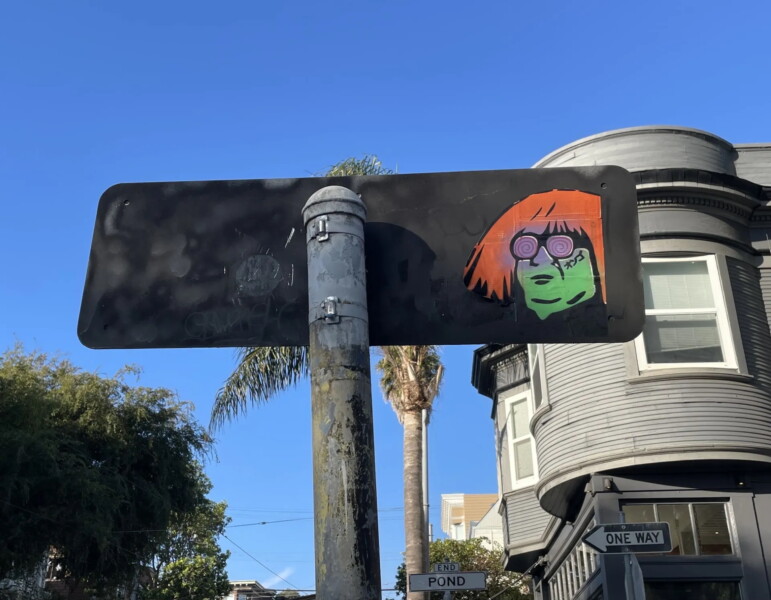
Many of the Ongo figures, such as this one on the back of a sign in the Castro, are stenciled. (JL Odom via Bay City News)
Some Ongos have been recorded by passing Google Street View cars and featured on Google Maps: “It’s kind of like cementing it in time, digitally,” the artist says.
The size of Ongos has increased, too. There are murals on the side of Lucky Penny coffee shop (which closed in 2015) at Geary Boulevard and Masonic Avenue and on Wiese Street, an alley near the 16th Street BART station.
The artist painted the murals freehand, foregoing stencils used for smaller pieces.
But in the past year, he’s cut back on public paintings, focusing more on studio work.
“You have to start somewhere,” he says. “You’ve got to paint illegally to get people’s attention and a cult following of sorts. Then, eventually, you can hopefully transition to doing commissioned or public murals that aren’t tagging — to painting things legally and selling them.”
While he recently started a part-time job to help with living expenses, he’s grateful he can lean financially on his art. He’s been selling Ongo art and merchandise via TikTok and Instagram, including vent cover plates, which he’ll install near customers’ homes.
“I’ve been extremely lucky,” he says. “Doing art full time doesn’t pay for all the bills; I’m not living comfortably doing just that, but at the same time, I’m like, ‘At least half my income is coming from art.’ So that’s pretty amazing.”
He has a personal touch, too. He’ll deliver his art by bike or mail it, using a Priority Mail label with an Ongo on it: “I’ve had a lot of people tell me it’s kind of like another piece of art. They end up keeping it, hanging it up somewhere, maybe even framing it,” he says.
Moving forward, he hopes for bigger Ongo murals, more commissioned work and a solo show.
“I’ve got concepts of a plan,” he says about the latter, with a laugh. “But, yeah, I haven’t settled on anything in particular.”