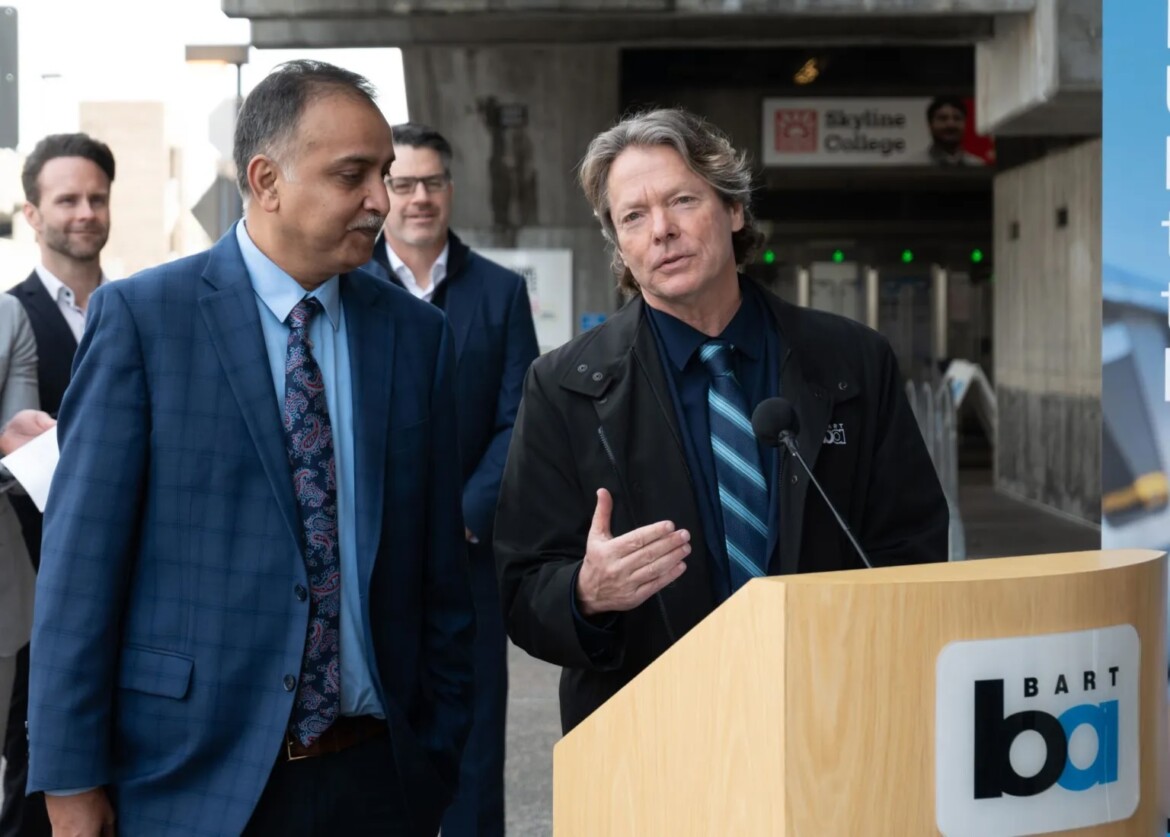
BART and Uber officials on Tuesday morning announced a new partnership that they expect will streamline trips and provide more transportation options to the public.
Travelers using the BART mobile app will now be able to plan, request, and book Uber rides to and from all 50 BART stations for trips ranging from 2 to 7 miles.
BART General Manager Bob Powers said at Tuesday’s announcement, held at the agency’s Daly City station, that the collaboration between BART and Uber will help make public transit more attractive because it eliminates the need to be juggling between different applications.
Powers added that while BART is one of the region’s largest operators, there is still work to be done to help commuters travel more easily to and from stations.
“Not everybody lives right adjacent to a BART station or a bus line and this is going to improve their experience,” said Powers. “This unique relationship with BART and Uber is not a common occurrence in the transit industry.”
“This unique relationship with BART and Uber is not a common occurrence in the transit industry.”
Bob Powers, BART general manager
Private ride-hailing companies have been partnering with transit agencies across the country to provide paratransit services, like in Los Angeles, Dallas, and Washington, D.C., but the partnership with BART marks a unique instance in which Uber is integrating its services into the app of an operator.
The head of transit partnerships at Uber, Chris Margaronis, said the partnership comes at a time when public transportation in the Bay Area faces major budgetary challenges and Uber wanted to help make incremental improvements to make transit easier.
“We can’t sit by idly waiting for a massive innovation or a public-private partnership that’s going to solve all problems, we need to focus on consistent, achievable wins,” said Margaronis. “While BART remains the indispensable backbone of the public transit system, Uber can act as a support system, providing efficiency and working on the edges.”
Uber subsidizing trips at some locations
Uber set aside a $50,000 subsidy that will provide a limited number of discounts for Uber trips beginning or ending at 10 BART stations. Those include Antioch, Bay Fair, Concord, Daly City, Fruitvale, Lake Merritt, MacArthur, Richmond, Walnut Creek, and West Oakland.
Alvaro Villagran of the Shared-Use Mobility Center, a nonprofit organization that advocates for public and private collaborations to address transportation needs, said the new partnership could help incentivize people to take public transit more often.
“It’s an opportunity to provide that first and last mile service, expand the service area, and the outreach for an agency,” said Villagran.
While Uber partnerships have been successful for some transit agencies, Villagran said that more time would be needed to see how successful BART and Uber’s new agreement will be.

BART is still recovering from a major decline in ridership during the COVID-19 pandemic. The agency traditionally relied on fares for operations, but post-pandemic, its funding model is struggling to cover operating costs.
Looking ahead, BART will have to find new sources of funding to keep it running for the millions of people that rely on the train service. Data shows 4,953,907 more exits in 2025 than in 2024, marking the agency’s highest ridership since the start of the COVID-19 pandemic but still lagging behind pre-pandemic trends.
Even with positive trends, July 2026 will mark the end of federal financial assistance initially provided to public transit systems that lost revenue due to the COVID-19 lockdown. BART officials hope to diversify their income stream, but the future remains uncertain.
Visit the BART website for more information and to download the BART mobile app.