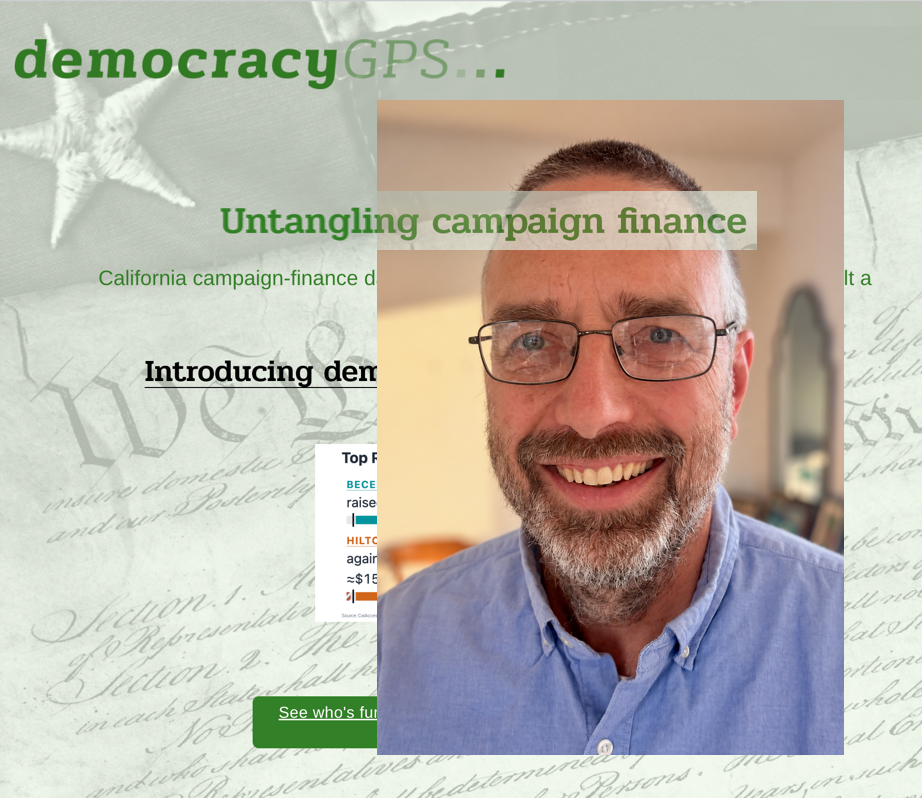
In 2013, Chris Krenn, a computational physicist and Piedmont-based civic innovator, launched DemocracyGPS, a non-partisan project working to answer this question: can technology help make democracy work better?
In his work, Krenn developed software-based public surveys with the aim of giving voters clearer avenues to having their views understood by elected officials, and vice versa. “I have a vision of an electronic, non-partisan democracy system that holds our elected representatives more accountable,” Krenn told the Exedra in 2019. “The idea is for voters to have a voice and a tool to apply more pressure than just an up or down vote every two years or so.”
This week, as the alignment of national midterm elections, important state and local elections, and crucial referenda brought intensified public focus on the uncertain health of U.S. democratic politics, DemocracyGPS tested its first ever Campaign Finance Explorer. The purpose of the CFE is to help voters follow the money.
Money has long been both the lifeblood and the scourge of American politics. But since the 2010 Citizens United Supreme Court decision, there has been a growing sense that oceans of dark money, deepening political polarization, and powerful oligarchies are stretching the system to a breaking point. Exedra journalist David Thigpen asked Chris Krenn to explain what kinds of impacts he hopes can arise out of the increased awareness CFE brings to voters.
David Thigpen: Explain to us, what does the CFE do?
Chris Krenn: The free and nonpartisan Campaign Finance Explorer allows voters to quickly see who is spending money to support and oppose candidates and propositions in California state elections. It tracked and updated 132 races on the Nov. 3 ballot every day, including statewide races like governor and treasurer, all 14 propositions, and all Senate and Assembly races. It currently does not cover federal congressional races or local elections, such as those for city council or school board. The Explorer uses software I developed, tested, and validated with AI assistance to make campaign finance data from the California Secretary of State easier to understand.
DT: Why is this important to voters now?
CK: Voters should always be able to easily find out who’s financing a campaign before deciding how to vote. There usually are good reasons why a person or organization makes a contribution to a campaign, but what is good for the contributor is not always good for the voter or for their community. Understanding who is behind political messages will help voters decide what news or advertising to trust and to make better decisions for themselves and their communities.
DT: What are some quick takeaways from Tuesday’s midterms?
CK: The Blue Wave revealed many things on Tuesday, including the fact that American democracy cannot easily be bought. With the help of current transparency laws, voters could see many of the contributors for and against US Senate candidates across the nation. According to analysis by PaidForPolitics of Federal Election Commission data, in three of the four biggest Senate races (TX, OH, & MI) the side with more money lost, despite having spent 1.6 to 2.8 times as much money. But in California, committees against Prop 40 and for Prop 42 (lead by Building a Better California) outspent their opponents between 5 and 1000 times, and in this case the sides with more money are in the lead.
DT: Isn’t much of this info already available on the internet?
CK: The Campaign Explorer makes California campaign finance data easier to navigate than the Secretary of State’s Cal-Access website. It also gives more detail about committees and their donors than general election guides such as CalMatters, VOTE411 and Ballotpedia. Other campaign finance sites, including OpenSecrets, Daylight, GoodVote, PaidForPolitics and Dark Money Map, offer different mixes of federal and state coverage, historical data, visualizations, and free or paid access. The Explorer focuses on California’s current state elections, is free, updates daily, and covers committee donors in detail.
One of the unique features of the Explorer is that it allows voters to easily see the donors behind campaign finance committees whose names can seem incomplete or opaque. “Working Families for Healthy Communities supporting Becerra for Governor 2026 sponsored by labor and community health organizations” and “Building a Better California” are two examples. “Working Families for Healthy Communities”, which spent $17M supporting Xavier Becerra for governor, received contributions from two unions and the California Medical Association, and it also received contributions of between $0.95M and $2.8M each from realtors, two casino-owning tribes, Airbnb and Meta. “Building a Better California” spent almost $400M across six proposition campaigns, including a combined $378M (nearly 95% of its total spending) opposing Prop 40 (the 5% wealth tax on billionaires) and supporting Props 41 and 42 (which if passed could nullify Prop 40.) “Building a Better California’s” four largest donors are Google co-founder Sergey Brin ($100M), venture capitalist L. John Doerr ($40M), former Google CEO Eric Schmidt ($40M), and Stripe co-founder Patrick Collison ($33M), all of whom could be subject to the wealth tax.
DT: What’s up next for your DemocracyGPS work?
CK: Before the next elections, we plan to continue to develop and improve our processing tools and website and to release our processing tools to the public.
Try DemocracyGPS’ Campaign Finance Explorer HERE