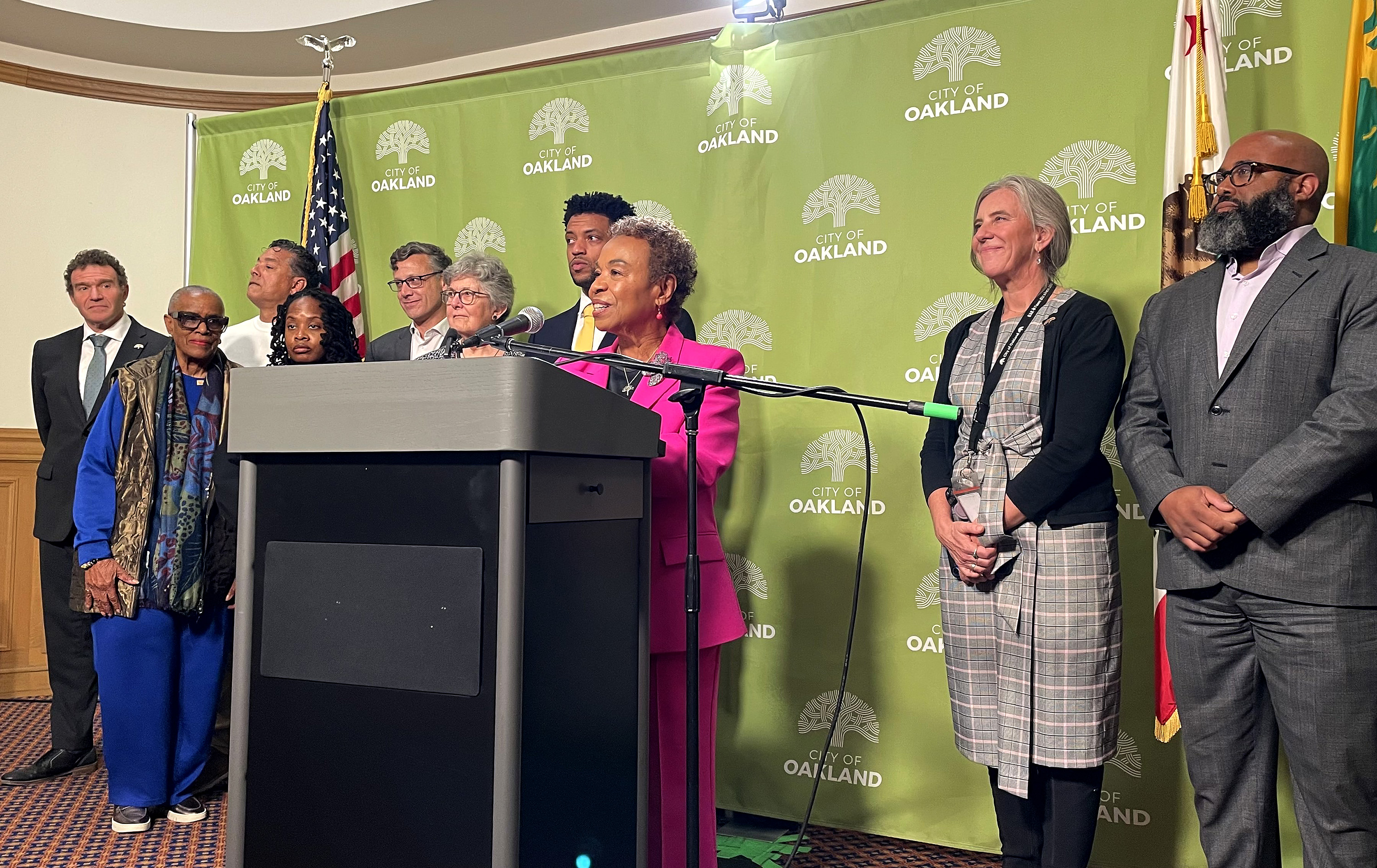
In her first official remarks after being reelected as Oakland mayor, Barbara Lee on Thursday hailed the likely passage of Measure EE and outlined some of her priorities at City Hall.
As of the latest preliminary voting results from early Wednesday, the incumbent Lee had secured 84.3% of the vote, well ahead of her three challengers, Julius Robinson, Mindy Pechenuk and Brenda Grisham.
Lee won the job in an April 2025 special election to replace Sheng Thao, who lost a recall election and is now embroiled in a federal corruption trial.
At Thursday’s press conference, Lee expressed gratitude to Oakland voters for reelecting her, and said that illegal dumping, public safety, affordable housing and attracting new businesses to the city will be among her priorities for the new term.
Lee also thanked voters for passing Measure EE, a charter amendment to dramatically change how the city government is organized.
Measure EE would do away with Oakland’s current hybrid system of governance and create a strong mayor system, in which the mayor has more authority and control over the city administration.
As of results announced early Wednesday, 73.8% of the votes have been in favor of the measure.
“For too long, Oakland’s government, residents have seen firsthand that the buck stops, really, with no one,” Lee said on Thursday. “Measure EE creates clearer lines of responsibility while preserving the City Council’s important legislative, oversight and constituency advocacy roles.”
In California, cities are typically run either under a “strong mayor” or “council-manager” system.
In strong mayor cities, the mayor is elected to be the chief executive, with responsibility to hire and fire top city officials, run day-to-day operations, propose budgets and wield veto power over legislation and budget decisions made by the city council.
Under council-manager systems, the city council still holds legislative authority but appoints a city manager who is responsible for running municipal operations, including hiring top department heads.
A new balance of power
Currently, Oakland’s system is run by a mayor who is elected by a citywide vote but can’t hire or fire department heads, veto City Council decisions or, with the exception of acting as a tiebreaker, vote on items before the council.
To correct this, Measure EE would allow Oakland’s mayor to appoint a city manager or administrator, subject to the approval of the City Council. The administrator would retain control over the finance and human resources departments, but the mayor would be responsible for managing the other departments.
The City Council would have the power to conduct legislative hearings and issue subpoenas to compel witness testimony or the delivery of documents.
Measure EE was placed on the ballot by the Oakland City Council in June, with a rare tie-breaking vote from Lee.
“No” votes were from councilmembers Zac Unger, Noel Gallo, Ken Houston and Janani Ramachandran. Councilmembers Rowena Brown, Carroll Fife, Kevin Jenkins and Charlene Wang voted in favor of placing the measure on the ballot.
City Council President Kevin Jenkins — who has won 82.6% of the vote in his reelection bid to represent District 4 — emphasized that the change brought about by Measure EE is not a “power grab” by the mayor.
Measure EE is “not going to diminish [City] Council’s role; it will just be different,” Jenkins said Thursday. “This measure is not about weakening council; it’s about creating a more effective partnership between the mayor and council.”

On Thursday, Lee said that her office will institute a “thoughtful, transparent and inclusive” Measure EE implementation plan in the coming days before the measure goes into effect in January 2027.
As the first step in that plan, Lee announced the launch of a search for a new permanent city administrator, who will act as “her number two” and be a part of her leadership cabinet.
In May, City Administrator Jestin Johnson resigned after inappropriate workplace communications involving him were allegedly discovered.
Assistant City Administrator Elizabeth “Betsy” Lake has since served as interim city administrator.
The post After reelection, Oakland mayor hails Measure EE, outlines priorities for new term appeared first on Local News Matters.