In summary
Across California, police departments are rapidly expanding “Drone as First Responder” programs, triggering intense public backlash over warrantless surveillance and corporate overreach.
Public pushback over municipal police drones is boiling over across California, turning routine local policy hearings into high-stakes battles over the boundaries of neighborhood surveillance.
The increasingly heated public debates are driven by landmark privacy litigation and a 2021 law that mandates explicit local board approvals for the use of “military equipment,” including drones. Those disclosures make clear that police are increasingly looking to drones as potential “first responders” in cities like San Francisco, Berkeley, Santa Ana and Stockton — forcing local leaders to face skeptical residents in public hearings required before drone programs can expand.
At those appearances, law enforcement agencies are pushing to broaden their drone use beyond emergency-only response to aid in everyday patrols, while citizens are concerned about drones conducting warrantless searches, if municipalities are hoarding too much data collected by drones, and whether drone makers have too much power and information.
Those tensions were on stark display earlier this month in San Francisco, when a policy debate at a police commission meeting drew a packed room of opposing residents.
The San Francisco Police Department asked commissioners to approve a policy allowing drones for a wide array of uses, including “public safety response,” active investigations, training, and “community outreach.” While prohibiting random “general surveillance” or tracking activities protected by the First Amendment, the draft stipulated that public footage would be retained for 30 days unless tied to an open investigation.
“With drones, you can fly at much lower altitudes, you can get thermal imaging, you can get tracking.”
Katie Inman, attorney at Holland & Knight
Supporters argued the technology is vital for modern crime-fighting. “Public safety and personal privacy shouldn’t be competing interests,” said Anna Carney, president of Stop Crime SF, urging commissioners to give officers every responsible advantage to save lives.
But privacy advocates and skeptical residents saw a slippery slope toward unchecked surveillance, drawing explicit parallels to the contentious rollout of automated license plate readers across the state. In recent years, cities like San Francisco and Stockton built extensive fixed camera networks supplied by vendors like Flock Safety. Now, communities fear that attaching drones to those same networks creates an inescapable, multi-dimensional dragnet — one that tracks citizens not just by car on the street, but from the air above their homes.
“We are all here today because these drones are impacting all of our communities, ” said Manny, a member of the privacy advocacy group DeFlock SF, who urged the commissioners to cancel the department’s contract with drone manufacturer Skydio. “If SFPD truly cared about operating these drones with any respect to privacy, the very least that can happen is one of you make an amendment to require a warrant,” he added, referring to language used in the department’s proposed policy.
Although commissioners voted to advance the policy to labor negotiations without adding a warrant mandate, the friction displayed in San Francisco reflects a statewide reckoning.
Legal uncertainty and the policy vacuum
The 2021 rules governing military equipment in law enforcement still leave a policy vacuum confronting municipalities across California: Local agencies that deploy drones are stepping into a legal gray area where technology is far outpacing state regulation.
A lawsuit against Sonoma County underscores the uncertainty. Privacy concerns festered for years in the county after officials launched a \drone program in 2019 for code enforcement. But investigators with the American Civil Liberties Union later uncovered hundreds of warrantless searches over private yards, homes, and windows — all conducted without a published policy in sight. In 2025, the ACLU of Northern California sued Sonoma, and last month, the county settled. Sonoma pledged to reel in its drone use, obtain warrants or consent before conducting residential property code inspections, restrict data retention, and directly notify residents if their property was subjected to aerial surveillance.
The case brought to the forefront the complex legal matrix officials must navigate in deploying unmanned aircraft.
“There’s three main buckets,” explained Katie Inman, a drone policy expert and attorney at Holland & Knight who previously worked at the Federal Aviation Administration. “You’ve got the broad…constitutional law principles, then you’ve got state statutes, and then you’ve got the third bucket, which is FAA operating rules.”
Inman noted that California belongs to a category of states that lack a comprehensive state statute explicitly governing law enforcement drone use, leaving municipalities on their own to read and comply with constitutional Fourth Amendment case law, which protects against unreasonable search and seizure.
She said the Supreme Court has ruled that aircraft surveilling areas that are visible to the naked eye from lawful altitudes do not violate Constitutional protections.
“But those were manned aircraft; they are not drones,” she said. ”With drones, you can fly at much lower altitudes, you can get thermal imaging, you can get tracking, you can get just a lot of hovering — a lot of surveillance potential there that you would not normally have.”
Across the state, nearly 60 law enforcement agencies use drone programs, according to the Los Angeles Police Department. Most foundational policies, including those in Chula Vista, Fremont, and the policy proposed in San Francisco, prohibit random surveillance, but programs diverge when it comes to deployment triggers and public oversight. Departments like Chula Vista deploy automated “Drone as First Responder” units broadly ahead of ground officers for routine 911 calls, whereas newer or more heavily scrutinized frameworks, such as San Francisco’s proposed policy, attempt to draw tighter lines by limiting flights to active criminal investigations, vehicle pursuits, or specific, incident-based emergencies.

Multimillion-dollar contracts and unproven safety claims
Beyond constitutional and policy questions, the rapid growth of drone programs is closely tied to an aggressive push by defense and surveillance technology vendors.
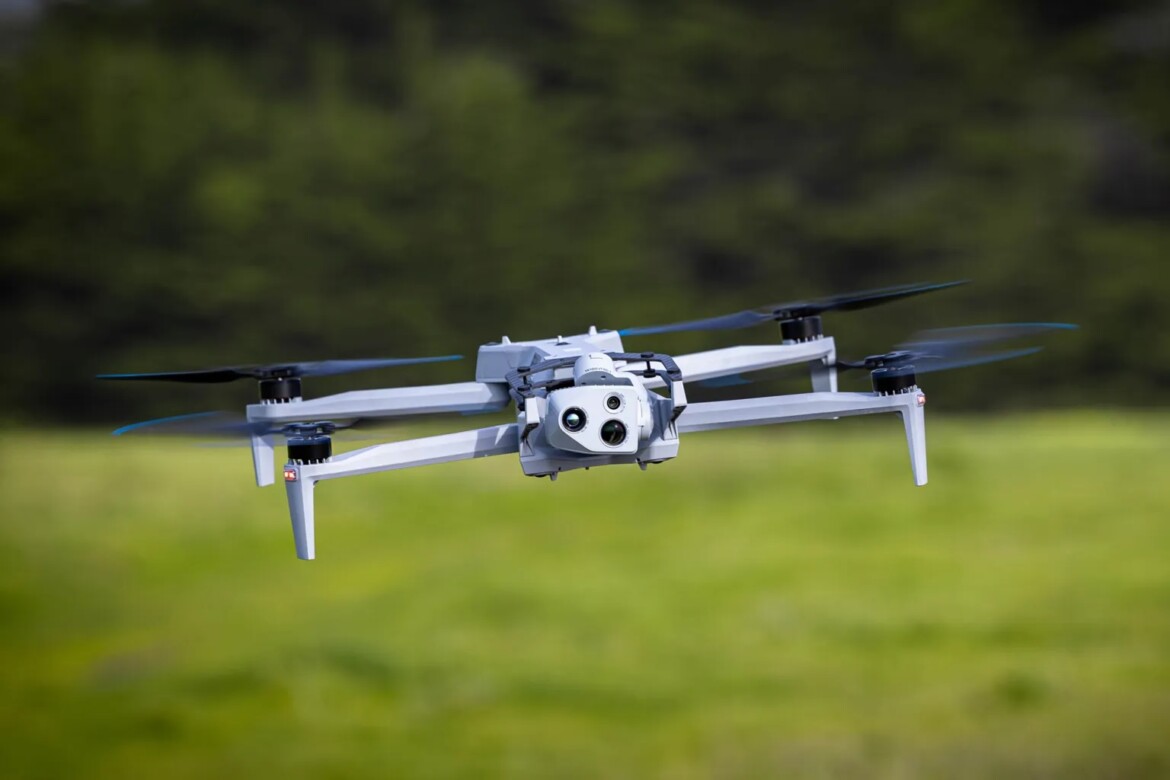
Both the San Francisco and Los Angeles police departments rely on hardware manufactured by San Mateo-based Skydio, while industry peers like Axon, which makes body cameras, and license-plate-reader manufacturer Flock Safety have also aggressively expanded into the market. Skydio originally launched to give extreme sports athletes a way to track and film themselves doing parkour or snowboarding. But after the U.S. government labeled Chinese drone maker DJI a national security risk in 2020, Skydio pivoted to fill the void for military, police, and enterprise customers.
At a recent customer conference, Skydio CEO Adam Bry laid out an ambitious roadmap: small drones for tactical flights inside buildings, mid-range aircraft for vehicle pursuits, and high-speed models capable of traveling 100 mph up to a 30-mile radius. Bry also outlined a future driven by AI, envisioning software that analyzes 911 calls in real time to automatically recommend dispatching an autonomous drone to a scene.
“SFPD should tie deployments to specific incidents… No general routine patrol. No general surveillance.”
Jesus Gabriel Yanez, recently-retired police commissioner
Executing that vision requires major investments — from taxpayers and billionaire backers alike. Santa Ana recently greenlit $682,900 for its Drone as First Responder initiative in partnership with Skydio, while the Stockton City Council approved a $3.15 million contract expansion with Flock Safety to integrate six drones into its existing network of 120 license plate reader cameras. In San Francisco last year, the police department received a $9.4 million donation from the crypto billionaire and Ripple cofounder, Chris Larsen, to expand its drone program and surveillance systems, Mission Local reported.
“The premise of the Bill of Rights is respect for liberty of the individual, and that used to mean something in this city,” a San Francisco resident named Ilona said at the Oct. 14 Commission meeting, lambasting officials for accepting Larsen’s drone donation. “But it doesn’t anymore because now we have sold out to tech billionaires…. SFPD has been sloppy and reckless with our privacy. How can we trust them with these tools?”
Venture-backed drone vendors have spent heavily to influence local officials to support their expansion — Flock Safety, for instance, has reportedly spent millions of dollars on local and federal lobbying, claiming its technology helped “solve” a million crimes last year alone. Yet researchers are increasingly skeptical of what vendors and law enforcement say the technology can help accomplish.
Police argue that drones help them respond to incidents more quickly, help them deescalate potentially dangerous situations, and improve crime clearance rates. A February 2026 study by the UC Berkeley Criminal Law and Justice Center found that while first-responder drones can improve response times, there is no evidence they reduce officer-involved shootings, lower overall use of force, or improve case resolution rates.
The rapid rollout has also intensified community anxiety over interconnected surveillance networks, and intensified the brewing nationwide backlash against AI-powered police tech.
Jesus Gabriel Yanez, a recently-retired police commissioner, spoke at the San Francisco commission meeting. He briefly read a passage from George Orwell’s dystopian novel “1984” before expressing his opposition to the drone use policy outlined by his former peers.
“SFPD should tie deployments to specific incidents that cannot be addressed without compromising officer safety — period,” Yanez said. “Those are the only times when we should allow for the deployment of a drone. No general routine patrol. No general surveillance.”
Opponents like Yanez point to past instances where California law enforcement agencies illegally shared license plate tracking data with federal immigration authorities, as well as technical missteps like a recent leak that exposed live police drone video feeds online due to vendor misconfigurations. That anxiety over vendor overreach and AI surveillance isn’t confined to California—similar resistance is bubbling up across the country. In Minneapolis, the city council voted to reject a police drone contract with Skydio following community protests over privacy and dual-use military technology. In New Orleans, advocacy group Eye on Surveillance successfully mobilized against a proposed policy that would have allowed weapons on police drones.
Whether through public city council debates sparked by AB 481 or court-enforced settlements like Sonoma County’s, California communities are trying to make it clear that adopting cutting-edge public safety technology will not come at the cost of privacy. The automated eye in the sky may arrive in seconds, but citizens are demanding to know exactly who is watching — and who holds the remote.
CalMatters Technology Reporter Khari Johnson contributed to this report.