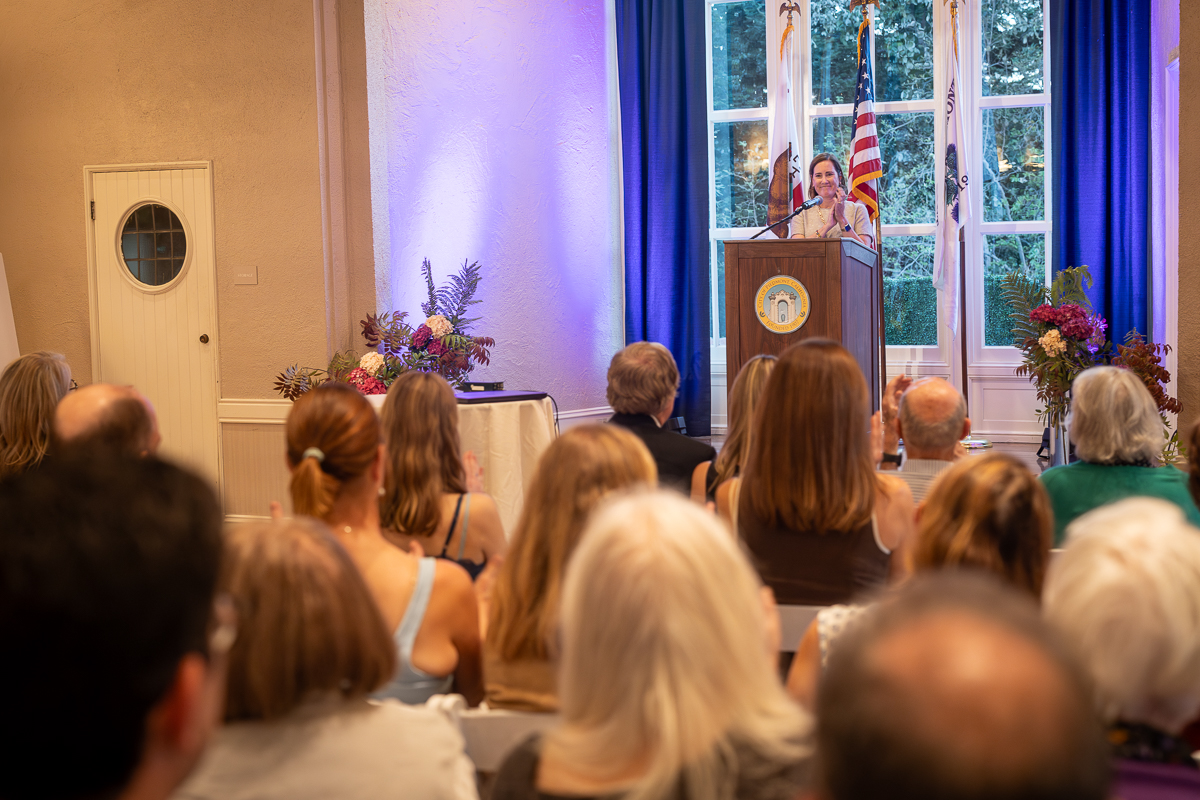
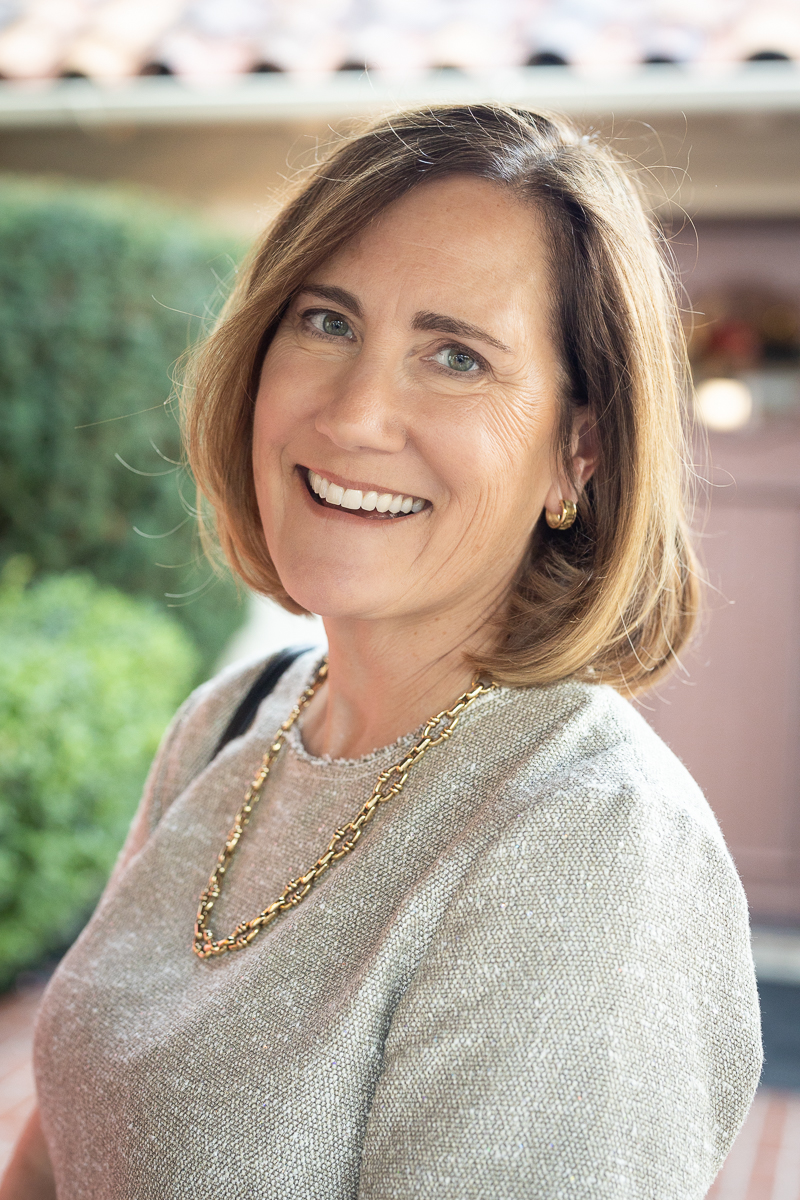
In what was one of her final speeches to the community before she leaves office in December, Mayor Betsy Smegal Andersen shared five lessons she’s learned from serving on City Council over the last nine years. City leaders, staff, and friends gathered in Piedmont Community Hall on Oct. 15 for her final State of the City address, excerpts of which follow.
Andersen was first elected to City Council in 2018 and was re-elected in 2022.
The first lesson: there is so much happening that residents never see.
There’s so much to love in the Piedmont we see and experience every day. Police on patrol. Professional first responders at the door within minutes of a call to 9-1-1. Recreation classes and camps, after-school care, all the special events we know, love, and look forward to each year. Playing with our kids and grandkids at the tot lot. Walking our dogs through Bushy Dell Creek. The trees of our urban forest turning color each fall. Our parks and traffic triangles filling with blooms each spring.How often do we stop to think about what it takes to make all of this happen? Behind every emergency response is an entire network you never see: dispatchers, equipment, and vehicles enabling our public safety personnel to be ready at a moment’s notice.
Behind every summer of over 300 Recreation Department camps is a team who crafted just the right mix of offerings, and then figured out where to locate these camps in a town of less than 2 square miles. And beneath every street swept by our public works personnel lies a century-old clay sewer system. Beneath our feet are storm drains and pipes leading to the Bay, built long ago for a climate that no longer exists.
And then, there’s the work that’s truly unseen, but that nothing else could happen without. Finance. Records. Technology. Every taxpayer dollar we spend has to be budgeted, tracked, and accounted for. That isn’t paperwork. It’s how we protect our money. Records aren’t just an interesting glimpse into the past for the would-be historians among us.
Some of the most important things the City has done in the last few years have names only a public servant could love: a new electronic document management system. A purchase order module for our financial system. An in-station alerting system for our firefighters. After tonight, you’ll probably never hear about any of these upgrades ever again. But all of them help city staff serve us better.
Which brings me to my second lesson: it’s harder than you think.
The most stubborn misconception I’ve encountered over the past nine years is that the City is flush with money. Spoiler: we’re not. I understand why people make this assumption. This is an affluent community. Some of our residents are very wealthy. Home prices keep climbing. Surely the City’s budget climbs with them, right? Before I joined the Council, I would have believed that too. But here’s the thing. For every dollar we pay in property taxes, just 18 cents comes back to the City.
We’re built out, so there’s no new land to grow our tax base. We’re almost entirely residential, so we can’t rely on commercial revenue sources like neighboring cities. And thanks to Prop 13, many homes are still taxed at values set decades ago. The result surprises people: Piedmont brings in less revenue per resident than Oakland, Berkeley, or Emeryville.Meanwhile, our costs are climbing far faster than our revenues. Since I joined the Council, construction costs in California have risen more than 60 percent. Health care, liability insurance, workers compensation – all these costs go up every year, sometimes in the double digits year over year, and these increases are outpacing inflation.
And then, there’s our facilities. Most of our public buildings are more than a hundred years old. Our parks and playgrounds were built generations ago. Decades of deferred maintenance have left nearly everything in need of repair. And for most of those needs, there is no dedicated source of funding.
My third lesson: people are what make it work.
Consider this: Piedmont has just 101 full-time positions. Think about that. We have 101 people providing all the things our residents expect: police, fire, public works, finance, building and planning, recreation and administration. That number has grown by a handful over the past two decades. But guess what? The work has grown enormously. More requests, coming in faster. Resident expectations shaped by same-day delivery and social media. And a steady stream of new state and federal requirements, almost all of them unfunded.So I’ll tell you what I’ve come to believe is the most important thing a City Council does. It isn’t voting on new ordinances. And it isn’t issuing proclamations – as much as I personally love that part. It’s hiring great people.
During my time on the Council, we’ve said goodbye to several extraordinary leaders who served this City with outstanding dedication and skill for years. For a city our size, recruiting worthy successors in a fiercely competitive market is no small thing. And yet today, every one of our departments is led by someone who has spent a career mastering their field, and who chose to bring that experience here. This speaks volumes about what an exceptional place Piedmont is. Of all the projects and efforts I’ve been a part of on the Council, I am most proud of the amazing individuals we have hired and the leadership team that works so hard on behalf of our community. And that talent and dedication runs through every level of this organization. Time and again, our City staff take on seemingly impossible challenges, and find new ways to meet them.
Our Administrative team is digitizing more than a century of paper property records, while clearing out decades of files we no longer need. Our Building Division cleared a pandemic-era permit backlog while quietly bringing a long-awaited online permitting system to life. Our Recreation staff virtually eliminated the Schoolmates waitlist at all three elementary schools this year, a lifeline for working families.
Our police officers and firefighters continue to deliver some of the fastest, most attentive emergency response you’ll find anywhere. And when the big storms come, our Public Works maintenance team works literally around the clock, circling 42 hot spots across the city to keep the storm drains clear. It takes about an hour to get them all. As soon as they finish, they start again.
I like to call Piedmont the “City of Volunteers,” and that spirit runs through City Hall. My predecessors and current colleagues are the only volunteer City Council in Alameda County. Piedmont has seven standing commissions and committees, plus ad hoc groups who advise us on major initiatives like the Housing Element or our new pool.These volunteers bring this community’s voices and expertise into everything we do. The Planning Commission makes project after project better, keeping Piedmont’s built environment beautiful. The Recreation Commission has brought an important focus on programming for adults and older adults, ensuring we’re supporting our community’s social and connection needs through all stages of life. And our Civil Service Commission is helping us modernize our job classifications, readying us for a twenty- first century workforce.
Every spring, the Council gets to interview applicants to serve on our Commissions and Committees. I’ve been part of this process nine times as a Councilmember, an even dozen if we count the times I applied. And every single year, the members of the council are blown away by the depth of expertise we have in this community, and generosity of our residents to offer their time and expertise.
We may be small in size. But we are rich in talent.
Which brings me to my fourth lesson: you have to build the future you want.
Residents had talked about a new Piedmont pool for decades. But in my mind, no one was doing much about it. So I volunteered for the Recreation Commission, and I was not appointed. The story could have ended there. But it did not. The Council in their wisdom appointed me to the Public Safety Committee where I got to meet residents of all ages and stages while we worked to organize neighborhoods around disaster preparedness.Of course the whole time I kept talking about the pool, even trying to promote a new pool as a good source of water in the event of a nearby fire. I showed up at all the CIP meetings simply asking for a new pool to be “on the list.” Eventually the City Council appointed me to the Recreation Commission, perhaps under the erroneous assumption that I’d stop talking about the pool. And you all know what happened next – if you don’t just wait for the mini-series.
I share this, not to toot my own horn, truly, but to empower those of you who want to make big things happen. Our community – our volunteers, residents working with the City Council, we set the vision. And our exceptional city staff work to make it happen. The success of the pool project is just one example.
Remember those 18 cents? We’re on solid financial ground not because Piedmont has plenty of money, but because we’ve been very careful not to spend what we do not have. And for that, we owe an enormous debt to the volunteers of our Budget Advisory and Financial Planning Committee.
A decade ago, they saw trouble coming: underfunded pension obligations, rising retiree health costs, a growing backlog of deferred maintenance. And they together with proactive city councilmembers and city staff helped us get ahead of it.
It paid off. When the pandemic brought in more transfer tax than we expected, we didn’t treat it like a raise. We used one-time money for one-time needs, the repairs we’d put off for too long. And that discipline let us take on an unprecedented volume of capital work: the pool and the dispatch center, yes, but also sewers and storm drains, sidewalks and park pathways.
This summer, we completed a Sustainable Parks Management Plan, at the urging of our Park Commission. This endeavor revolved around one simple question: what do we need to do now, so the things we love about our parks are still true twenty years from now?
Next week, we’ll share a draft plan to help residents move their homes off natural gas and onto clean electricity. It’s the product of two years of working with a community task force, carrying forward a commitment this community has driven since our first Climate Action Plan in 2010.
When the State asked us to show how a built-out city could accommodate 587 new homes, we didn’t spend limited tax dollars fighting a losing battled against the State of California, like some cities did. With the help of our Housing Advisory Committee, we did the hard work of figuring out where and how that growth could happen.
But building the future we want isn’t only about what we build. It’s also about what kind of community we choose to be. As part of that last Housing Element, the State asked something more of us, too: to take real, meaningful steps to undo patterns of exclusion, and to open doors to people who were historically shut out. The professionals call it “affirmatively furthering fair housing.” We took this charge seriously.
For decades, racially restrictive covenants kept people of color from buying homes in Piedmont, and many other communities across the Bay Area. We can still see the impacts of that history today. It can be uncomfortable to think about and to talk about. I grew up here. I love this city. And I think loving a place means telling the truth about it.
That’s what the Sidney and Irene Dearing memorial we’re building in Triangle Park is meant to do. It challenges all of us: to reflect honestly on this community’s past, to look clearly at who we are today, and to ask who we want to be. And then to do the work of getting there.
That work has begun. Every City employee now receives anti-bias training. Our City hosts community events open to residents and non-residents alike. At Council meetings, we take time to recognize the many cultures and traditions that make up our community. It’s a small gesture. But it’s a way of seeing our whole community, and
recognizing that all of our stories are part of Piedmont’s story, too. I acknowledge that there is more work to be done for Piedmont to be the welcoming and inclusive community we want it to be – where everyone feels like Piedmont is home.
Every one of these proactive efforts began the same way: with people in this community who looked at Piedmont and believed it could be better, and then did something about it. That’s democracy at its best. And over nine years, resident advocacy has made us a more sustainable city – and a more inclusive oneWhich brings me to my last lesson, and the one I’m most certain of: we have what it takes.
I’ve been thinking a lot about the Wizard of Oz, this idea that there is someone else more powerful coming to save us. I sometimes still find myself thinking “they” should fix that pothole, “they” should paint that curb. What my nine years on Council, traveling on my own yellow brick road of sorts, has taught me is that behind the curtain is not a wizard, or even a little old man pretending to be a wizard. What is behind the curtain is a mirror reflecting back at us. There is no they. There is only us.
I won’t stand here and tell you the road ahead is easy. You’ve heard tonight how limited our resources are, how old our buildings and infrastructure are, how much we already ask of the people who get up every day to serve this city and our residents. But I have watched how this community meets challenges. I know we can do hard things, because we have done hard things.
When I joined the Council, there was no fund set aside to help us cover rising pension costs. Today there is. There was no long-range plan for our capital needs. Today we plan five years ahead. If you wanted a permit or a business license, you came to City Hall, in person, during business hours. Today you can do it from your kitchen table – in the middle of the night! The basement at City Hall used to flood when it rained. And the old pool leaked.
Well, you know how the pool story ends. And I’m happy to report, the basement doesn’t flood anymore either. None of this happened by luck. It didn’t happen because “they” took care of it. It happened because, again and again, you and I, we the volunteers, the people of this community decided we could do better, and our hard working City employees found a way to deliver.
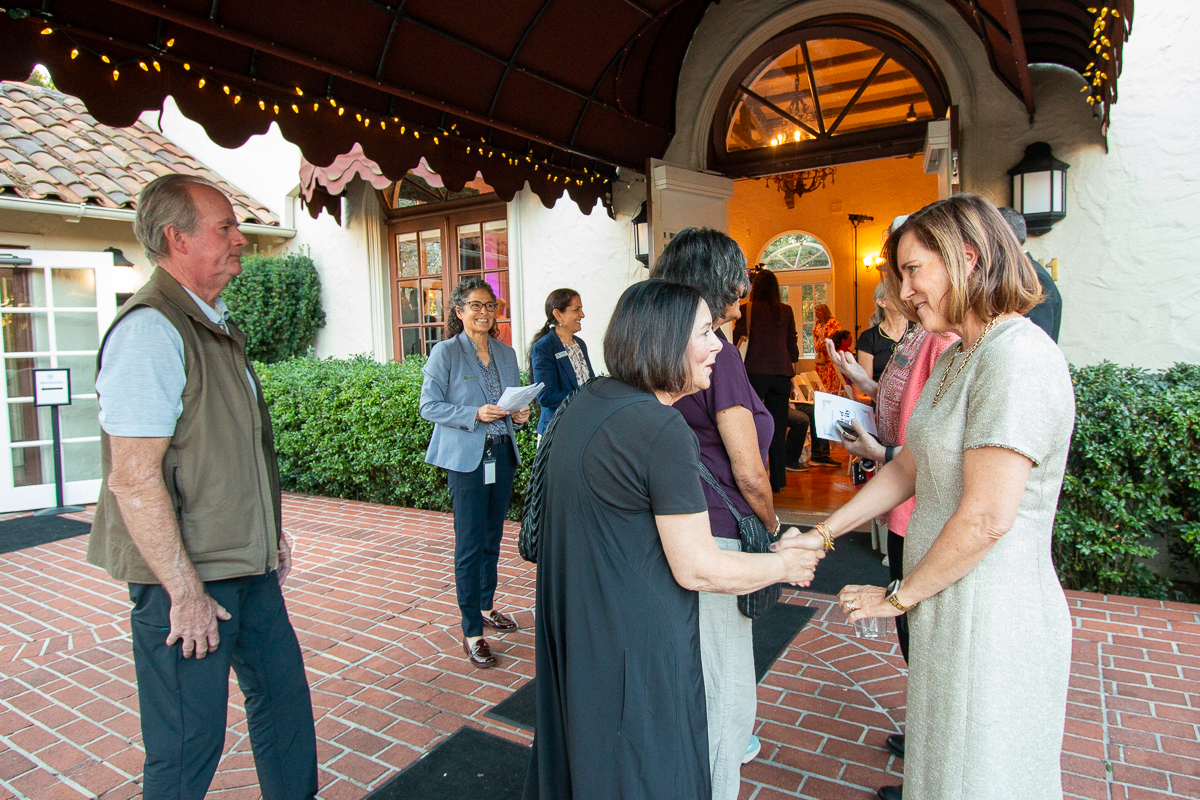
The mayor and other city officials greet residents as they arrive at Piedmont City Hall on Oct. 13, 2026 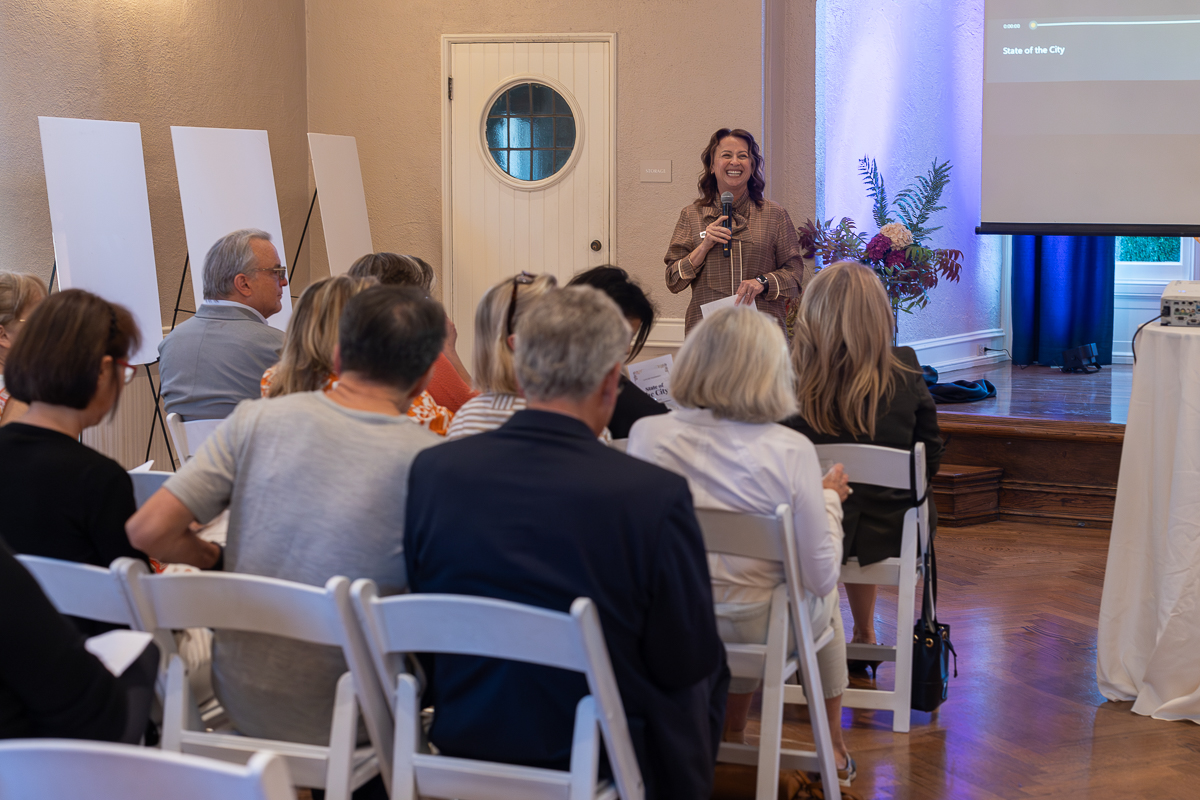
City Administrator Rosanna Bayon Moore introduces the mayor for the State of the City event on Oct. 13, 2026 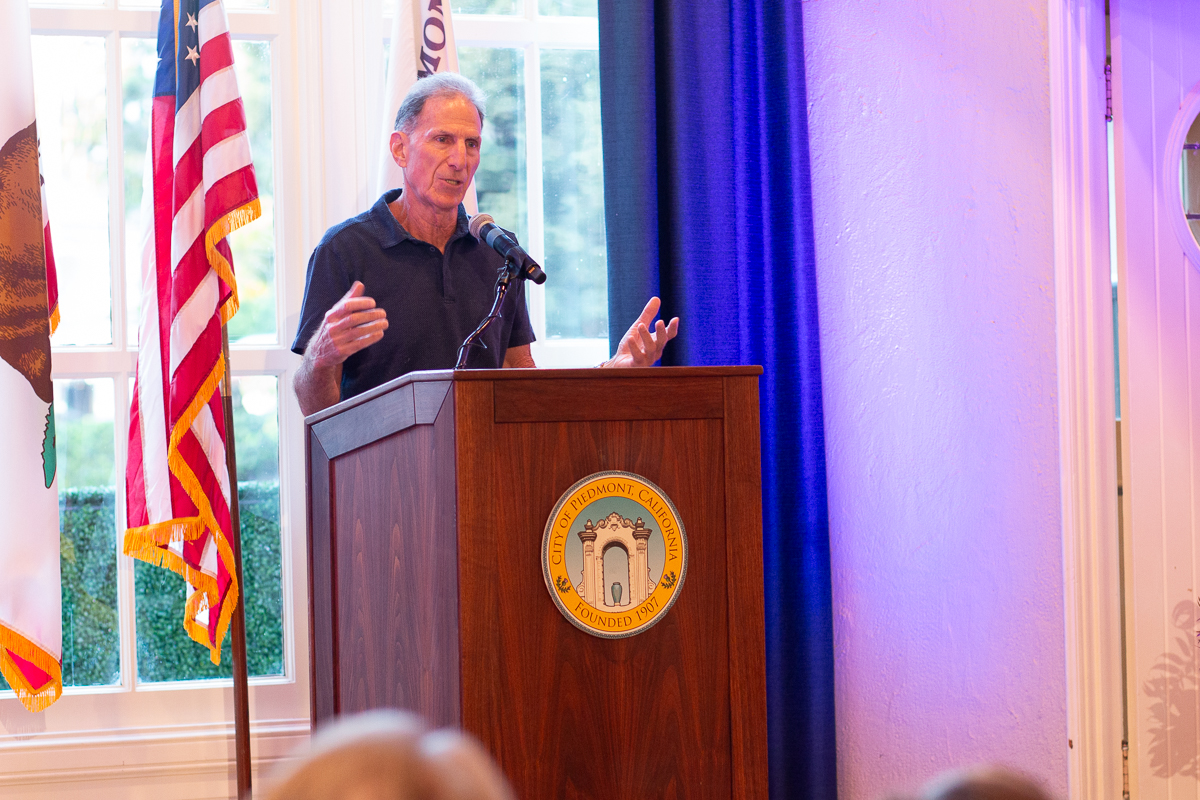
Resident Eric Havian shares remarks about Mayor Betsy Smegal Andersen’s tenure at the State of the City event at Piedmont City Hall on Oct. 13, 2026 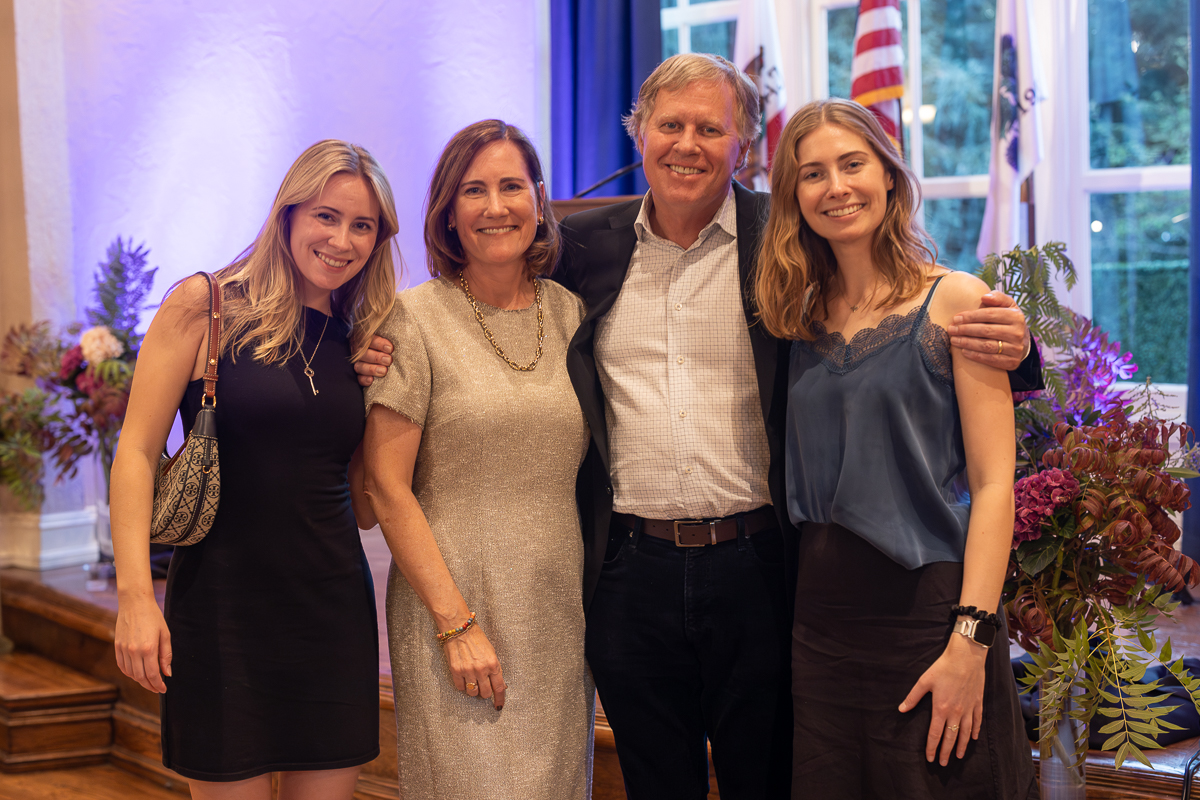
The Andersen family following the State of the City address on Oct. 13, 2026