This story was originally published by EdSource. Sign up for their daily newsletter.
As California schools struggle to hire enough credentialed arts educators — despite receiving $1 billion annually for arts education — some new elementary school teachers are learning ways to weave arts instruction into traditional academic subjects.
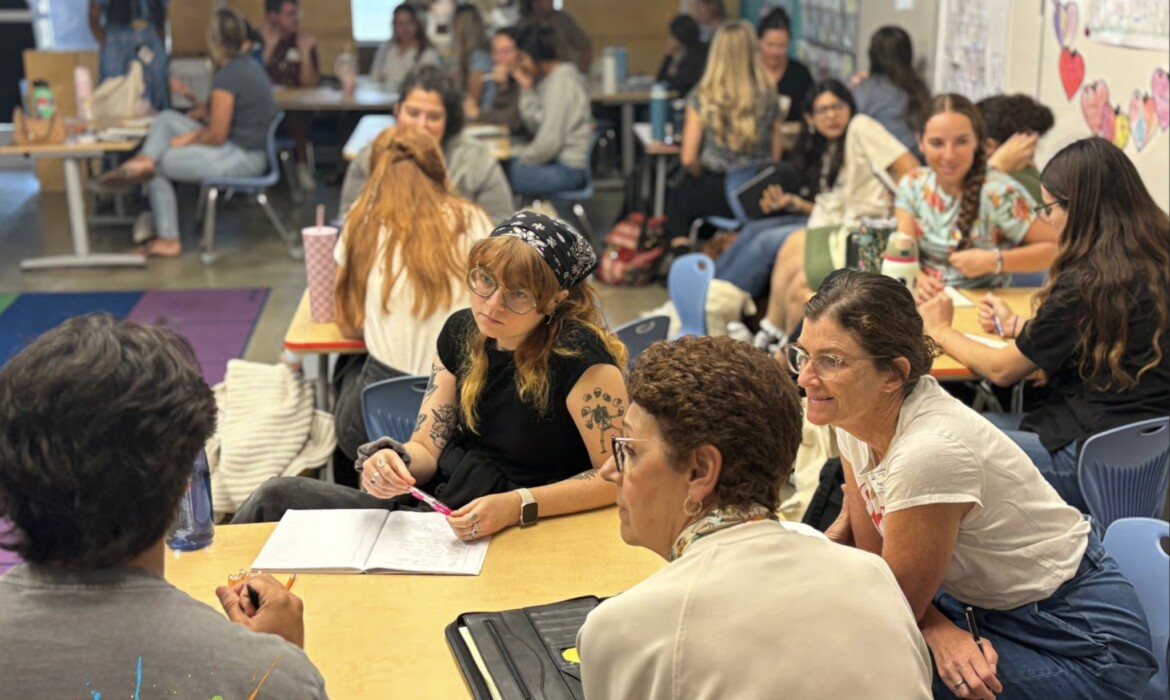
At Cal State San Marcos in San Diego County, prospective elementary school teachers learn to integrate the arts into core academic teaching through the Collaborative Residency for Education in the Arts and Teaching Excellence, known as CREATE.
The program differs from single-subject credentialing programs, in which student teachers go on to become music, art, theater or dance teachers. Instead, CREATE residents learn to teach in elementary classrooms using arts-based instruction for core subjects like math, science, English and history.
Christiane Wood, coordinator for the CREATE residency, helped launch the program after voters in 2022 passed Proposition 28, which sets aside roughly $1 billion per year to fund the expansion of arts education in California schools.
“The residency grew out of our recognition that Prop. 28 would create both an exciting opportunity and a significant need for educators prepared to meaningfully integrate the arts into California schools,” said Wood.
Residents teach alongside a mentor teacher in a K-9 multiple-subject classroom for a year, receive a $25,000 stipend and take courses with teachers across a range of arts disciplines. The residency partners with local school districts such as San Marcos Unified, Vista Unified, Fallbrook Union Elementary and High Tech High.
Rachael Cooke, a CREATE resident earning her teaching degree at CSU San Marcos, said the program has taught her creative ways to teach reading and math. At Vista Unified’s Academy of Visual and Performing Arts, Cooke helped her third grade mentor teacher plan lessons that have students draw out phonics and science experiments and incorporate dance movements to remember vocabulary.
“It’s incorporated into every little thing,” Cooke said, “and students aren’t even conscious that it’s arts integration.”
Research suggests that arts-based instruction can improve learning in core subjects, strengthen retention and engagement and support cognitive and social-emotional development for students.
Wood said the residency, which is part of the university’s multiple subject teaching credential program, teaches educators to unpack why certain arts-based approaches work for students and how they can adapt them into their own classrooms.
“We want residents to develop the confidence and knowledge to see the arts not as an ‘extra,’ but as a meaningful way for children to think, communicate, create and demonstrate their learning,” Wood said.
Since launching in 2024, the residency has enrolled three cohorts for a total of 62 student teachers. The program is funded through at least 2028 by a $3.2 million grant from the California Commission on Teacher Credentialing.
Nicole Lucarelli, a teacher resident at Monte Vista Elementary in Vista Unified, said arts integration has been “eye-opening” for helping some of her fifth grade students who struggle in math. After she tasked them with drawing out a math problem, many found new and creative ways to arrive at the same answer, she said.
The approach “instills in us as future educators that being a ‘math person’ is not necessarily a real thing,” Lucarelli said. “The arts make you critically think more, and students are more engaged with their lessons.”
Some teachers may not incorporate art into lessons due to cost, said Lucarelli. She said her mentor teacher has had to purchase crayons, watercolor paints and some basic materials at her own expense, and Lucarelli has had to scale back lessons because of budget constraints.
“Teachers who’ve been teaching for a long time don’t necessarily feel that arts integration can be as easy as it is,” Lucarelli said. “If you don’t have the art supplies, then it can be challenging to want to incorporate it.”
Merryl Goldberg, executive director of CSU San Marcos’ Center Artes, which houses the residency, said some school districts have dedicated Prop. 28 funds to workshops, professional development and special assignment teachers focused on arts integration.
“There is no shortage of opportunities to learn from each other without districts having to reinvent the wheel,” Goldberg said.
Lucarelli hopes to become an elementary school teacher at a high-needs campus. She said the residency has taught her how to introduce the arts to students who may lack access to traditional arts programs.
“Seeing the ways that the kids express themselves gives me a deeper understanding of their foundations of knowledge, and how I can connect what they’re learning back to real life,” Lucarelli said.

This story was originally published by EdSource.