Oakland lost the A’s, Raiders and Warriors. Now it’s betting on its grassroots entertainment culture to fill the void.
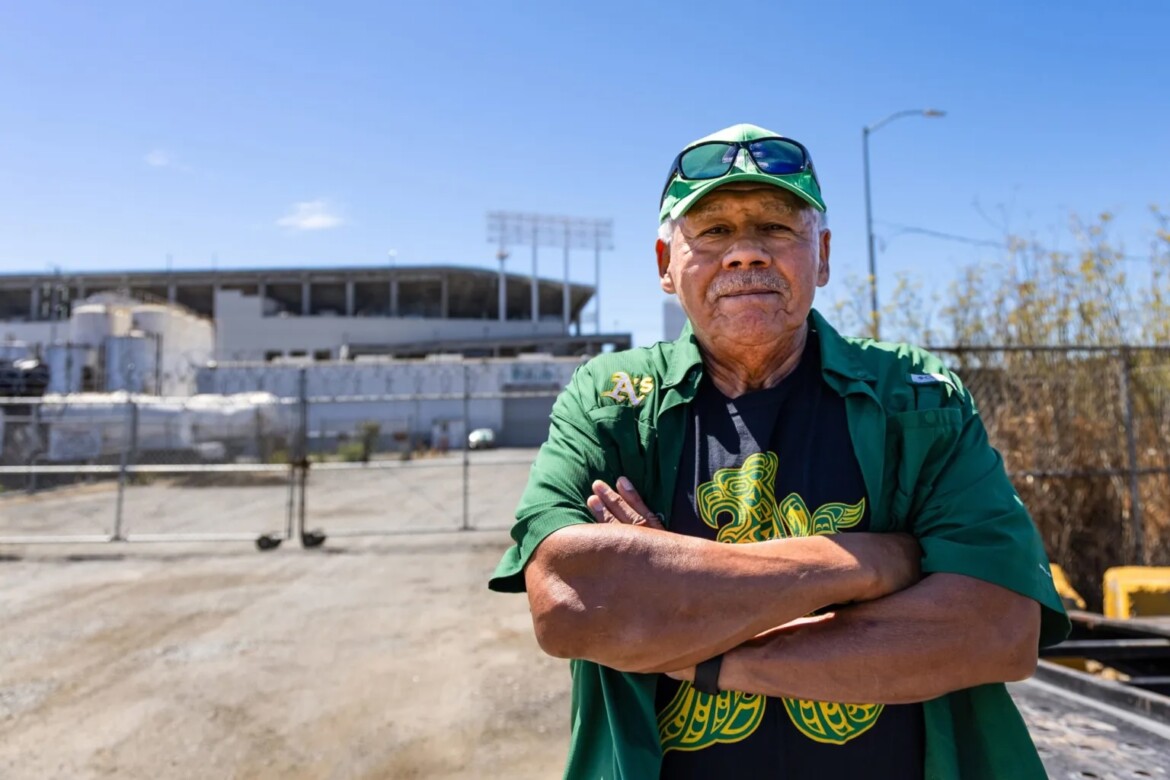
Anyone who attended Oakland Athletics baseball games in the team’s final decade at the Oakland Coliseum remembers the heart of the stadium: The Bleacher Diehards of Section 149 in right field, known for their rumbling drums, cheerful flags and crazed fervor.
Tony Perez, 72, grew up in those bleachers and can recall days as a 12-year-old when he and his brother would sit in right field watching the A’s take batting practice.
For Perez, who used to attend north of 40 A’s games per season, the A’s departure was a loss like no other.
“It basically crushed me,” said Perez. “You can’t replace this.”

Nearly two years removed from an era when the A’s, Raiders and Warriors all called Oakland home, the city has become an intriguing case study for sports economists.
The departure of major league sports from the city has left thousands of Oakland sports fans like Perez with a major gap in their lives, forcing them to reconsider how they spend discretionary time and money on sports and entertainment.
For most cities that lose their sports teams, sports economists predict little economic harm, because entertainment spending tends to remain relatively constant, with spending on professional sports representing a redistribution of people’s spending rather than the generation of new economic activity. When sports go away, people find other ways to spend time and money.
And most sports economists would have supported Oakland’s stance in its stadium negotiations with the Raiders and A’s, which fell through in large part because the city was unwilling to make the financial concessions demanded by the teams.
During a 2017 Initiative on Global Markets Economic Experts Panel, conducted by the University of Chicago’s Booth School of Business, 20 of 26 economists agreed with the statement: “Providing state and local subsidies to build stadiums for professional sports teams is likely to cost the relevant taxpayers more than any local economic benefits that are generated.”
Oakland’s former sports fans have plenty of other places around the Bay Area to spend their time — and money.
In the specific case of Oakland, however, sports economists also caution that by losing major sports, the city is now competing against other Bay Area cities to keep its former sports fans.
It’s early in the city’s post-big-time-sports era, and there aren’t a lot of hard numbers. But many of those fans report they are spending more of their discretionary time and money in neighboring cities, especially San Francisco and San Jose, which have a greater share of the region’s big-name sports teams and also more opportunities to spend on concerts and dining.
“It probably comes down to spending more time in San Francisco and in other parts of the Bay,” said Kanan Clifford, a 19-year-old North Oakland resident, about what he’s doing to substitute his attendance at A’s and Raiders games in Oakland. “Those cities have a lot more, not just baseball, but other things going on.”
Meanwhile, though, Oakland is fighting to keep its diehards in “The Town,” steering the city toward a grassroots future, characterized by the local culture and civic pride that Oakland decisionmakers feel have always been the city’s most attractive attributes.
“We don’t have those big sports teams, but on the other hand, I feel like we’ve opened up so much more capacity to support the unique individuals and cultures that are in Oakland,” said Lyz Luke, Oakland’s cultural affairs manager.
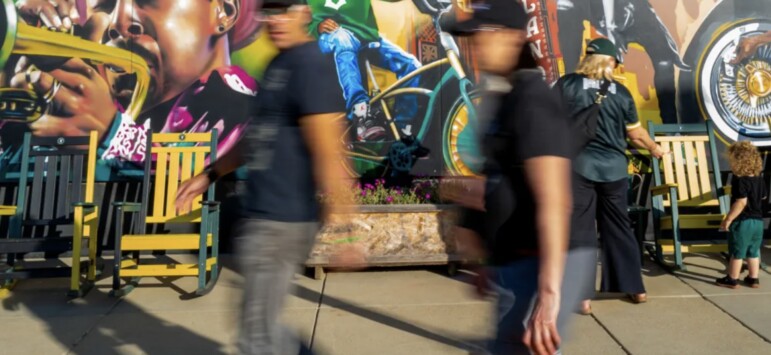
Julian Caballero/Bay City News
Attendees walk past a mural by Oakland-based artists Deandre Drake and Steven Anderson at Raimondi Park in Oakland on Saturday, Aug. 29, 2026. The mural, completed in the summer of 2024, honors Oakland’s rich history and culture. (Julian Caballero/Bay City News)
What the economists predict
For years, economists have theorized about how much professional sports contribute to the economic vitality of cities and regions.
Many of the field’s leading scholars have found that when people spend money on professional sports franchises, they often spend less on other local goods and services.
“Our results suggest that professional sports has a small positive effect on earnings per employee in the Amusements and Recreation sector, but that this positive effect is offset by a decrease in both earnings and employment in other sectors of the economy,” wrote sports economists Dennis Coates and Brad Humphreys in their study “The Effect of Professional Sports on Earnings and Employment in the Services and Retail Sectors in U.S. Cities.”
Coates and Humphreys published a series of studies from 1999 through the early 2000s — using econometric analysis of metropolitan-level panel data, natural experiments and industry data — that found negligible economic effects from professional sports and have since served as keystone studies in the field.

As an extension of those findings, most sports economists believe Oakland’s unwillingness to accept major financial burdens in stadium negotiations with the Raiders and A’s made sense, given that reports estimating the economic impact of major stadium projects often overstate their value.
In 2016, while Oakland and Alameda County ultimately put $350 million in public funds behind a proposed $1.3 billion Raiders stadium, Nevada offered the Raiders a far more aggressive $750 million public financing package, backed by a hotel-tax increase, pushing Raiders owner Mark Davis to move the team to Las Vegas.
Similarly, the A’s made their move to Las Vegas (via Sacramento) with the promise of a new stadium backed by $380 million in public financing from Nevada lawmakers. Oakland city officials said it had agreed to pursue more than $425 million in public funding for off-site infrastructure at the Howard Terminal site — which needed major development to become a valid stadium location — but maintained that the ballpark itself needed to be privately financed by the A’s.
The city was especially reluctant to put its general fund or existing tax revenues behind the stadium project because it could leave the city responsible for the project’s debt if stadium-generated revenues fell short of projections, according to the city.
“In general, the answer is it’s not worth spending that money,” said Coates, who now teaches sports economics at the University of Maryland, Baltimore County, about cities spending money on new stadium projects. “If the goal is to create jobs or generate income or tax revenue, that doesn’t happen, not in any meaningful way.”
But while sports economists advise cities to be skeptical of major stadium subsidies, Oakland’s picture is clouded by its place in the Greater Bay Area. It is the nation’s only major metropolitan region anchored by three large cities — San Francisco, San Jose and Oakland — and economists note that people can easily substitute their Oakland sports fandom with entertainment spending in these competing Bay Area cities.
“Fans of the A’s or the Raiders have alternatives that are easily accessible with fairly short drives,” said Coates, speaking on the unique dynamics of Oakland’s greater metropolitan region. “That wouldn’t be true in most places.”
As a result, while Coates’ studies deem it unlikely that major sports teams leaving Oakland would have a major impact on the Bay Area as a whole, he finds it entirely “possible” that it could benefit other Bay Area cities’ economies at the expense of Oakland’s.

Jason O’Rear/Chase Center via Bay City News
An undated photo of the Mission Bay and South Beach neighborhoods of San Francisco and traffic on the San Francisco-Oakland Bay Bridge. Oakland residents can cross the Bay Bridge to watch the Golden State Warriors at Chase Center, foreground, or the San Francisco Giants at Oracle Park, background, or numerous other entertainment events hosted by the two venues. (Jason O’Rear/Chase Center via Bay City News)
The impact in Oakland
And indeed, early in Oakland’s newly big-league-sport-less era, many Oakland residents report that they are now spending less of their time in the city and more time at home or in other Bay Area cities.
San Francisco’s entertainment economy is booming, with two major sports teams in the Giants and Warriors and a music scene fueled by major events at Chase Center, Golden Gate Park, Bill Graham Civic Auditorium and many historic music clubs.
But it’s not just “The City” that has major entertainment attractions — San Jose has the Sharks and Santana Row, while Santa Clara has the 49ers and California’s Great America.
“I wish they would bring more entertainment to this side,” said Cameron Appelbaum, a 20-year-old resident of Oakland’s Rockridge neighborhood.

A significant development has been San Francisco’s prominent role in hosting recent national and international sporting events — NBA All-Star 2025, the 2026 Super Bowl and FIFA World Cup 26.
According to the Bay Area Host Committee, the regional planning organization that helped coordinate them, these events were projected to create $1.4 billion in economic impact across the Bay Area. However, the activity was centralized in Santa Clara and San Francisco counties, with Levi’s Stadium in Santa Clara serving as the host venue for the Super Bowl and World Cup, and Oakland largely out of the picture.
BAHC projected $370 million to $630 million in economic impact for the Super Bowl, with $250 million to $440 million headed toward San Francisco County and $100 million to $160 million headed toward Santa Clara County.
Similarly, the planning organization outlined $480 million to $630 million in economic impact for the World Cup, with $140 million to $180 million taking place in San Francisco County and $270 million to $360 million located in Santa Clara County.
And now the 2028 Major League Baseball All-Star Game is expected to be played at Oracle Park in San Francisco.
Even Oakland sports fans who refuse to embrace longtime Bay Area rivals such as the Giants and 49ers are finding other options. Ben Malloy, 44, can’t bring himself to root for either team, but he has attended San Jose Barracuda minor league hockey games and University of California, Berkeley, baseball games.
And indeed Cal Athletics is promoting itself as the major sports attraction in the East Bay, now that professional sports are gone from Oakland.
“As much as it hurt my heart for the Raiders and the A’s and everyone to leave, this is the show here,” Cal football head coach Tosh Lupoi said in a recent news conference. “On this side of the bridge, especially, there’s no professional organizations and this place is fully capable of being one of the elite, premier college environments.”
And it’s not just sports. San Francisco and other Bay Area cities offer a variety of marquee entertainment options that have no direct equivalent in Oakland, and there are strong signs these benefit from a “spillover” of former Oakland sports fans now looking elsewhere for leisure.

In August 2025, Golden Gate Park hosted three concert weekends — Outside Lands, Dead & Company and Zach Bryan — attracting 437,000 attendees and creating $193.1 million in economic activity for San Francisco, according to data from the Bay Area Council Economic Institute.
Meanwhile, many Oakland residents feel that the city just doesn’t have enough “going on” to compete.
“You go downtown in Oakland … a lot of the time, it feels like a ghost town, which is unfortunate,” said Clifford of North Oakland.
Former A’s and Raiders season ticket holder Amy Medeiros reported that with sports out of Oakland, she has increasingly taken her son to see movies at Dublin’s Regal Hacienda Crossings, which is known for being one of two theaters in the Bay Area — alongside San Francisco’s AMC Metreon 16 — with a full-size 70mm IMAX screen.
There are others like San Leandro resident Emmett Cadigan, who used to attend as many as 20 A’s games per year. Fans like Cadigan came from other Bay Area cities to cheer on the A’s and now find themselves with fewer reasons to go to Oakland.
Without the A’s, some former fans aren’t finding new places to spend their time. They’re simply staying home.
“The time is just absorbed,” said Cadigan. “Tuesday, we’re gonna play game night (at home), and we would’ve went to a baseball game.”
Although it’s difficult to prove a direct causal relationship, without major league sporting events, Oakland has also struggled more than many other Bay Area cities to recover its pre-pandemic tourism levels.
Visit Oakland, the city’s official tourism organization, reported the city attracted 3.2 million visitors in 2025, 81.4% of its 2019 pre-pandemic total, while visitor spending of $553.6 million wa 75.5% of its 2019 level.
In May, San Francisco Travel projected that 24.2 million visitors — 92% of its 2019 total — will spend $9.9 billion in the city in 2026, which is expected to surpass the city’s pre-pandemic visitor-spending record.
San Jose and Santa Clara also report substantial tourism recovery, with visitor spending in some recent years exceeding pre-pandemic figures.

Julian Caballero/Bay City News
Players from both teams brace as the ball flies in from a corner kick during an Oakland Roots home game at the Oakland Coliseum on Saturday, Sept. 12, 2026. The Oakland Roots earned 11 corner kicks, applying pressure on Lexington’s tough defense. (Julian Caballero/Bay City News)
Betting on the grassroots
On the surface, early economic indicators suggest a bleak picture for entertainment spending in Oakland, but city leaders hope that an absence of major sports teams will instead work to strengthen the city’s cultural vitality.
Oakland’s city planners, in fact, argue that big-brand sports teams were never Oakland’s true cultural identity and that the city’s most attractive attribute has always been its commitment to local, grassroots arts and culture.
“You keep hearing me say grassroots over and over again,” said Luke. “That’s just what Oakland is: we’re rooted.”
Over the last few years, Oakland has reshaped its approach to arts and culture, making culture an explicit part of its broader economic-development strategy. The city’s 2025-2029 Economic Development Action Plan lists “support” for “artistic, cultural and social activities” as one of its five primary goals for the period.
In December 2025, Oakland’s City Council established four pilot entertainment zones, which allow patrons 21 and older to take alcoholic drinks purchased from licensed restaurants and bars to an outdoor area during specific neighborhood events. The pilot zones were the city’s Jack London, Northlake, Temescal and Uptown districts.

“We’re just trying to see can we get people out in the community and activate the streets a bit more and create more connectedness between the individual businesses and through districts,” said Luke.
In recent years, the city has also expanded its cultural districts program — geographic areas designated to recognize and celebrate minority heritage and culture — as a way to integrate local culture institutionally into city planning.
The city established two new cultural districts in 2023 — the Latinx Cultural Arts District in Fruitvale and the Lakeshore LGBTQ Cultural District — which joined the Black Arts Movement and Business District that was established in downtown and West Oakland in 2016.
According to Luke, the districts are all part of a plan to expand the city’s arts and music scene beyond districts where they’ve historically been concentrated — like the Fox Theatre-anchored Uptown — throughout the city, fostering citywide community and culture.
“Oakland is the culture to support your own, to support your local artisan, to go to that small little music venue,” said Luke. “You take pride in finding those backyard shows, those underground spaces and we take pride in making it easier for those spaces to become legit and city-sanctioned.”
Oakland has also secured dedicated funding for Black filmmaking, with City Council allocating $750,000 this summer to support indie filmmakers, while the city continues to dedicate 1.5% of eligible municipal capital-improvement costs to public art projects.
Meanwhile, the city does have professional sports teams — notably the Oakland Ballers, a baseball team competing in the Pioneer League, and the Oakland Roots and Soul, competing respectively in the men’s and women’s United Soccer Leagues.

Undoubtedly, these are small teams whose economic impact is tiny compared to the major sports franchises that left. The Ballers, for example, reported they drew more than 100,000 fans during their 48-game 2025 season, a total the A’s and Raiders frequently surpassed in just a few games during their heyday.
According to their financial filings with the U.S. Securities and Exchange Commission, the grassroots teams remain unprofitable, with net losses totaling millions of dollars, and have relied on outside capital to help finance their operations.
But the picture is improving, with the Ballers’ 2025 annual SEC filing showing the team’s revenue jumped more than 60% in 2025, to $5.15 million from $3.19 million a year earlier, and the Roots currently seeking to build a new soccer venue with at least 15,000 seats, potentially at the Port of Oakland’s Howard Terminal site.
And throughout this growth, the teams have been grounded in the city’s commitment to fostering a grassroots entertainment identity.
“We really try to touch all the cultures,” said Casey Pratt, the Ballers’ vice president of communications and fan entertainment, after calling Oakland the “cultural epicenter” of the Bay Area. “Our mission with the team is to bring diverse communities together for shared joy.”

All Ballers and Roots games have themes — from Día de Los Ballers to the Roots’ Hella Juneteenth Match — that pay homage to the city’s diverse local cultures. With these themes and intimate home stadium venues, the result is a kind of local sports energy that longtime Oakland sports fans like Perez say has the same “Oakland intensity” that used to have a home in the Coliseum’s bleachers.
“I would say people are kind of missing out on that local vibe,” said Christy Johnson-Limón, deputy director of Oakland’s Economic and Workforce Development Department, referring to people seeking sports entertainment in other Bay Area cities.
“They can go to a Niners game over in Santa Clara, and they can go to Chase Arena — it’s going to be a different experience here in Oakland.”
Oakland’s city planners are especially unshaken by unfavorable comparisons between Oakland and San Francisco, noting that the cities are not “easily comparable” due to major differences like population size and budget.
San Francisco is geographically smaller than Oakland but has roughly twice its population, according to U.S. Census data. It adopted a total budget of about $16.23 billion for the 2025-26 fiscal year, nearly 7.5 times Oakland’s $2.16 billion budget.
Both Johnson-Limón and Luke formerly lived and worked in San Francisco, but said they moved to Oakland because of a sense of “authenticity” that they felt wasn’t honored by San Francisco’s tech boom. Now, they’re fighting to keep Oakland rooted in the local culture that they feel differentiates the city from its counterpart across the Bay Bridge.
“I think we’re just two different things,” Luke said of comparisons between the two cities.
“Do you want your shiny object, or do you want the thing that’s the authentic real deal? Like that’s the difference between San Francisco and Oakland, and we invest in the real deal.”
The post Take me out of the ballgame: Oakland bets on grassroots culture to fill its pro sports void appeared first on Local News Matters.