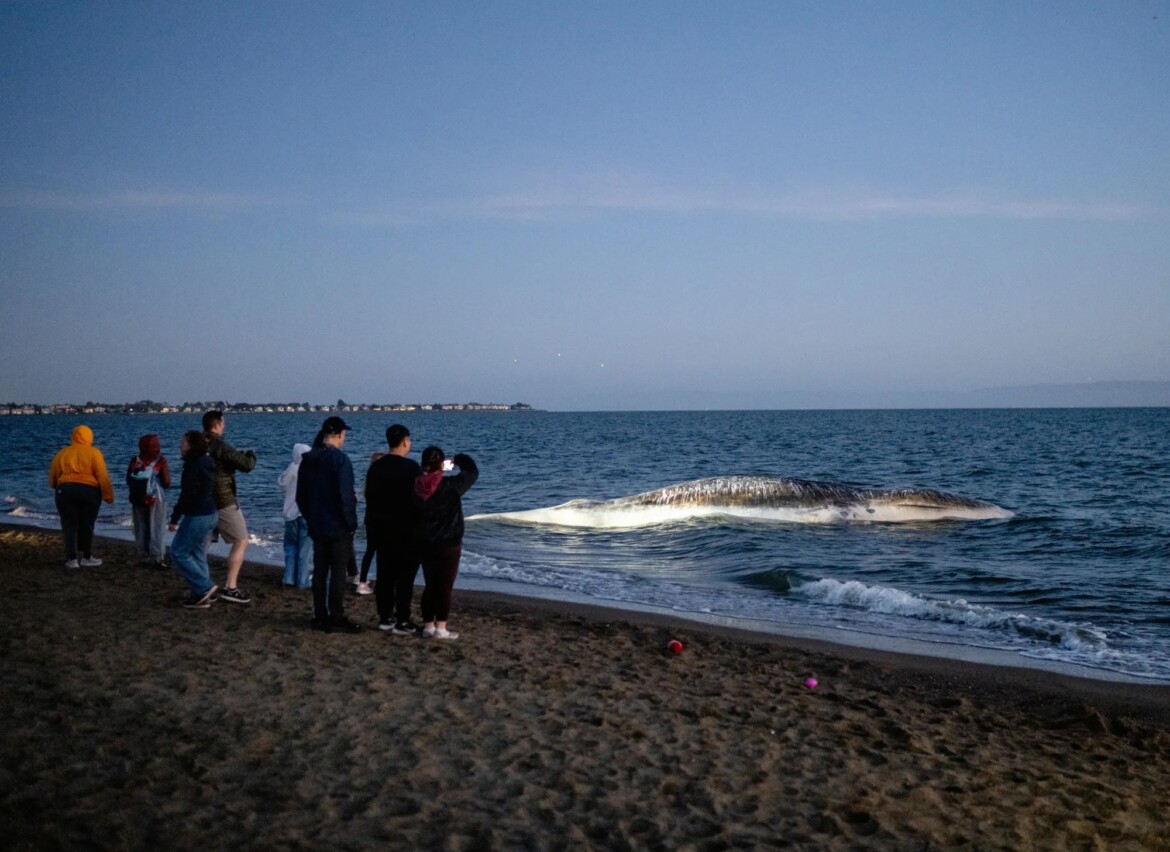
A petition to list the eastern North Pacific gray whale on the federal endangered species list went unanswered last year. On Tuesday, three environmental groups threatened to sue the federal agency that administers the Endangered Species Act for failing to meet a required deadline.
If the whales are listed as endangered, protecting the species would legally require the government to consider protecting the ecosystem the whales depend on — the sea beneath the melting Arctic ice.
Groups challenge federal inaction
The nonprofits Center for Biological Diversity, Oasis Earth and the International Marine Mammal Project of the Earth Island Institute allege that the National Marine Fisheries Service has failed to issue required findings on a petition to list the gray whale population as threatened or endangered. In a letter to the service, they said the agency was required to decide by last Monday whether listing the gray whales under the Endangered Species Act is warranted.
The Endangered Species Act is a 1973 federal law designed to protect and recover plant and animal species that face the threat of extinction. The goal of the act is to conserve listed species and the ecosystems they depend on, according to the website of the National Oceanic and Atmospheric Administration, which includes the fisheries service.
Michael Milstein, a NOAA spokesperson, said in an email that it is the agency’s policy not to comment on litigation.
A statement from the environmental groups cites a 2026 study published in the journal Frontiers in Marine Science that found eastern North Pacific gray whales have experienced a dramatic decline in body condition and increased mortality following prolonged heat events in the North Pacific that decreased the nutritional value of their prey in the Arctic.

“In 2025, the population estimate and calf count stand have reached some of the lowest levels on record, declining over 50% since the population’s peak in 2016,” the report said.
In response to climate change, gray whales have been exploiting new habitats, including San Francisco Bay, resulting in increased overlap with human activities. The study found that a minimum of 114 new gray whales have used the Bay as habitat since 2018.
When they enter the Bay looking for new food sources, the whales risk being injured or killed by vessel strikes or entanglement in fishing gear. Blunt and/or sharp force trauma consistent with a vessel strike was determined to be the cause of death for 30 of 70 carcasses examined between 2018 and 2025.
This population of gray whales was protected under the Endangered Species Act until it was declared recovered and delisted in 1994.
‘Extraordinary’ changes in the Arctic
The August 2025 petition to the federal agency was filed by Rick Steiner, who worked as a professor of fisheries at the University of Alaska and was stationed in the Arctic. He now leads the nonprofit Oasis Earth, which focuses on policy solutions to the environmental crisis.
The petition argues that changes in sea ice, ocean currents and organic matter reaching the seafloor, known as the benthic zone, are reducing the abundance and nutritional quality of the small crustaceans living on the seafloor that whales depend on for food.
“Today, given the extraordinary climate-change/sea-ice loss induced alteration of their benthic feeding habitat in the northern Bering Sea/Arctic Ocean, and the certainty that this will continue and worsen over the remainder of this century, it is clear that this important whale population urgently needs the full protection offered by the Endangered Species Act,” Steiner’s petition said.
Steiner acknowledges that some gray whales can switch from seafloor prey to fish and zooplankton — tiny drifting animals — but he argues in the petition that the current climate-driven changes are occurring too rapidly for the whales to adapt.
In the petition, Steiner cites NOAA’s 2025 estimate of about 13,000 eastern North Pacific gray whales that traveled along the West Coast of the U.S., the lowest population estimate since the 1970s. That study documented declining reproduction and malnutrition and estimated that ecosystem changes in the Arctic are the root cause of the decline.
According to NOAA, the 2026 count of about 17,750 gray whales raises questions about the population estimates and whether the recent decline is continuing.
Mark Palmer, associate director of the International Marine Mammal Project, said in an email that the 2026 whale count is an anomaly attributed to the methodology used to estimate population size from sightings.

“Most whales die at sea and sink and are not recorded,” Palmer said. “The general trend is still a decline, given 187 whales to date in 2026 have stranded, representing perhaps one tenth of all deaths.”
Palmer also noted that President Donald Trump’s administration has cut many of NOAA’s climate researchers and scientists who work on marine mammals. The administration has also weakened the Endangered Species Act through a series of regulatory measures, which are also being challenged by environmentalists in court, he said.
At least 187 gray whales have stranded and died along the West Coast so far in 2026, according to NOAA, many due to vessel strikes and entanglements. Between 2019 and 2023, an unusually high number of whale deaths were associated with starvation, according to NOAA research.
The organizations are giving the fisheries service 60 days to issue the required findings. If it does not, they intend to file a lawsuit in federal district court against the National Marine Fisheries Service and the department that oversees NOAA, the U.S. Department of Commerce, along with the U.S. secretary of Commerce, seeking an order requiring the agency to publish the findings.
The post Protecting gray whales could mean protecting the Arctic appeared first on Local News Matters.