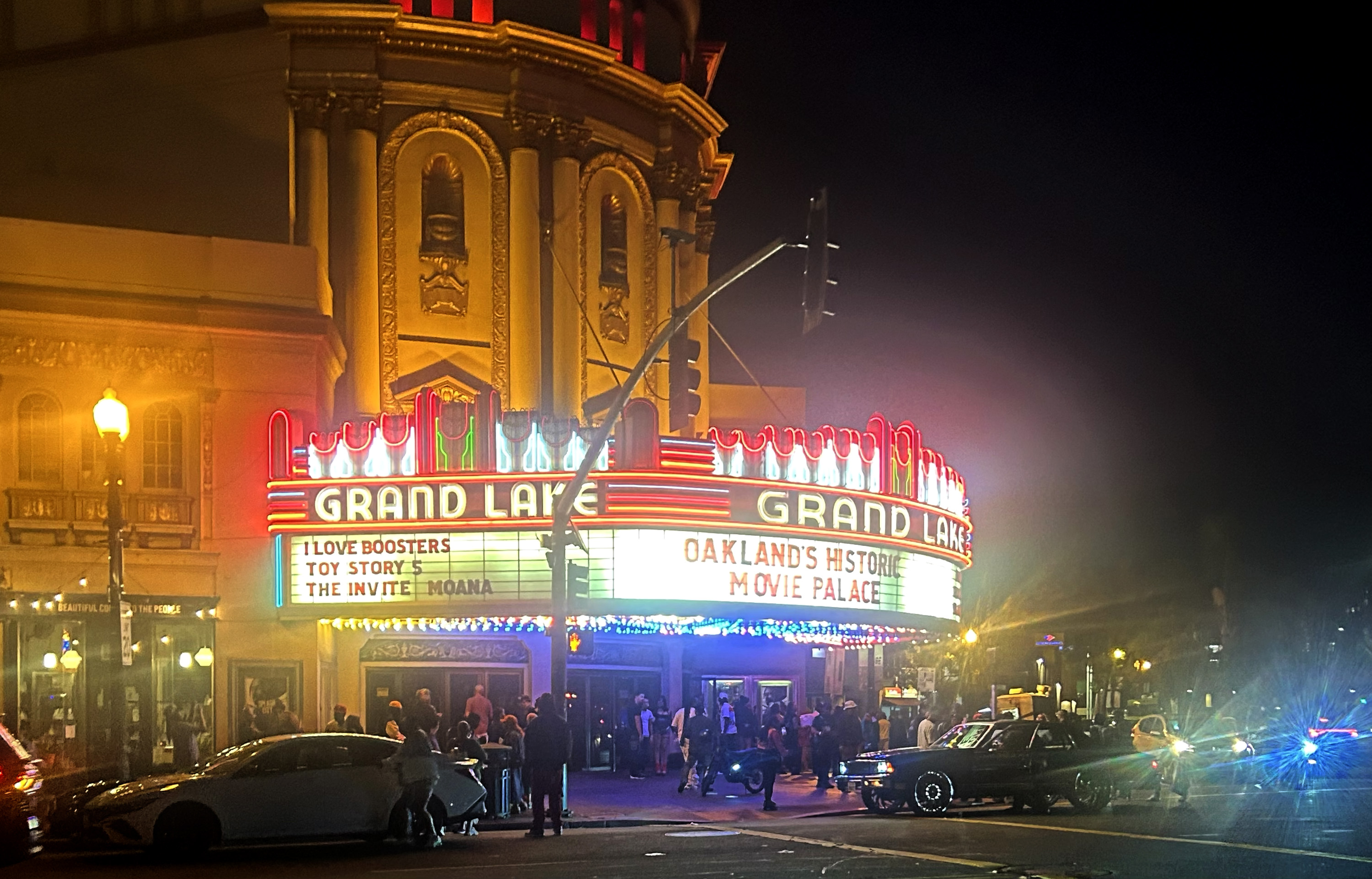
OAKLAND — Over the last decade, Oakland’s famous filmmakers Boots Riley and Ryan Coogler have seen massive critical and commercial success. Moviegoers routinely pack theaters for new Black Panther and Creed installments, and Riley’s mind-bending “Sorry to Bother You” and “I Love Boosters” are already staples in the genre known as Black Surrealism.
But what’s less well known are the smaller indie filmmakers, film advocacy groups, and film rebate programs that attract far less public attention but are helping position Oakland as a center for Black filmmaking — now and in the future.
Organizations such as Cinemama and Rep’d Film Collective host frequent events in Oakland where local filmmaking creativity takes shape. There’s been a resurgence in special events and premieres, including a film showcase at City Hall produced last month by the group Bay Area Film Night. And now there’s a $750,000 film incentive program approved by the city to encourage more moviemaking in Oakland.
All these factors build upon one another and are helping make Oakland an incubator for Black film talent — actors, producers, screenwriters, and directors.
A rich filmmaking history
Oakland filmmaker Patrick Manning finds a parallel between the current film fervor and an earlier period of great creativity in the city.
“We think about the history of West Oakland being the Harlem of the West, right? It was like a big jazz boom here, so we think about the jazz of it all, Oakland incubates that, it’s always done so,” Manning said.

To be sure, Black filmmaking is not a new phenomenon in Oakland; it goes back decades, long before Riley and Coogler came on the scene. In 1974, the Oakland Museum Association’s Cultural and Ethnic Affairs Guild started the Black Filmmakers Hall of Fame, which honors people who have contributed to further advancing Black cinema.
Notable inductees include Gordon Parks, Melvin Van Peebles, James Earl Jones, and Cicely Tyson.
In the 1980s and ’90s, Black filmmakers like Cheryl Dunye and Marlon Riggs made Oakland their stomping grounds. Dunye is best known for her film “The Watermelon Woman,” and Riggs for his film “Tongues Untied,” both seminal works in the LGBTQ cinematic universe.
Outside the mainstream but nonetheless prominent, the Black Panther Party produced newsreels and political films in the 1960s and 1970s.
And later in the century, Oakland was an important location for Black blockbuster filmmaking as well. The blaxploitation classic “The Mack” was filmed in Oakland, and “Poetic Justice” was partially filmed here in 1992.
Fast forward to the 2000s, and the Wayans family, a New York-based filmmaking powerhouse, attempted to set up a film studio in Oakland. The planned location for the studio was a decommissioned Army base in West Oakland. The deal fell through, however, due to the Wayans family’s missed deadlines and disagreements with the city over the project’s development. Plans were scuttled in 2008.
More recently, like so many other enterprises, Oakland’s filmmaking community was hard hit by the COVID pandemic, and film production in the city was largely put on pause in the early 2020s.
But now, Black filmmaking is resurgent, and the city’s incentive program for low- and medium-budget filmmaking is expected to add new energy.
Making an investment
In June, the Oakland Film and Television Incentive Program secured funding through a City Council vote that approved it for the fiscal year 2026-27 mid-cycle budget. The council allocated $750,000 to boost indie filmmaking in the area by giving filmmakers a financial incentive to make movies in the city. The program includes partial rebates for some filmmaking costs, including labor costs when moviemakers hire residents living in high unemployment Oakland ZIP codes.
In a telephone interview, District 4 Councilmember Janani Ramachandran said $500,000 will go to filmmaker rebates, and the other $250,000 will go toward overseeing the city’s film support program.
In the realm of major motion pictures, this sum would be a modest amount of money, but for small-budget indie producers, it can make a dramatic difference. And accompanying this financial kick is a general bubbling up of Oakland film activity.
In July alone, there were filmmaker writing meet-ups, film premieres, and special screenings at the Grand Lake Theatre, while Boots Riley led film Q&As at the New Parkway Theater.

Events such as these are common in larger film markets like Los Angeles or New York, but they now happen in Oakland and other parts of the Bay Area with growing frequency.
Niema Jordan is a founding member of Cinemama, which describes itself as an Oakland-based hub for Bay Area filmmaking. For her, Oakland’s history as a city of activists and storytellers expands into moviemaking.
“There’s always this sort of throughline of resistance and independence and doing things on your own, and I think all of those things come together for really great filmmaking,” Jordan said.
Manning noted how the landscape of filmmaking has changed and opened the door for smaller markets.
“So moving forward as LA and all the typical strongholds of film are loosening, you don’t have to be in LA to get it off, you don’t gotta be in New York, you can kind of really be anywhere,” Manning said.
Dexx Broughton is a filmmaker from the South Bay who was brought to Oakland recently for a Rep’d Film Collective event that screened his most recent short film, “Sorry I Missed Your Call.”

For Broughton, Oakland’s film activity is part of a broader filmmaking movement that is taking place in many parts of the Bay Area.
“There’s a new renaissance coming to town. We are here and we’re screaming loud to let people know our time is now.”
Competing on a smaller stage
In the tradition of Oakland activism, Oakland’s filmmaking community is also involved in protesting industry consolidation that can come at the expense of small producers.
In July, roughly a dozen Bay Area documentarians gathered outside the U.S. District Courthouse in downtown Oakland to protest a proposed merger between Paramount Skydance and Warner Bros. Discovery.
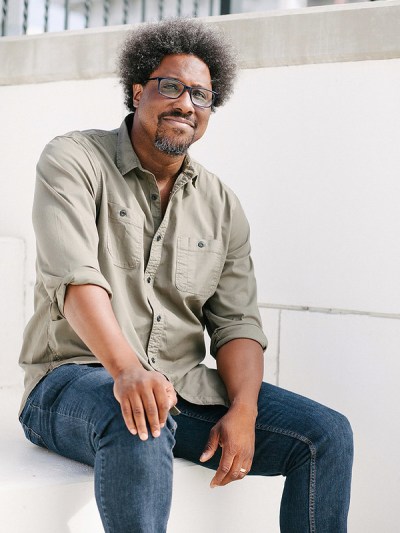
W. Kamau Bell, Emmy Award-winning filmmaker and longtime Oakland resident, came to the protest to show his strong concern about media consolidation.
“More accessibility means more choices, more projects, more people working. And if you have media consolidation, that’s less choices, less projects, and less people working in a place that’s already less accessible for filmmaking,” Bell said.
Media mergers like the one proposed between Paramount and Warner Bros. make it harder for smaller markets like Oakland to compete. This in turn pressures local film talent to move to traditional film centers like Los Angeles and New York.
According to Boots Riley, aspiring filmmakers are lured to such cities by the presence of major studios and industry elites.
“There’s always been a lot of amazing talent in the Bay Area but there hasn’t been the infrastructure to keep folks here,” Riley said in an interview outside of the Grand Lake Theatre.
“You could live across the street from Warner Bros. and that’s not getting you closer to getting a film made but there’s kind of this sense that there is.”
But Riley and others, through their films and community activities, are working to nurture that same sense in Oakland.
Within the creative space, the existence of role models goes a long way. For up-and-coming filmmakers, Riley and Coogler are stellar examples of filmmakers from Oakland who “made it” in the industry.
And they’re also inspiring as creatives who are not afraid to share uncomfortable stories. Coogler’s film “Fruitvale Station,” about the killing of 22-year-old Oscar Grant at the Fruitvale BART station is an example.

Tajianna Okechukwu is from San Leandro. She is an actor, screenwriter, and director, and she works as the program manager for Cinemama. Tajianna went to school at Azusa Pacific University, near Los Angeles. She returned to the Bay to help uplift the filmmaking community.
“I was very young witnessing the tragedy of Oscar Grant’s passing and holding his story in my heart. So once Fruitvale dropped, it really pierced my heart because this is something that’s real, that is from my community, that I can empathize with in a real way,” Okechukwu said.
For Okechukwu and many others, nurturing Oakland’s film industry is not just critical to ensuring that local Black filmmaking thrives in the future. It also helps ensure that, through film, Oakland’s story gets told.
“How do you leave home with your imprint which will then leave it in a better place than before you left,” she said, “so that the next person who’s in your same line of work can honor their purpose?”
The post Betting on Black: Oakland looks to establish itself as incubator of Black filmmaking talent appeared first on Local News Matters.