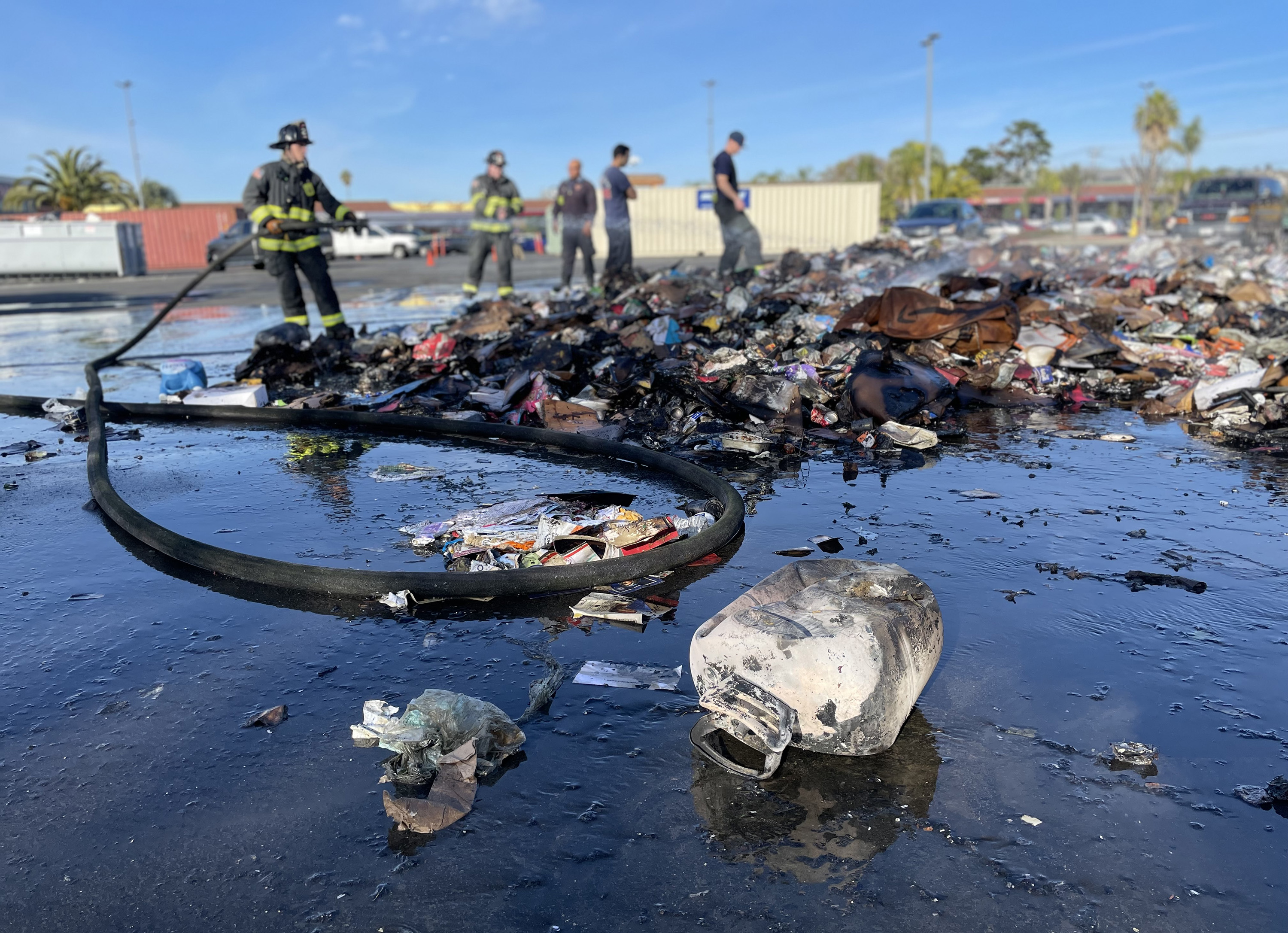
Joe La Mariana will never forget the night: Sept. 7, 2016. It was 8 p.m., and La Mariana was working out on his exercycle. Then he got the phone call.
“It was a four-alarm fire,” said La Mariana, the executive director of RethinkWaste, a recycling and disposal agency that serves the San Francisco Peninsula. “Our materials recovery facility [MRF] — the place where mixed materials from recycling bins are sorted and prepared for sale — was burning. I went down there immediately. It took a hundred firefighters to get it under control, and I didn’t get home until 4 a.m.”
There were multiple negative ramifications from the blaze, said La Mariana.
“Our MRF was out of commission for four months, the recyclable materials we typically process had to be sent to other sorting facilities, and we had to lay off 80 employees,” said La Mariana. “Before the fire, our insurance policy cost about $180,000 a year. That jumped to $3.1 million in two years because of the perceived risk.”
And what’s driving that growing risk of dangerous, polluting trash fires? Ironically, a technology popularly associated with “green” economics: lithium-ion batteries, the devices that power EVs and store energy for large solar arrays.
The advantages of lithium-ion batteries are many: they are light, recharge quickly, and store large amounts of power. But they have one profound downside: if they are ruptured or damaged, they can burst into flames. Worse, the fires aren’t easily extinguished — they are essentially runaway chemical reactions.
“You can’t put them out through any of the usual ways,” said La Mariana. “They burn white hot. You have to isolate the actual battery from the waste material and let it burn out.”
Water only does so much
To mitigate the threat, the agency has installed automatically activated water cannons in their MRFs.
“But they just drench the recyclable materials so they can’t burn,” said La Mariana. They don’t actually extinguish the battery fire itself.”
Concerns remain high for RethinkWaste since that massive 2016 conflagration; La Mariana said the agency still responds monthly to fires in its MRF. Some are caused by pressurized gas containers — used propane and butane canisters or oxygen tanks that people toss in their blue bins, thinking it’s okay “because they’re metal.”
But that lapse in thinking can have catastrophic consequences when the canisters are crushed by a loader or other piece of heavy equipment or crunched up in machinery that compresses and bales recyclable materials.
Lithium batteries are “in a vast number of consumer products now — cellphones, cars, scooters, tools, toys, even vapes. And as municipalities have stepped up their recycling efforts, these batteries are increasingly ending up in the waste stream.”
Maurice Quillen, Recology San Francisco
Still, lithium-ion batteries remain the major fire threat — and it’s one that’s growing, said Maurice Quillen, the vice president and general manager at Recology San Francisco, a sister agency of RethinkWaste that has lost recycling trucks to battery fires.
“The batteries have been around for a long time, but their use has expanded dramatically in recent years,” said Quillen. “They’re in a vast number of consumer products now — cellphones, cars, scooters, tools, toys, even vapes. And as municipalities have stepped up their recycling efforts, these batteries are increasingly ending up in the waste stream.”
That risk isn’t just localized, La Mariana emphasized. Recycling centers bale cardboard, plastics and other materials for overseas sales. Lithium-ion batteries unintentionally packed with recyclables can ignite, threatening the container ships transporting them.
Ship fires associated with lithium-battery packs “already have occurred, and the threat and concern are growing as more and more of these batteries are produced,” La Mariana said.
More education needed
It might seem obvious that it’s a bad idea to throw a lithium-ion battery in the garbage or recycling bins, said Quillen, but not all consumers are aware of the hazards. And even those that are may be unsure of what to do with the batteries and products containing them.
“Often they may not even know the type of battery their device has, or how they can extract it for disposal,” said Quillen. “Smartphones, for example — in most cases, it’s now impossible for the average consumer to remove their batteries. So in exasperation, people just toss the phones in their blue bins. There’s a lot of education that needs to be done.”
La Mariana agrees with Quillen that recycling agencies need to ramp up consumer awareness.

“We’ve even seen Tesla battery packs thrown in the recycling bins, so we’ve increased our outreach program to meet the challenge,” he said. “If you have batteries — any batteries — to dispose of, put them in Ziploc bags and place them on top of the black garbage bin when you set out your containers for collection. The driver will stop and pick them up. Some recycling centers also have special disposal areas for batteries and e-waste.”
But regulation also is needed, said Quillen — and on that front, there’s been some progress.
Assembly Bill 762, a bill that would phase out single-use disposable vapes and e-cigarettes that incorporate lithium-ion batteries, is currently pending in the state Senate Appropriations Committee. And Senate Bill 501 is before the Assembly Appropriations Committee; it would require greater “producer responsibility” — e.g., manufacturer buyback — for the lithium-ion batteries commonly used in e-bikes, lawn tools and similar mid-sized products. Both bills are expected to pass into law.
“We definitely need some stewardship rules on these products,” said Quillen, “and these bills are a good start.”
The post ‘They burn white hot’: Lithium-ion batteries a growing risk for Bay Area recycling centers appeared first on Local News Matters.