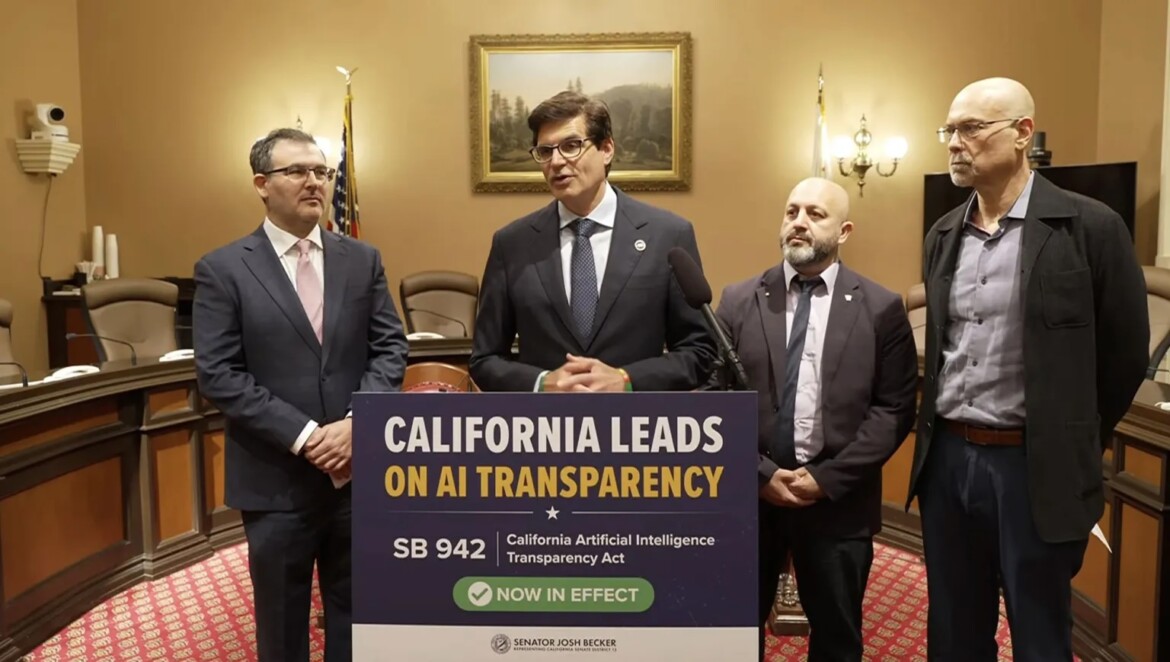
A landmark state law requiring notification about content created by generative artificial intelligence went into effect over the weekend, creating a new regulatory framework in California that will soon also apply to social media content and recording devices.
The state’s Sunday implementation date was timed to coincide with regulators in the European Union, in what the legislation’s co-author, State Sen. Josh Becker, D-Menlo Park, said was unprecedented coordination between the two governments.
The California AI Transparency Act requires companies that use generative artificial intelligence — which is sometimes referred to as GenAI or gen AI — to provide digital evidence that discloses that fact to a consumer in the metadata like a digital signature or fingerprint.
Or, as Becker called it during a news conference from the state Capitol in Sacramento on Monday, a “nutrition list” of what ingredients went into making the content.
Becker elaborated on the new law and a new bill that could modify the portion of the law that restricts its application to products that have over 1 million users. The new bill, Senate Bill 1000, would make the regulation apply to any generative AI product, regardless of the size of its userbase.
“This is the beginning of a foundational change on how content is represented on the internet.”
State Sen. Josh Becker
The bill would also clarify that the onus is on content creation tools to include the digital information to be in compliance.
Becker said the law will help content consumers trust what they were seeing online, saying it was aimed at stopping deepfakes, scams, and creating uncertainty around elections.
“This is the beginning of a foundational change on how content is represented on the internet,” Becker said.
He said the legislation’s long runway giving companies time to comply was to ensure the requirements were “technically feasible — that the companies can implement it and will be expected to implement it and comply.”
Coordinating with Europe
The law was first passed in 2024 and its implementation date was delayed in 2025 to August to both coordinate its activation with the European Union and gave artificial intelligence companies more time to implement technology that would make the companies own products that generate images, text, audio, or other content compliant with the law.
Neither Meta nor Google responded to requests for comment Monday on whether they were complying as of the legislation’s deadline.
The law also gives companies hosting social media users’ content until Jan. 1 to ensure that their sites are compliant, including user-generated content.
The key provision that kicked in this week requires companies that offer generative AI to offer users a free tool that can disclose whether content was created with those tools by displaying information about how it was created, while keeping information from the creator private.
Website owners must first verify that content appearing on the site carries common metadata about its creation, such as what tool or software was involved.
The law states websites offering such content must offer a tool that clearly lets users verify the content’s “authenticity, origin, or history of modification, including, but not limited to, all of the following: whether provenance data is available, the name of the GenAI system or capture device that created or substantially altered the content, if applicable, and whether any digital signatures are available.”
Violators could face fines of up to $5,000 for each violation, and charges could be brought by local district attorneys or the Attorney General’s Office.
Creating stability for evolving AI sector
David Evan Harris, a policy expert with the California Initiative for Technology and Democracy, known as CITED, said that the transparency provided by the regulation would help the evolving artificial intelligence sector gain stability and even empower new tech companies to provide such verification tools.
He also said the state was filling a vacuum left by the federal government.
“While Washington is abdicating responsibility for this, California and the EU are stepping forward,” he said.
Eddan Katz, head of policy and government affairs with the technology start-up Encypher, said at the press conference that the regulations were written to make sure that technology that creates content makes a record of what it is doing.
Encypher and a growing number of companies can then use tools to verify the record is there, rather than trying to detect artificial intelligence in the content.
“We’ve actually changed the paradigm in which to think about battling this problem,” Katz said.
Becker also said California was leading the way on AI regulation, with Washington state passing a similar law and New York currently considering one.
The state’s requirements on devices that capture images and can manipulate them with generative artificial intelligence kick in starting in 2028.
The post California begins enforcing new transparency rules for AI-generated online content appeared first on Local News Matters.