This article has been republished with permission from SplashPad News.
Wendy Silvani attended the May 16 and May 23 Listening Sessions sponsored by Caltrans to solicit feedback on whether to lift the truck ban on I-580, which has been in effect since the highway was built in the 1960s. Here’s her review of the presentations and the community feedback.
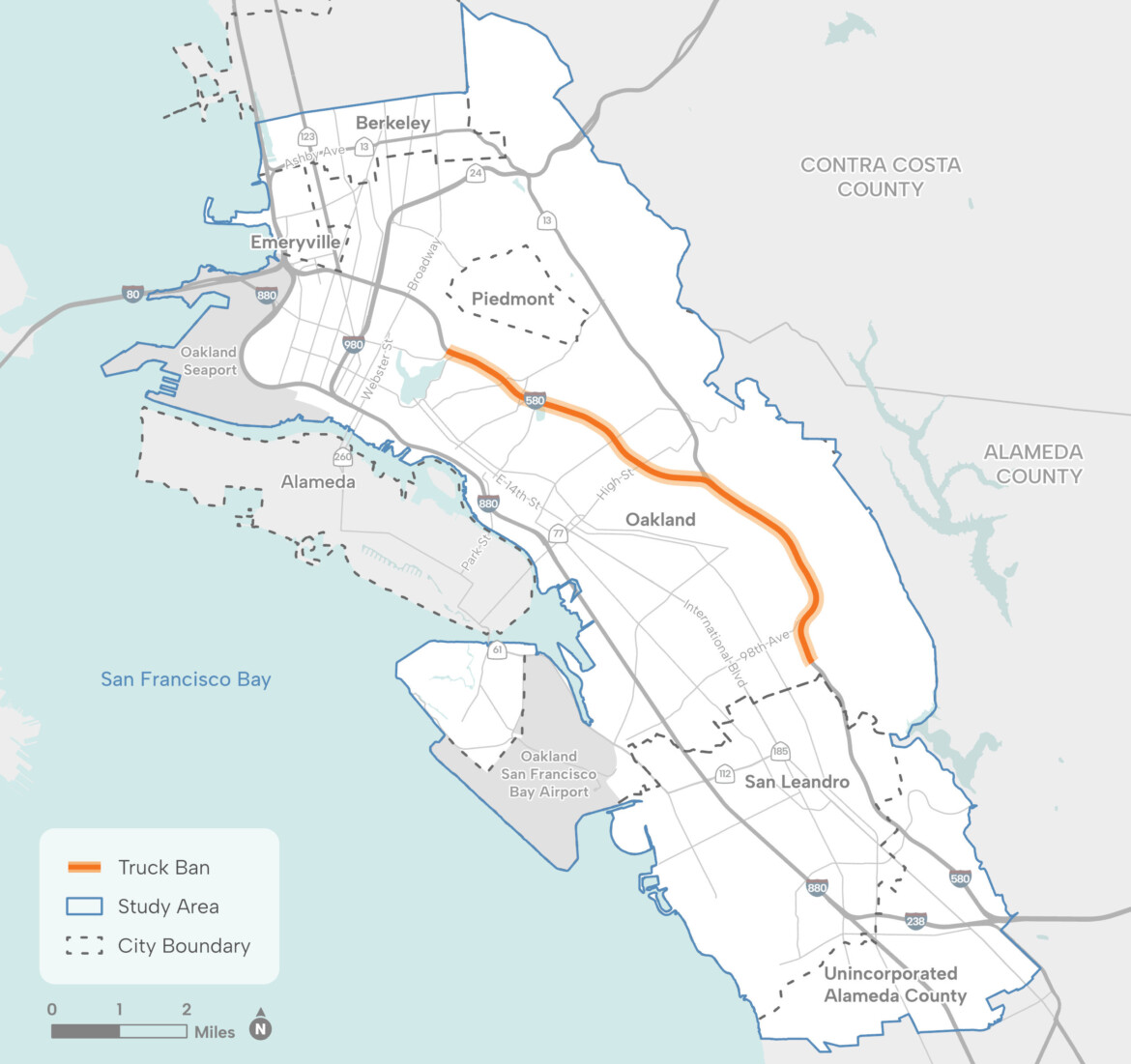
Vehicles over 4.5 tons have been barred from the 8.7-mile stretch of I-580 between Grand Avenue and San Leandro since the freeway opened in the 1960s. The restriction followed a 1951 Oakland truck ban on MacArthur Boulevard and was reaffirmed in 1968, 1972, and 1990. In 2000, Oakland, San Leandro, Berkeley, Emeryville, and Alameda asked the state to codify the ban in the California Vehicle Code, making it permanent.
Caltrans is now conducting a $600,000 study of what could happen if the ban were lifted. It looks at travel patterns, traffic, safety, air quality, and noise along the I-580 and I-880 corridors and nearby highways and arterials, both with and without the restriction. Results of the technical analyses will be released within weeks.
The scope of the Study includes State Routes 13 and 24; I-238, I-980, I-580, and I-880; and the arterial streets of West Grand, Hegenberger, and Hesperian Blvd.
Caltrans said the study responds to concerns raised in West and East Oakland, including the 2021 West Oakland Environmental Indicators Project, the East Oakland Mobility Plan, and a question from East Oakland students about why trucks use I-880 but not I-580.
Caltrans explained that the scope of the Truck Study includes four components:
- Traffic analysis
- Air Quality and Noise Impact assessments
- Racial Equity assessment
- Community Engagement
The traffic analysis will evaluate conditions through 2035, both with and without the truck ban, and predict how many trucks may be diverted to I-580 and how traffic volumes on nearby roadways might change.
The air quality assessment will estimate the impact of pollutant concentrations, exposure to pollutants, and health risks with and without the ban. This assessment focuses on vehicular emissions, diesel particulate matter, and cancer risk from diesel particulate matter exposure.
The noise assessment will project changes in noise levels from truck and passenger vehicles, with and without the ban.
The racial equity component will compare the racial and demographic characteristics of neighborhoods that experience burdens associated with heavy truck traffic with those that do not, and assess how that burden may shift if the ban is removed.
The community engagement component of the Study is now ramping up in anticipation of the release of these analyses in a few weeks. Caltrans has held four “Listening Sessions:” : two Zoom meetings in late April, an in-person session at St. Jarlath’s Church on May 16, and a second on May 23.
Caltrans will post fact sheets and short videos on its website covering all study components. It also plans to hold office hours at the Oakland Main, Dimond, and West Oakland libraries this summer and to attend several Farmers Markets, including San Leandro, Fruitvale, Prescott, and South Berkeley. As of May 23, no dates or times have been set.
The May Community Meetings
Close to 150 residents who live between Grand Lake and San Leandro, both above and below I-580, attended the May 16 session at St. Jarlath’s in the Fruitvale district. Over 170 attended the May 23 session. Residents raised a number of concerns, most of which fell into one of these four categories:
- The insufficient scope of the Study
- No representation from the I-580 and I-238 communities or from the unincorporated parts of the Study Area is on the Technical Advisory Committee, which is guiding and advising the process and is now more than halfway through the project
- Exclusion of safety concerns both on the highway and the arterials, such as how emergency evacuation during fires would be impacted
- Inadequate outreach to communities along I-580, SR-24, SR-13, and I-238, and limited access to study materials and meeting information
Study Scope

Residents expressed concern that the Study’s scope is flawed and urged Caltrans to halt or reset it. Caltrans could not provide information on whether impacts on all arterials connecting I-880 and I-580, such as Fruitvale-Lincoln, Park Blvd, 35th, High, and others, are being evaluated, or on how any truck restrictions could be enforced given the shortage of police officers. Speakers noted that many of these arterials are on Oakland’s High Injury Network roadways and said the study does not account for added maintenance costs, street improvements, accidents, or other impacts of heavier truck use.
Residents said the study appears to focus on “spreading the harm” rather than improving conditions in East and West Oakland. Attendees called the process too narrow, too rushed, and poorly explained to the public. Meeting attendees called the Study ‘suspect’ and said it was set up for a predetermined outcome, with a very narrow focus, an abbreviated timeline, and woeful public engagement.
They also accused Caltrans of reneging on promises integral to the approval process for building I-580. One speaker quoted then-Governor Gray Davis in 2000, who said when signing the law to make the ban permanent, “…a ban on trucks on a 10-mile section of I-580 has been in continuous effect since 1963. A study by Caltrans found no reason to lift the ban. To do so would be a breach of faith with the residents of Oakland.”
Others pointed to the lack of consideration for I-580’s susceptibility to fires, landslides, and other natural disasters because of its alignment; structural deficiencies because it was not designed for heavy truck traffic; and the failure to account for the costs of increased road damage or the economics of health care, morbidity, and safety.
Several speakers characterized the effort as a ‘giveaway’ of additional truck lanes to the trucking industry, providing economic benefits to the Port and truckers without regard to harm inflicted on impacted communities.
The Technical Advisory Committee (TAC)
This body, which includes representatives from the cities of Oakland, Berkeley, Emeryville, Piedmont, Alameda, and San Leandro, also has a major ‘industry partner’ – two members of the California Trucking Association are at the table, along with two I-880-based community organizations. The Port and Alameda County are also on the TAC, as are the CHP, Transit, and the County Health Department.
Caltrans assured the audience that the TAC has no decision-making authority, though it can recommend in favor of or against the ban in its final report. Rather, its purpose is to guide the approach and advise on the Study’s scope and methodology. It has met three times so far, with a fourth meeting scheduled for June 1.
Residents said the TAC has excluded communities along I-580, Highways 13 and 238, unincorporated areas, and the Tri-Valley while giving trucking industry representatives a seat at the table. They questioned why an industry group like the Trucking Association, which initiated previous attempts to lift the ban in 1972, 1990, and 2000, is on the Committee when neighborhood groups are not. Caltrans said members were chosen for technical expertise and community relationships, and that it is open to adding I-580 corridor representation, though it was noncommittal when asked to delay the June 1 meeting until that happens. Lakeshore Homeowners Association is one such organization under consideration; other community advocates from other neighborhoods have also submitted potential participants.
Safety


Residents raised broad safety questions, including whether I-580 and Highway 13 can handle large tractor-trailers, whether bridges and pavement are strong enough, and what retrofits might be needed. They also cited concerns about added noise, vibration, visibility, maneuverability, emergency response, and evacuation delays.
Speakers noted that many schools, senior centers, hospitals, and homes lie close to I-580 and said the study must account for impacts on vulnerable residents and on nearby arterial streets. Others also raised concerns about property values and the number of serious big-rig crashes in Alameda County.
Insufficient Outreach
Nearly all speakers in both sessions criticized Caltrans for its woeful lack of outreach. They stressed that a project of this magnitude for so many people — a majority of Oakland’s population alone, plus thousands more from San Leandro, Berkeley, unincorporated areas, and the Tri-Valley — should have a much more robust public engagement and outreach campaign. Both those who rely on I-580 and SR-13 for travel and those who live or work nearby should have had an opportunity to learn about this.
As one speaker put it, “Facilitation 101 is to meet people where they are. Many do not use e-mail or apps to find out about meetings; they don’t use Zoom; and there has been no translation into Spanish and other languages. Neighborhoods where impacts would be most significant should have had an opportunity to provide feedback on the Study’s goals, metrics, and methodology – the TAC’s stated purpose. They also should have been informed about these Listening Sessions.”
Complaints spanned a lack of notification for both TAC and outreach meetings, a lack of available information (approaches and priorities determined months ago), and an inadequate plan to reach the I-580 and 238 communities over the summer.
For more information
The official Caltrans website provides information about the Study, TAC members, upcoming public engagement opportunities, and a way to sign up to receive project updates and leave a comment.
NoBigRigs580 is a community-based organization opposed to lifting the truck ban. This website includes a history of the truck ban, an explanation of why the community coalition opposes it, a petition to sign to register opposition, ways to let your elected officials know how you feel about it, and a number of technical papers on the I-580 community, demographics, pollution levels, and other resources. The website also offers a volunteer sign-up to help get the word out this summer at community events and to join its mailing list.

A proud Oakland native, Wendy Silvani attended Oakland public schools and earned a journalism degree from UC Berkeley. She has called the Grand Lake neighborhood home for nearly 50 years. After early work in advertising and public relations, she has spent the past 30 years helping Bay Area communities stay connected by designing and managing shuttle and transportation services.
Slides and images are from both Caltrans and NoBigRigs580