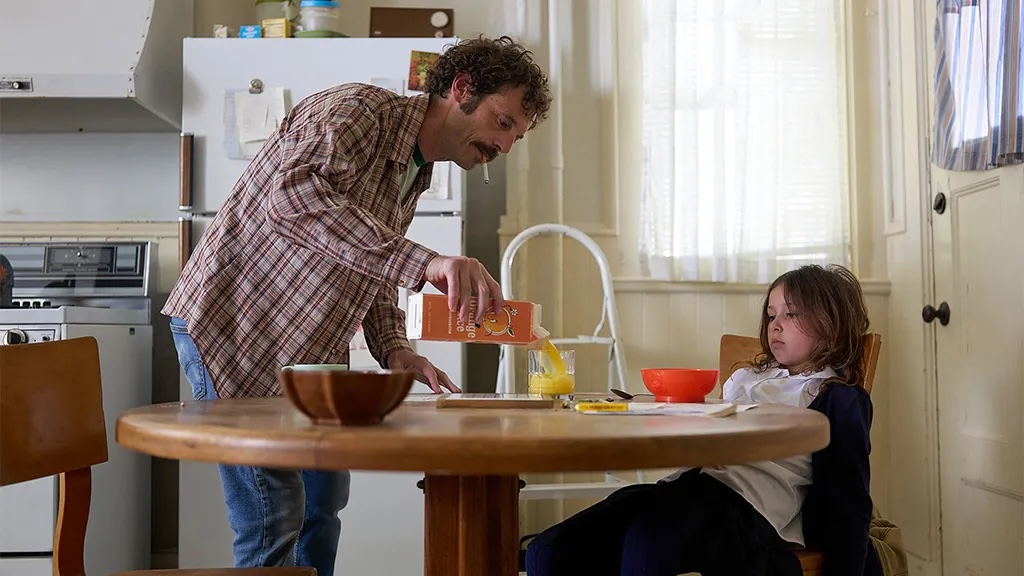
The Castro Theatre presents a Harvey Milk Day screening of “Fairyland,” filmmaker Andrew Durham’s underseen 2023 coming-of-age indie set in 1970s-80s San Francisco, at 8 p.m. Friday. Based on Alysia Abbott’s memoir, the movie embraces unconventional families and a historic San Francisco as it follows a father-daughter relationship from the times of free love and gay liberation to the dark years of the AIDS crisis. Emilia Jones, Scoot McNairy, Geena Davis and Nessa Dougherty star. Visit thecastro.com for more information.

San Francisco filmmaker and former journalist Kerwin Berk looks at the U.S. incarceration of 120,000 Japanese Americans during World War II in “Kintsukuroi,” a narrative film that begins streaming on asianamericanmovies.com on Tuesday. The drama follows two Northern California families who are forced out of their homes and relocated to prison camps while their sons fight for the United States on European battlefields.
A Memorial Day weekend tradition at the Balboa Theater in San Francisco, the Hitchcock Fest presents its 2026 edition Friday through Monday. The lineup consists of 13 Alfred Hitchcock-directed films and the San Francisco premiere of the 2025 documentary “Kim Novak’s Vertigo.” Visit balboamovies.com.
Here’s the schedule:
Friday, May 22: “The Lady Vanishes” (1938) at 4:30 p.m.; “North by Northwest” (1959) at 7:30 p.m.
Saturday, May 23: “The Wrong Man” (1956) at noon; “The Man Who Knew Too Much” (1956) at 2:30 p.m.; “Rope” (1948) at 5 p.m.; “Rear Window” (1954) at 7:30 p.m.
Sunday, May 24: “The 39 Steps” (1935) at noon; “Suspicion” (1941) at 2 p.m.; “Strangers on a Train” (1951) at 4:30 p.m.; “Psycho” (1960) at 7:30 p.m.
Monday, May 25: “Stage Fright” (1950) at 12:30 p.m.; “The Birds” (1963) at 3 p.m.; “Kim Novak’s Vertigo” (2025) at 5 p.m.; “Vertigo” (1958) at 7:30 p.m.

“Silent Friend,” written and directed by Ildikó Enyedi (“My 20th Century”), now in Bay Area theaters, begins with a time-lapse image of a germinating seed and then considers the possibilities of plant life more deeply. Three botany-themed human stories, each featuring a different time period and camerawork style, make up Enyedi’s overlong but coolly creative movie. A magnificent ginkgo tree anchors the saga. Planted in 1832, the tree stands at a university in Marburg, Germany.
Unfolding in its midst, the drama covers more than a century of botany. In 1908, Grete (Luna Wedler), the college’s first female student, studies plants through the practice of photography and discovers marvelous patterns and properties in them. In 1972, Hannes (Enzo Brumm), a farm-raised student who can’t relate to post-1960s counterculture, finds his calling when conducting research on a geranium. In 2020, during the COVID lockdown, Hong Kong neurologist Tony Wong (Tony Leung Chiu-wai) converses on Zoom with a French botanist (Lea Seydoux) who inspires him to perform an experiment that might allow him to communicate with the ginkgo tree. While its 147-minute runtime and contemplative tone makes it seem sluggish at times, the splendid, original film offers an engrossing depiction of the botanical world and the human search for scientific truth and personal meaning. The charismatic actors make an emotional impact.
Leung is magnetic as a scientific explorer with a sage of quality and a child’s curiosity. Wedler, who received an actor prize at the Venice Film Festival and newcomer Brumm, too, convey a seeker’s passion.

“The Wizard of the Kremlin,” currently playing in Bay Area theaters, is a drama about Vladimir Putin’s Russia directed by Olivier Assayas and based on a novel by Giuliano da Empoli. Paul Dano plays a fictional government official Vadim Baranov, who transforms Putin (Jude Law) from a KGB officer into one of the world’s most powerful autocrats. Filled with facts and events, the movie might appeal to those interested in Russian history, and Law’s Putin is indeed watchable. But the film is too long, slow, and dramatically flat to satisfy as a political thriller, examination of power or character study.