At an annual state archeology conference in March, anthropology professor Alexis Boutin fielded some questions about whether her program was still operational. Boutin has taught at Sonoma State for 17 years and coordinates the university’s highly regarded master’s program in cultural heritage and resource management.
“I had to say, ‘Of course we are,’” Boutin said. “‘We’re still totally sustainable.’”
Boutin knew what was behind her colleagues’ questions. Last year, the university laid off about a quarter of its faculty to address a $20 million deficit. Enrollment had dropped more than 45% over a decade, and over the summer, the university eliminated all 11 intercollegiate athletic programs. In June, the state Legislature provided the university with $45 million in one-time funding. Another $10 million came from Cal State University’s chancellor’s office.
“We captured the public eye for all the wrong reasons,” said Boutin. “Now we need to turn that around and be on the public’s radar for all the good things we’re continuing to do and that we’ve always done.” She said she is “cautiously optimistic” that new leadership will help stabilize the university.
When Michael Spagna became Sonoma State’s president in January — the university’s fifth leader in five years — he inherited a campus in turmoil. Academic programs faced cuts or consolidation, faculty worried about job security and students questioned the university’s future.
A big part of Spagna’s approach is to work closely with faculty, administrators and students to highlight Sonoma State’s secret sauce — a solid liberal arts education. That includes strengthening career pathways such as nursing and teaching and raising the university’s profile.
“I knew coming in as the new president, that one of the things I was going to have to do is rebuild relationships, rebuild trust and get people in a positive trajectory,” he said in an interview with EdSource.
Spagna’s former colleagues say he brings consistency and transparency to the job — his fourth in higher ed administration on four CSU campuses. Following a revolving door of provosts at Cal State Dominguez Hills, Spagna helped restore continuity from 2017 to 2024, according to former colleagues. In September 2024 at Cal Poly Humboldt, he stepped in following a vote of no confidence in the previous president and helped stabilize the campus after student protests, a former member of his team said.
“He is a fixer,” said Bethany Gilden, who was Spagna’s chief of staff at Cal Poly Humboldt. “One of his strengths is in the shared governance realm and bringing faculty along. I think if he does all of that at Sonoma, they’re going to be in a really good place.”
Early career in education

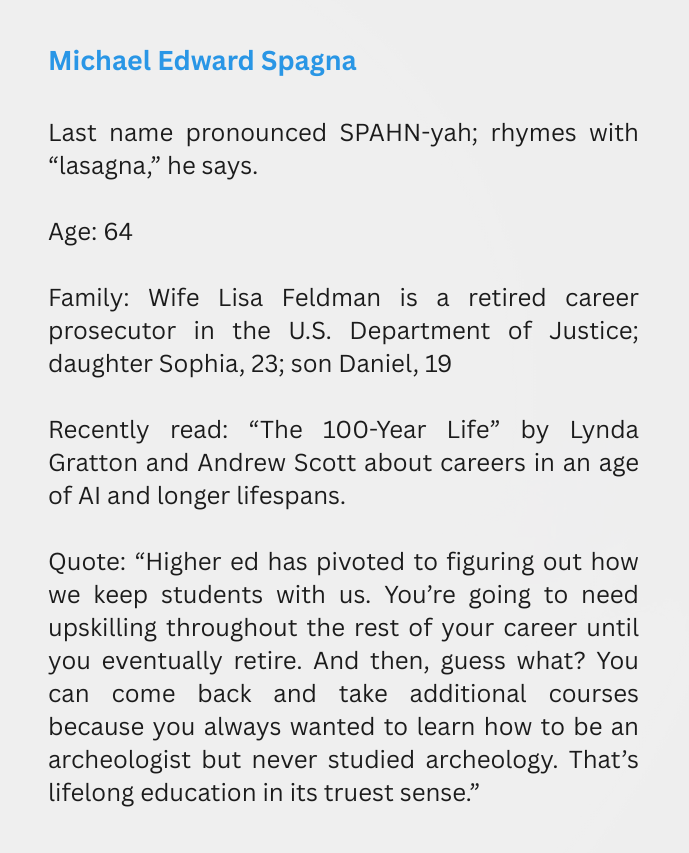
Spagna (pronounced SPAHN-yah) started his career in the mid-1980s, teaching civics, physics, and algebra to middle schoolers at Westmark School, a private college-prep school in Encino that serves students with language-based disabilities like dyslexia and dysgraphia, a learning disorder that affects a person’s ability to write clearly and coherently. While working on his master’s in special education at UCLA, he taught patients in the inpatient neuropsychiatric ward on campus.
“That was the toughest job I ever had,” he said, “because those were kids that had barely survived school. They’d given up. It taught me a lot about what I’ve applied ever since, in how I build relationships. Everybody has strengths, and our job is to try and find those strengths.”
He moved to the Bay Area in 1987 to pursue a Ph.D. in special education through a joint program at UC Berkeley and San Francisco State. In 1991, he took his first higher-education teaching position at Cal State Northridge. As dean of the university’s Michael D. Eisner College of Education, he helped secure a $7 million gift for its Center for Teaching and Learning.
A former colleague said Spagna also raised the university’s profile by building relationships with business and political leaders and establishing data-sharing partnerships with other universities.
“There became, for the first time, a collaboration between the CSU and the UC universities to enhance research about assessing progress of K-12 students,” said Beverly Cabello, who was associate dean of the College of Education while Spagna was dean. “He is excellent at forming meaningful collaborations leading towards positive action.”
It wasn’t an easy start. Before Spagna became dean, faculty felt shut out of budget decisions, Cabello said. One of his first steps was to share detailed financial information during monthly leadership and faculty meetings.
“He let the faculty know, ‘Look, here are our resources and here’s the budget. We’ll go over it and make collaborative decisions about things,’” Cabello said. “So the faculty looked at, for example, the resources provided for technology, and they got to make decisions about what they think should be funded for technology that relates to the faculty in the college.”
In 2017, Spagna left Northridge to work as provost and vice president for Academic Affairs at Cal State Dominguez Hills, where six provosts had cycled through in eight years. It was the first of several roles in which he focused on restoring stability.
“When I came into Dominguez Hills, I had seven sets of files from the previous provosts, who had all engaged in a whole bunch of good activities, but it resulted in a lot of arrested development,” Spagna said. “You could see initiatives started, and then six months later someone was out of there, and the next person didn’t pick up on it.”
He encountered a similar situation at Cal Poly Humboldt. Former president Tom Jackson had launched the campus’s transition to a polytechnic university but drew ire for his handling of pro-Palestinian student protests in April 2024. After students occupied an administration building, Jackson called in law enforcement, prompting faculty to vote no confidence in his leadership.
“We had this flash point of the occupation,” Gilden said, “but that was a sign that people felt we didn’t have a president who was listening or engaged.”
Jackson stepped down in August 2024, and Spagna took over as interim president. Gilden said that the first time she met Spagna, he asked her for advice.
“I said, ‘Show your face, talk to student media and don’t pretend like April didn’t happen,’” Gilden recalled. “And he did all of those things. He never pretended that this harmful thing never happened.”
A racial discrimination claim
Not all of Spagna’s former associates speak positively of his leadership. In 2012, while serving as dean of the College of Education at Cal State Northridge, he faced a racial discrimination claim regarding the selection of a department chair. A faculty member alleged she was passed over despite receiving the majority support in a department vote.
Marilyn Joshua Williams, a former professor of elementary education, said most of the roughly 20 faculty members in the department voted for her to become chair of the college’s Department of Elementary Education in 2011. Williams, who is Black, said that after the vote, Spagna, who had joined Cal State Northridge as a professor in 1991 and became dean in 2008, called a department meeting.
“He announced to the department that he wasn’t going to seat me, and then to add insult to injury, he brought a white male in from another department who had no experience in our department and seated him over me,” Williams recalled in a recent interview. “It ended up being a career-ending move, which was kind of unfair because his career kept going.”
Williams said that Spagna told her in a private conversation that some white faculty members had come to him and said they did not want to work with her.
“I felt that he could have just said to the people that didn’t like me, and this is where his leadership hopefully has developed, ‘This is the person who won, we’re going to seat her,’” Williams said. “But rather than doing that, he said he didn’t want to seat me.”
Williams filed a lawsuit against the CSU system that was settled in 2014. She left the university in 2015 at age 62, earlier than she had planned to retire. A spokesman for Sonoma State declined to comment, citing CSU’s policy on personnel matters.
Enrollment woes
Sonoma State’s low enrollment is one of Spagna’s biggest challenges. Enrollment has fallen to about 5,000 students, down 46% from about 9,400 students in 2015, Sonoma State’s high watermark. That decline has been due to multiple factors, Spagna said, including the pandemic and the broader debate about the value of higher education.
He also said the university took a “reputational hit” after eliminating athletics and some academic programs, but that the university has also stopped investing in high school recruitment programs throughout the state. Funds from the state and the CSU system are helping the university to pay for recruiters and marketing, which Spagna hopes will pay off over time.
“By fall of 2028, I expect to start seeing some upticks in our enrollment,” he said. He hopes to see increases of 100 to 300 students every year. “It’s not going to be something dramatic, but we’re going to be on a better trajectory as a university.”
State funding and support from the chancellor’s office helped the university balance its budget while holding on to nearly $13 million in reserves, according to campus budget officials. But it hasn’t been easy for faculty following last year’s cuts.
Theater arts was among the programs that were eliminated. Scott Horstein, who directed the program, was initially set to leave at the end of May but was recently extended for two more years. He was reassigned to the English Department, where he will develop an interdisciplinary curriculum for performance and other fields, including nursing and education.
“I’m very much in grief for the loss of my department,” he said. “On a personal level, President Spagna extended me for a couple of years and said yes to the things that I wanted to do.” He said that he and other faculty are “grateful for the prospect of some stability.”
Ashley Metzger, a senior at Sonoma State, said she sees parallels between what happened at Cal Poly Humboldt and what Sonoma State is going through.
“Sonoma State’s reputation has been all over the place,” said Metzger, a communications and media studies major. She thinks Spagna is off to a “good start” by hiring a new interim athletic director and retaining geology, which had been slated for elimination. But she wonders if the new stability will continue.
“Is that momentum going to keep up to really bring Sonoma State to the place where it had been?” she said. “We haven’t had a good year for five years for something to showcase the school.”
This story was originally published by EdSource.
