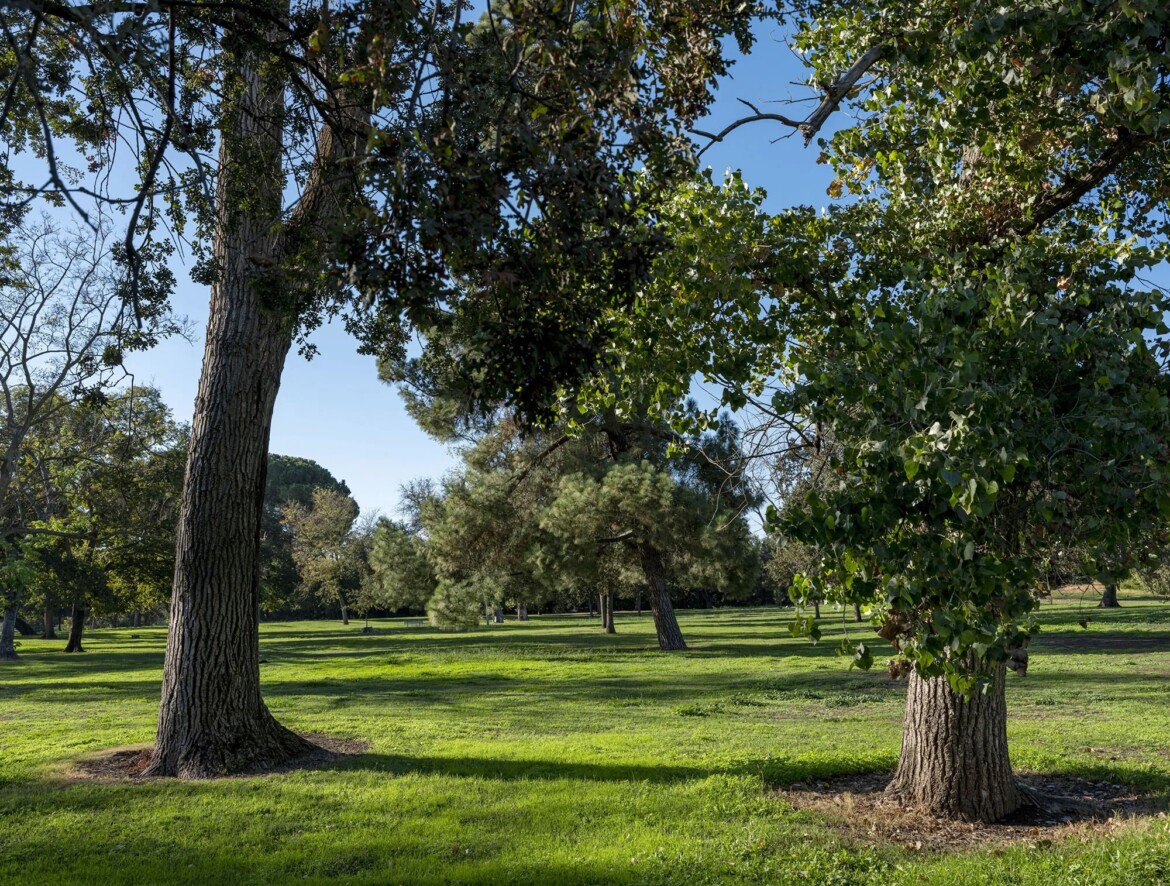
IN THE PUBLIC IMAGINATION, climate change conversations are associated with vast landscapes — oceans, glaciers, rainforests — not local school yards or neighborhood parks. But according to the panelists who spoke Monday at the Commonwealth Club, a public discussion forum in San Francisco, those neighborhood green spaces are crucial for maintaining our connection to nature and meeting global conservation goals.
The panel was hosted by Climate One, a program of the club, as part of a city-wide event called San Francisco Climate Week.
California Natural Resources Secretary Wade Crowfoot was joined by Guillermo Rodriguez, the California director of the Trust for Public Land, a philanthropic organization that works to connect people to natural spaces. Also speaking were Jason Morris of the environmental nonprofit Pisces Foundation and landscape architect Emily Rylander.

While the Bay Area is often associated with technological fixes such as electric vehicles and renewable energy, the panelists argued that the “ground beneath our feet” is an equally critical climate solution. California’s diverse ecosystems — from forests to coastlines — play a vital role in absorbing carbon and stabilizing the atmosphere, they said. Integrating natural systems into climate policy can help buffer the impacts of wildfires, droughts and hazardous air quality, while advancing carbon neutrality goals.
“What does a place-based response strategy to the extreme heat crisis look like?” asked moderator Jenny Park, director of Climate One.
In underserved communities across the country, concrete is everywhere, but so are schools, said Rodriguez. The TPL has long advocated for transforming these paved public properties into green shade havens.
An example of opening up schools to the general public at 3 p.m. till sundown, and then open them up on the weekends, is a brilliant creative idea, said Morris, adding that private philanthropy can often try experiments that can later influence policy.
“How do we get around the insurance issues? How do we get around the safety issues? It’s been figured out in communities across the country through engagement,” he said.
Balancing technology and nature
Community-centered climate strategies that prioritize parks, open space and local engagement are gaining momentum as California leaders and advocates push to balance high-tech solutions with nature-based approaches.
Equity remains a central concern. Historically underserved neighborhoods often have fewer parks and less tree cover, contributing to higher temperatures and poorer health outcomes.
In the town of South Gate, a predominantly Latino community in Los Angeles County, a former industrial site was transformed into a 7-acre park that includes a fruit orchard, playgrounds and a constructed wetland that cleans millions of gallons of river water annually. It was done with the help of the TPL, after extensive engagement with the community.
“The community said, we want swings, we want a playground, we want trees, we want shade, but we also want economic development,” said Rodriguez.

California State Director and Vice President of the Pacific Region Guillermo Rodriguez speaks about public access to nature at the Commonwealth Club in San Francisco on Monday, April 20, 2026. (Ed Ritger/Commonwealth Club via Bay City News)
They planted 200 fruit trees, 100 of them avocados, and developed an orchard because the community wanted food security, Rodriguez said. They built a wetland to clean dirty water from the neighboring Los Angeles River and then used that to irrigate the orchard. The project highlights how parks can function as green infrastructure, providing food security, water management and economic opportunities alongside recreation.
“We got the Conservation Corps of Long Beach involved, and they do the maintenance on the facility,” Rodriguez said. “The local food bank is delivering the product from the orchard to the community.”
Later funding came from the state Natural Resources Agency and the federal Land and Water Conservation Fund, as well as a significant investment from the California State Water Resources Control Board.
“What’s so amazing about the outdoors, is that it offers something for everyone,” said Rylander, the landscape architect. “I think the places that are less successful can be overdesigned, or they’re just not relevant to the community.”
Access isn’t always a walk in the park
About 100 million Americans lack a park within a 10-minute walk, limiting opportunities for community and the health benefits it provides, according to Rodriguez.
“Science tells us that if you use a park, you have better mental health and more community engagement,” Rodriguez said. “And it doesn’t cost you an entrance fee.”
Those small public spaces add up in California’s conservation goals.
“Leaders around the world in some very ambitious countries got together and said let’s try to protect 30% of the Earth by 2030,” said Crowfoot.
The governor set this target for the state through an executive order in 2020, and it was codified by the Legislature a couple of years later.

“In the last three years, we’ve added 2.5 million acres as conserved land in California, and we have several more million more acres to go,” said Crowfoot, adding that voters passed a climate bond in 2024 that gives the state an ability to borrow $10 billion to invest in climate resilience and outdoor parks.
Crowfoot said indigenous tribes in Northern California for 20 years campaigned for the removal of four defunct dams on the Klamath River.
“These were dams that were really no longer needed, and they were disconnecting salmon from about 400 miles of their habitat,” he said. “Biologists suggested that it would take three to five years for the salmon to return to their native habitat, because there would be a significant purge of the sediments. It took 10 days. One year later, surveys demonstrated over 10,000 salmon returned.”
Over 200,000 acres of land have been returned to Native American tribes in California to steward that land, said Crowfoot.
“Some of these tribes have not held land since California’s statehood,” he said. “Nature is such an important gateway to this work. It has to be relevant in people’s lives. It can’t be about atmospheric carbon or the now super pollutants. It has to be about what’s going to help improve your life or the life of your family. And what that means is your kid has a comfortable, safer school yard, or you have a park in your community.”
The post Climate Week panel says neighborhood parks, schools key to global climate goals appeared first on Local News Matters.