Gov. Gavin Newsom’s proposal to shift the operation of the California Department of Education has received a key endorsement from the Legislative Analyst’s Office.
The nonpartisan LAO said last week that moving control of the department from the State Superintendent of Public Instruction to a new education commissioner under the governor’s authority would clarify confusion over who should manage the state’s TK-12 education system. The roles “are clear in theory but often murky in practice,” said the LAO, which evaluates state policies for the Legislature.
This lack of clarity can mar the rollout of major programs like transitional kindergarten and leave districts unsure of where to turn to for guidance. According to the LAO, overlapping roles among the Department of Education, the State Board of Education and other agencies create confusion about who is in charge. The change that Newsom is proposing “could result in clearer direction and support for school districts,” the LAO said.
Under Newsom’s plan, the state superintendent would continue to be elected every four years, as required by the California Constitution, but with diminished power and a small staff with a minimum budget. While the state superintendent would have limited authority under the governor’s proposal, the LAO suggests that the state superintendent could become an independent evaluator of public schools as well as the chief advocate for K-12 education.
Newsom proposed the major restructuring of the TK-12 bureaucracy in January as part of his 2026-27 budget. The plan would take effect in January 2027, coinciding with the start of the next governor’s and next state superintendent’s term of office. Newsom disclosed his plan one month after the university-based research organization Policy Analysis for California Education (PACE) revived the idea in an in-depth report.
Associations representing school boards, school administrators, and county superintendents, as well as a number of student advocacy organizations, including Children Now and Education Trust-West, announced their support. Tony Thurmond, the current state superintendent, opposed the proposal, stating it is unclear how the changes would improve student performance. The California Teachers Association, which has succeeded in electing state superintendents aligned with labor, has been silent on the proposal.
The reorganization is not a new idea. As the LAO noted, the challenges of a “two-headed” system of school oversight have been debated for a century. PACE’s report was the sixth extensive study by a research organization or government commission in 30 years that recommended placing the Department of Education under the governor, and the LAO’s is now the seventh.
California is one of only nine states that elect a state superintendent. In 14 states, the governor appoints both a state board of education and the chief education officer. In 10 states, the governor appoints a state board of education, and the board appoints the state school officer; in seven states, an elected state board of education appoints the chief education officer.
Each of the half-dozen California studies differed on key aspects of what a new governance system should look like. The LAO offered its own take, too.
Newsom’s plan recommends that the next superintendent be named a voting member of additional state education boards and commissions, including the community college system’s Board of Governors, but doesn’t add other responsibilities.
Redefine the state superintendent’s roles
The LAO envisions a more influential role for the state superintendent. It also said the Legislature should play a stronger role in monitoring and controlling the restructuring, recommending that the Legislature:
- Vet and confirm the new education commissioner. An assumption behind the realignment is that the appointee would be an experienced manager with knowledge of California’s education system. The last four state superintendents had been legislators without a management background.
- Require the governor to present a spending plan that ensures the total funding for the Department of Education, the state superintendent and the state board doesn’t exceed what the state spends now. The plan should identify savings by eliminating redundancy in the current system.
- Write into law the roles of future state superintendents. The LAO recommends that they should advocate for the main issues they campaigned on, evaluate the effectiveness of state education programs and identify areas of improvement.
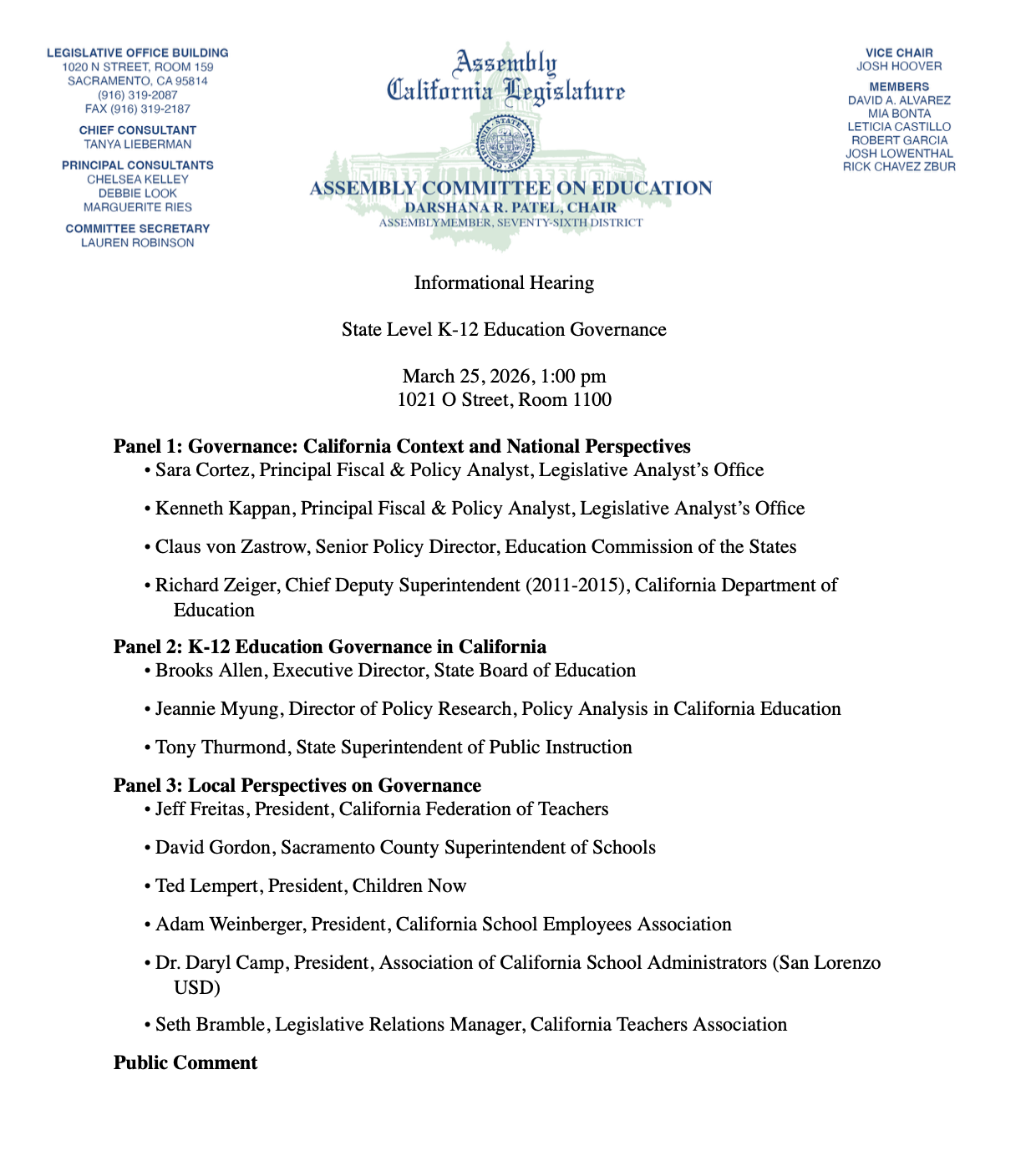
To date, none of the commissions’ and researchers’ reports have gained traction in the Legislature, and three times voters have rejected initiatives to eliminate the state superintendent’s position. Whether Newsom’s call for action and the inclusion of the proposal in his budget will make a difference may become clearer when the Assembly Education Committee holds an extensive informational hearing on March 25 at 2 p.m. Thurmond will be on one of four panels of presenters. Here is the agenda.
EdSource: The California State PTA has taken no position on Gov. Newsom’s realignment plan. An earlier version, fixed on March 27, said that the PTA backed the proposal.