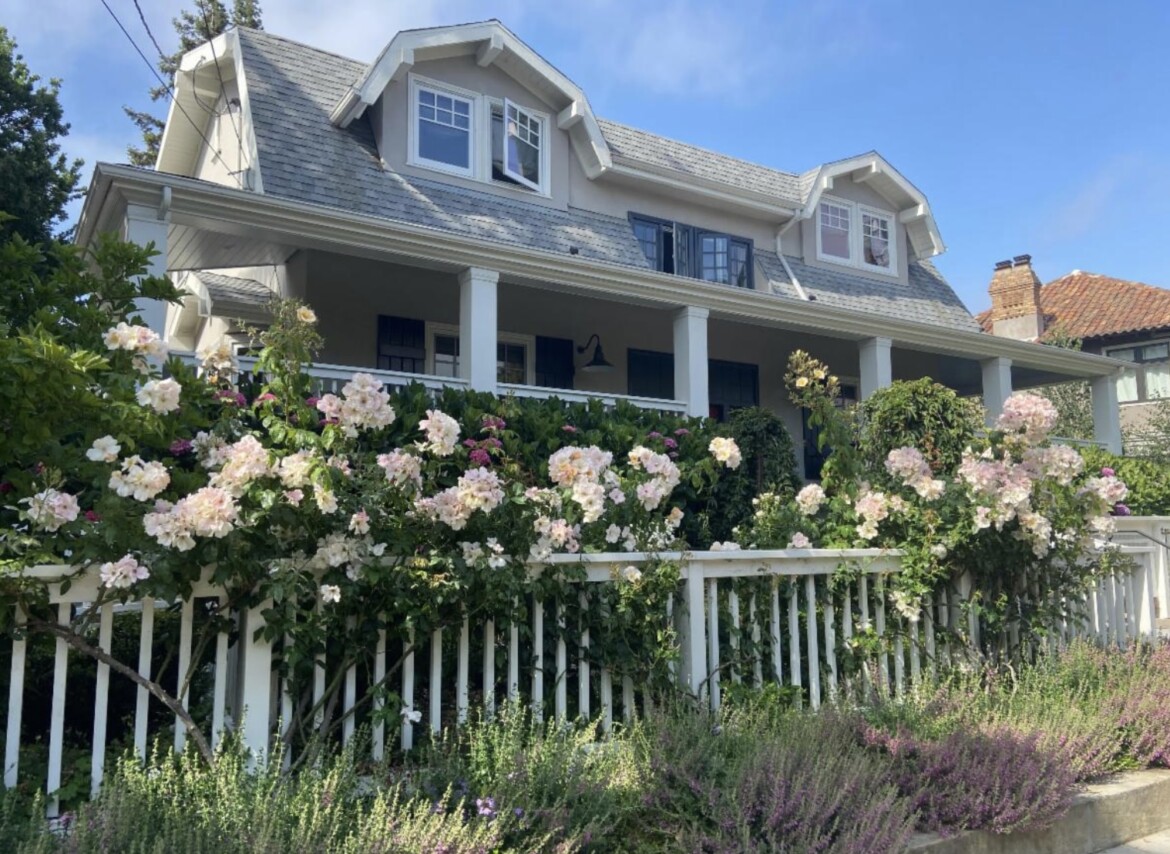
Finding home insurance puts homeowners between between a rock and a hard place — one that has no room for roses.

[SPONSORED]
The personal stories of one realtor’s battles and triumphs in the highly-competitive Bay Area real estate market, seeking to illuminate and humanize the very real ups-and-downs of homeownership.
“Hopefully, this is all of it,” my email said. “I’ve spent more than $2,000 this week meeting your requests for a water pressure monitor valve, household temperature gage, and central fire monitoring system . . . “
Which begs the question: If a house that has NO knob & tube wiring, new copper plumbing, new electrical panels, a composition-shingle roof (w/solar), Tesla Battery walls, insulation between floors, walls, and ceilings, double-pane windows, new furnace(s) and water heater(s), renovated kitchen and bathrooms, low-flow water fixtures, and a security system that includes strategically-placed cameras . . . IF MY METICULOUSLY MAINTAINED, and COMPLETELY RENOVATED HOME (!) is struggling to retain homeowner’s insurance, what house actually meets the more stringent requirements insurers are demanding? How are average people supposed to keep their homeowner’s insurance?
”I apologize,” the representative said, (anticipating that I was on the verge of an unpleasant meltdown.) “The insurance company wants additional proof.” (Really?!?) Photos, work orders, copies of checks to the contractor, and a ADT certificate outlining the monitoring systems aren’t enough?
Moreover, it’s not going to stop there. Last week, at COMPASS’ weekly office meeting, Sheryl Drinkwater, a local architect and home-hardening specialist, spoke to our assembled group about fire safety and home-hardening regulations that are either already in place (and largely ignored), or headed to a theater near you. (Could they make it any more difficult?)
While we’re all aware that properties in the hills must annually clear grass and weeds around their structures, new building requirements will likely limit ANY plantings within 5′ of a building, preferring rock, moonscapes, and succulents instead of anything that resembles our current green landscapes. Goodbye climbing roses.
Beauty isn’t high on the priority list. Preventing the spread of fire is. (They have a point, but it comes at an aesthetic cost to be sure.)
Honestly, if I have to rip out half my garden, I think it will kill me. My deep, colorful beds, which I have lovingly tended for the past 12 years, are comprised of blooming Dogwoods, Magnolias, Japanese Maples, and a strategically-placed row of tall Birch trees that provide privacy between my house and the neighbor’s next door (a living fence). There are dozens of hydrangea bushes, azaleas, native grasses, white roses, and blooming ground cover, not to mention butterflies, birds, and bees that are busy pollinating and nesting among the branches.
The truth is, cities are dense environments, in which the current goal of “infill” designed to create MORE housing, not less, is in direct conflict with the recommendations heading our way. Sheryl was suggesting structures sit 100′ apart, that plantings not touch each other, that flora and fauna be limited to endemic species, that hedges be avoided, that any attached trellises, overhangs, or shade structures be removed, that eaves be enclosed, etc., etc., etc.
But as 90% of fires are started by embers landing on roofs, wouldn’t it make more sense to focus our efforts there, instead of ripping out foliage around our properties? Is it realistic in our urban settings — especially when ADUs are considered part of the solution — to move in this direction? Isn’t there a case to be made in a world of “global warming” for the importance of plantings and shade trees contributing to reducing temperatures in our concrete jungles, and to provide shelter for our animal friends? Is the next step having every homeowner cement over their yards. (That’s clearly NOT the solution.) Needless to say, I left that meeting feeling defeated only to return home to more demands from my insurance rep.
With MOUNTING frustration, I began shopping for new homeowner’s insurance, but was told by several companies that they either no longer write in California or won’t insure “high-value homes” above $2 million. (If anybody’s got a better idea, please send it my way.) Given the boxed-beam ceilings, custom woodwork, and sheer size of my house (we also have an attached garden apartment), it’s unlikely that we’d be able to rebuild within the stated limits, especially with tariffs in play.
So what’s the upshot? Homeownership is going to get more expensive as the costs to own continue to climb, so buckle up and get ready. Your cancellation notice is probably in the mail as we speak.
How can we help you?
Julie Gardner & Sarah Abel | Compass Realty
Not just Realtors, but consultants in all things house and home, we’re here to educate, explore, examine and refer . . . In short, you may count on us to take care of your home as if it were our own and anyone who knows us, knows we take pretty darn good care of our homes.
Learn MORE