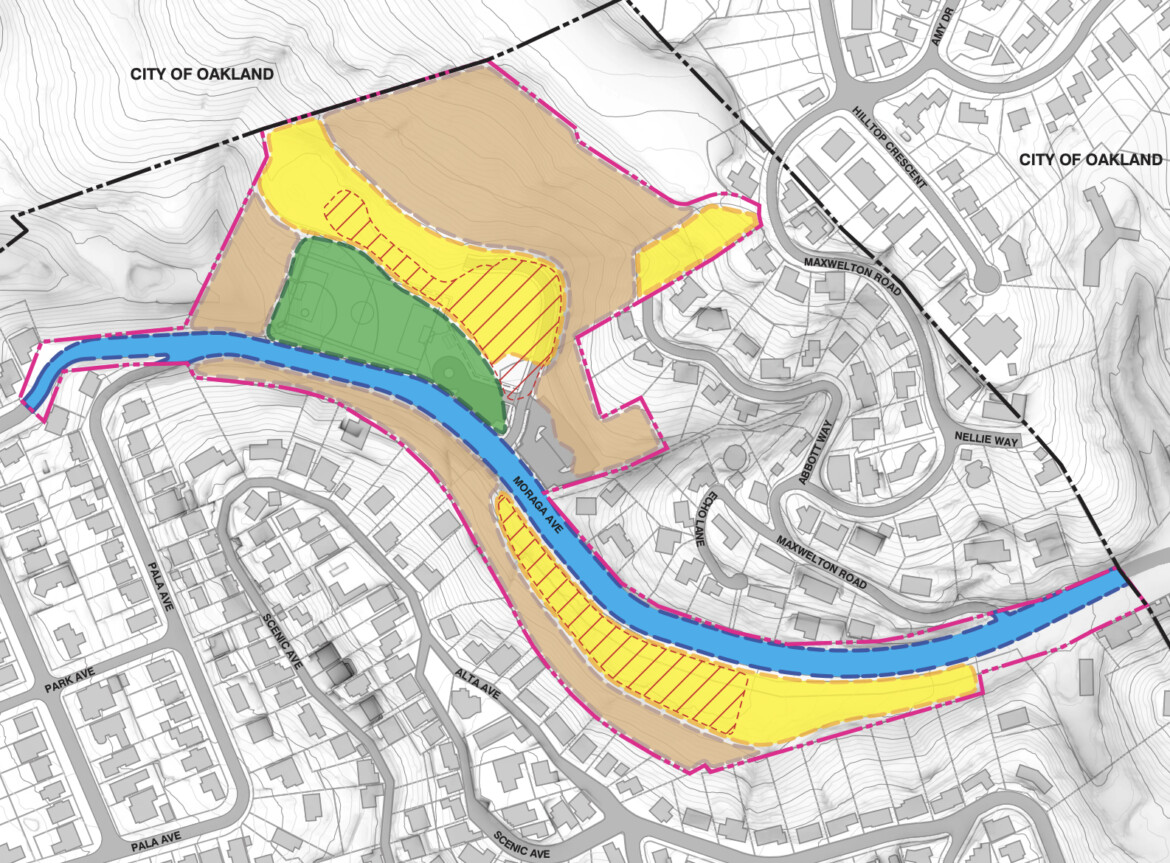
City Council on Monday night directed the city to issue a Request for Qualifications (RFQ) this spring for potential developers of the Moraga Canyon Specific Plan. Director of Planning and Building Kevin Jackson said the city recommended an RFQ over a Request for Proposal (RFP) approach in order to attract more qualified developers and to give the city more local control over the eventual development plan.
On Oct. 6, 2025, the City Council adopted the Moraga Canyon Specific Plan (MCSP). The MCSP sets forth the regulations and standards governing:
• The development of a minimum of 130 multifamily housing units, including 60 housing units affordable to households earning low, very low and extremely low incomes.
• The development of two new single-family units on two lots to be created on Maxwelton Road and Abbott Way.
• The maintenance and improvement of city facilities.
• Improvements to utilities, infrastructure, and recreational amenities on city-owned land in Moraga Canyon.
• Improvements in bicycle, pedestrian, traffic, and wildfire safety.
According to the city, a review committee consisting of both senior city staff and subject matter experts in relevant fields, such as real estate finance, housing development, land use planning, or architecture, would evaluate responses and make a recommendation to City Council. The city would then enter into an exclusive negotiating agreement with the selected firm. There will be an opportunity for community engagement at that time, the city said.
Affordable housing experts and Piedmont residents Andy Madeira and Carol Galante both spoke during public comment and added their recommendations to the mix.
“Don’t pick the person who promises everything,” Madeira cautioned. He said the city should be clear about what it was asking for, noting that the MSCP is big and includes a lot of public improvements. Seek a long-term partner who will be with you for decades, he said. Madeira also recommended the city add Piedmont residents to the review committee, noting that the city has ample housing expertise to draw on.
“I am thrilled that we are at this place,” said Galante. There is a fine line between an RFQ and an RFP, she said, and noted that the city should not only understand a developer’s residual land value analysis, but should do its due diligence by following up on references from other cities and banks, and uncovering a developer’s funding sources or any past defaults.
Mayor Betsy Smegal Andersen asked how the city would guard against selecting a developer who might overpromise and under-deliver.
Bayon Moore said the city favored the RFQ path for this reason, namely because the RFP pathway, oriented toward conceptual design plans, could draw the city toward a particular bid package. “We [will be] thinking long and hard about the [development] team’s track record and past experience,” she said, not solely about a concept that may or may not be realized.
In order to qualify for $2.1 million in A1 funds (a countywide affordable housing initiative approved in 2016) the city needs to be negotiating with a development partner by December 2026, Bayon Moore said.