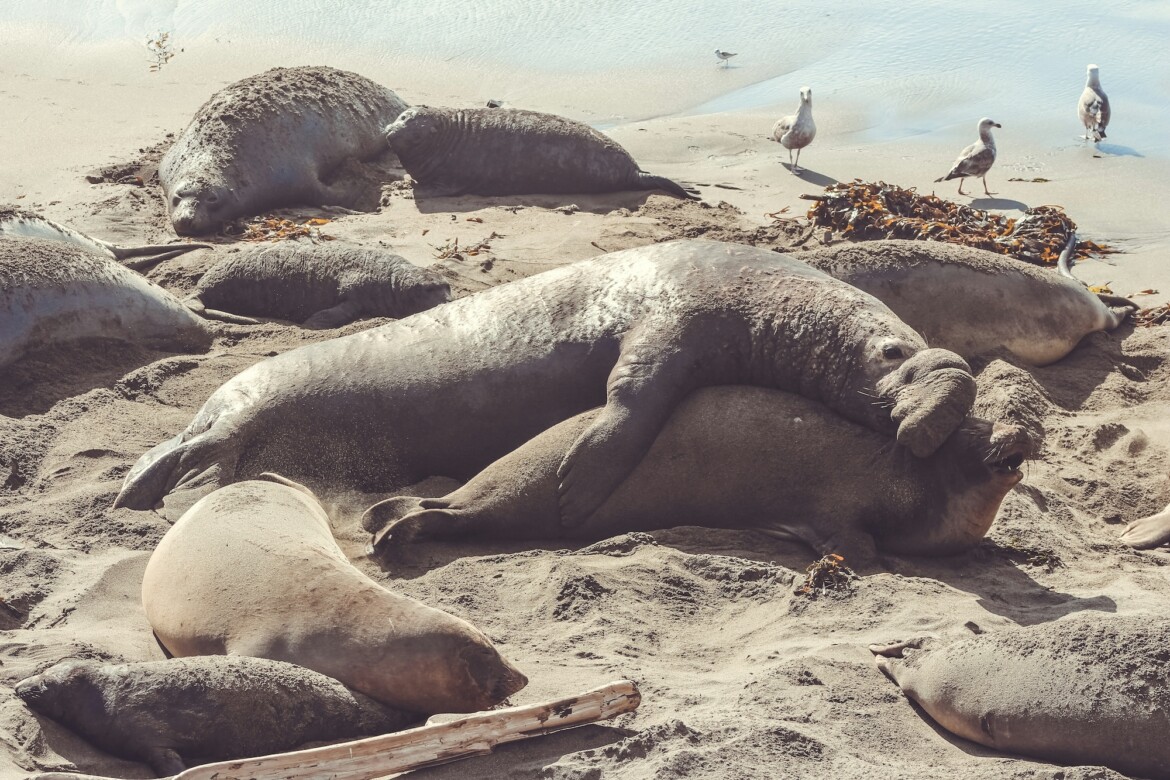
Wildlife authorities confirmed Thursday that nine more elephant seals, a sea lion and an otter have died from bird flu at Año Nuevo State Park in San Mateo County.
That brings the total number of confirmed animals killed in and around that location by the H5N1 avian influenza to 18, with all but two being northern elephant seals.
“As you probably imagine, this count reflects only the animals that have gone through sampling and confirmatory testing in multiple labs,” said Christine Johnson, director of the Institute for Pandemic Insights at University of California, Davis. “So there are likely more animals that we will be updating on in the coming weeks.”
The outbreak was first announced in February after the virus was confirmed in seven dead elephant seals by the U.S. Department of Agriculture’s National Veterinary Services Laboratories.
It is the first confirmed outbreak in any elephant seal population in California, but it so far seems confined to the famous, well-studied population that migrates back to the beaches at Ano Nuevo State Park every year.
Researchers and wildlife experts from several agencies and organizations are monitoring bird and marine mammal populations along the coast, conducting additional testing and providing updates to the public.
So far, it appears as if this specific variation of the virus emerged in 2022 in bird populations migrating through the Pacific Flyway and caused a mass mortality event in northern fur seals on an island in eastern Russia.
And while researches say there is still much to learn about how the virus has changed and how it jumps from one species to another, there is some good news about the current outbreak.
“We are only seeing a handful of new suspect cases every day, and there’s an incredible team of scientists conducting field investigations and a network of NOAA Fisheries, marine mammal stranding and response experts that are keeping a really close lookout for all new cases, reporting those, and we’re continuing to ramp up testing,” Johnson said.
The number of new symptomatic and dead animals is continuing to stay relatively consistent, with an average of about two newly dead animals and two newly symptomatic animals discovered every day, and testing is still being done to see if the virus is responsible, according to Patrick Robinson, the Ano Nuevo Reserve Director at UC Santa Cruz.
“We estimate around 47 seals on the mainland have died since the start of the outbreak,” Robinson said.
Outbreak spares most adult females
In another bit of good news, roughly 80% of the adult female population had migrated away from Anu Nuevo prior to the outbreak and none have been found dead or with flu-like symptoms, which is a good sign for this particular population’s long-term prospects.
And while it’s unclear how or to what extent the virus might be spreading among the otter population in the area, Johson said it’s not unusual for H5N1 variants to migrate to other species without causing another large outbreak there.
“For example, in other outbreaks, dolphins have even been found with infection,” Johnson said. “So these occasional sort of one-offs of other species that get infected in a big outbreak is pretty typical, and we’re just going to hope that it stays that way for sea otters.”
As a precaution, the elephant seal viewing area at Año Nuevo State Park has been closed and tours have been canceled, but people can still visit other areas of the park.
Visitors there and at other beaches should remember to keep their pets leashed and avoid all contact with stranded, sick and dead marine mammals and birds.
More information about the outbreak is available online at the Institute for Pandemic Insights.
The post Bird flu kills more elephant seals, other marine mammals at Año Nuevo State Park appeared first on Local News Matters.