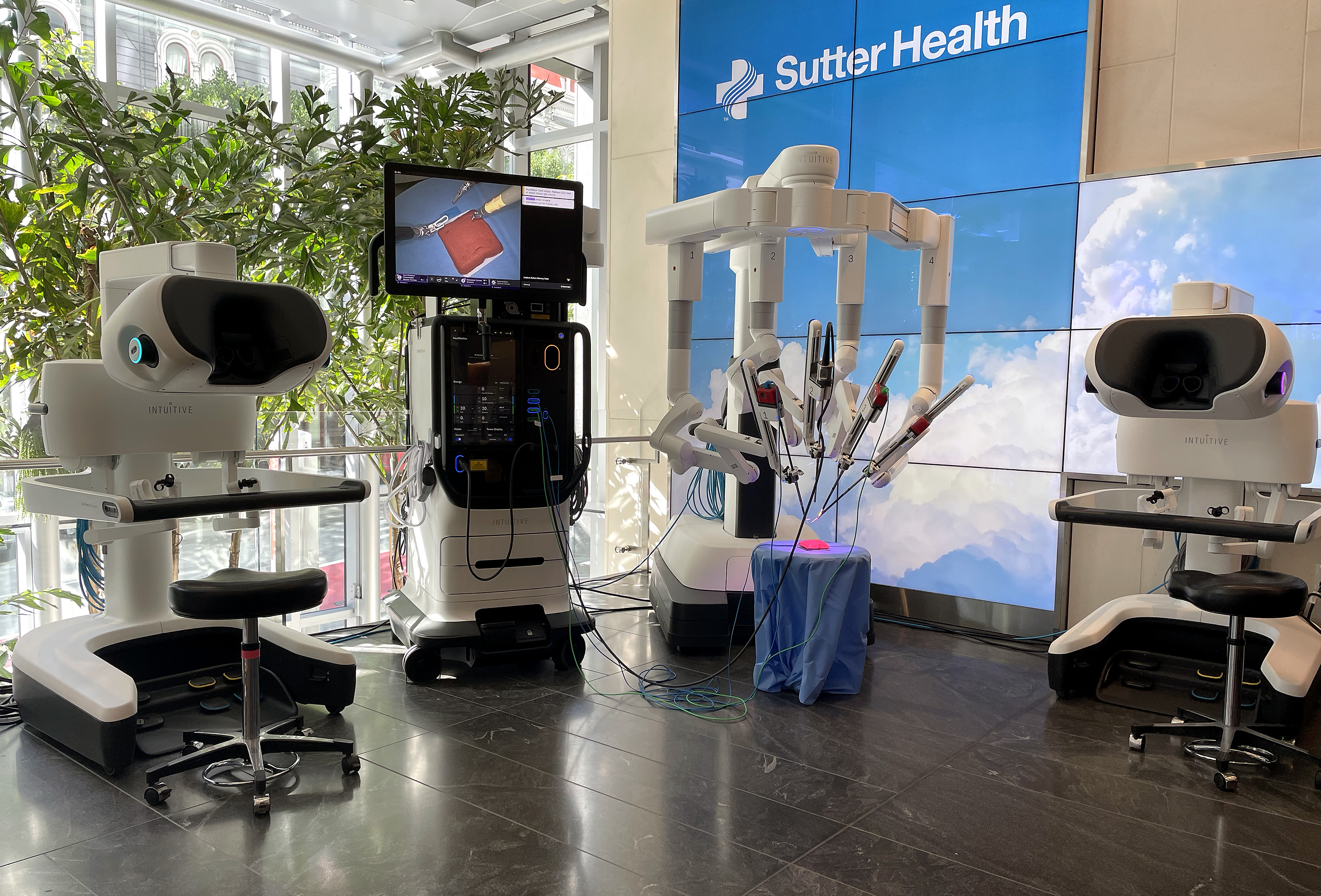
A San Francisco hospital unveiled a newly acquired robotic surgical system Tuesday, touting it as a major step forward in surgical care.
At the Van Ness campus of the Sutter Health California Pacific Medical Center, doctors said that this technology will enable surgeons to operate with greater precision, reducing blood loss and the chance of infection, resulting in shorter post-surgery recovery times.
Sutter Health CPMC has procured three Da Vinci 5 robotic surgical systems, manufactured by Sunnyvale-based Intuitive Surgical Operations Inc. Two will be deployed at the Van Ness campus, and the third will be set up at the Mission Bernal campus.

The system will be a game changer for procedures that require surgeons to reach deep into the body, according to Dr. Eric Miller, a urological oncology surgeon at the hospital.
“When you think of getting to a really deep space behind a separate organ, that would be traditionally very difficult,” said Miller. “But we can literally navigate behind, and through, and over, and around using this tool and get excellent visualization with microscopic dissection techniques right in front of you. Otherwise, you would be reaching down, trying to get a good body angle, a bigger incision, and so on. This allows you to make tiny fingernail-width incisions to get access to those hard-to-reach places.”
But the system merely acts as an extension to the surgeon, said Miller, and cannot make any decisions of its own.
“There’s no AI, there’s no introduced voluntary activity that the robot performs,” said Miller. “If I move one way, it moves that way. It’s meant to replicate my every action.”
Each surgical system consists of four distinct components: two surgeon consoles, a vision cart, and a five-armed “boom.”
Surgeons sit at the consoles and use handles and pedals to remotely manipulate the five arms of the boom, which offer the use of different surgical instruments. High-resolution cameras capture a live three-dimensional video of the target area, which guides the surgeons as they manipulate the arms of the boom.

The vision cart acts like a computer for the system, processing the videos and displaying the video feed on a screen for observers other than the operating surgeon.
Dr. Anthony Squillaro, co-chair of Robotic Surgery at the hospital, explained that the handles at the console give surgeons tactile feedback to minimize overstretching or injuring the tissue.
“It’s kind of like your lane assist in your car,” said Squillaro. “If your car is veering off the white lines in the lane, it’ll start to bring it back. We’re still controlling it, but it’s giving us an assist.”
The Da Vinci 5 systems — which cost the hospital around $2 million each — could also be used for telesurgery, wherein a surgeon can assist another surgeon performing a procedure at a different location miles away.
“Let’s say that there are no specialists in a rural part of California,” Squillaro explained. “It’d be great to get a generalist surgeon to be able to have one of these, and then one of us subspecialists here in San Francisco could guide them. We’re in the golden age of robotic surgery, and it is only going to get better!”
The post Sutter Health’s new robotic surgical systems in SF aim to speed patient recovery appeared first on Local News Matters.