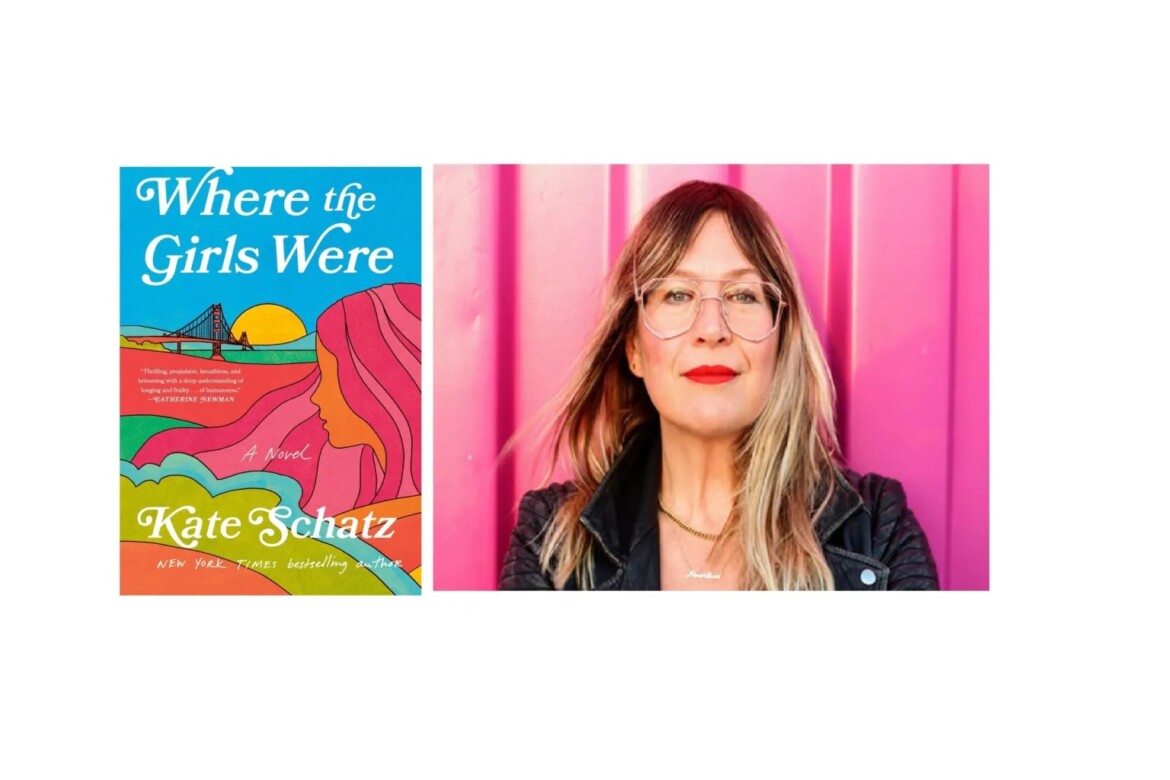
Alameda writer Kate Schatz’s first novel is set in 1968, but it couldn’t be more relevant to women’s struggles today.
The feminist, known for her nonfiction “Rad Women” books and “Do the Work: An Anti-Racist Activity Book,” written with W. Kamau Bell, now turns her eye to fiction—or returns to fiction, which she says was first love back in her student days—to take on the women’s rights and reproductive freedom.
She’s launching her evocative historical novel “Where the Girls Were” (Dial Press, March 3, 2026), about a serious high school senior dealing with an unwanted pregnancy in the days before Roe v. Wade, with talks this week in Santa Cruz and Alameda.
Elizabeth “Baker” Phillips, a brilliant but naïve senior headed for Stanford, gets pregnant during a time of free love, but has few options. She goes to an unwed home for mothers where she connects with other young women, works to solve a mystery and tries to take control over her destiny.
The plot stems from a surprise confession by Schatz’s mother: “When I was in my early twenties, my mom revealed to me her long-held secret, which is that she had two unplanned pregnancies in the 1960s and was sent away, and gave both of the babies up for adoption,” Schatz says.
Not only didn’t Schatz know this about her mother, she says, “I didn’t know that about anyone. I had never heard of that phenomenon.”
Schatz, who was born after abortion became legal, hadn’t heard about “the baby scoop era” between the end of World War II and the 1973 Roe decision when approximately 1.5 million young American women were sent to “homes” and surrendered babies to adoption.
“The inspiration for the book is both very personal, coming from my mom’s experiences, and then also very political, coming from this history of women and of reproductive rights that I had absolutely no idea about,” Schatz says.
The fictional San Francisco home for pregnant teens in the novel is based on Schatz’s years of research.
“One thing I’ve learned from writing nonfiction is that research looks like so many things, like sitting in a library with stacks of books and a magnifying glass, or at a microfiche machine, like in the old days.” Schatz says we often think of people writing as “sitting at their computer, their typewriter at their desk, typing out words.”
“And I’ve learned that in both cases, it looks like so much more. I’m writing in my imagination all the time…. I’m writing when I’m having conversations with people.”
Along with reading about the history of reproductive justice (she recommends “The Girls Who Went Away,” a book of oral histories by Anne Fessler), Schatz found stories online.
It was a bit difficult to talk women to about their experiences, she says: “It’s hard because it is still something that a lot of people don’t talk about. There are women who are in their seventies and eighties who still have not told anyone. It’s actually a challenge to find people who, A, are willing to share, and B, really want to go there.”
She adds, “The kind of texture and dynamics of the home, and the different experiences and emotions of the girls who are there, definitely came from reading a lot of stories and doing interviews.”
Schatz felt strongly that the story show a range of experiences, including that things weren’t always horrific in the homes: “I say that very carefully because there are absolutely people who will say that what they endured was incredibly traumatic and shame-filled and terrible. And then there are also accounts of women who actually did feel safe and cared for in these homes and who did feel like it was the only option and who didn’t have the worst time.”
In selecting the book’s time period, Schatz was fascinated by 1968, with the assassinations of Martin Luther King Jr. and Robert F. Kennedy, and especially the violence of the Democratic Convention in Chicago, seeing it as a kind of turning point politically, “the idea of the whole world watching and the way that the protests were televised and broadcast in this new way.
“And with all of this exploding in the backdrop, there’s one individual in this story wrestling with her own kind of revolution.”
Though historical, “Where the Girls Were” is unbelievably timely, as reproductive rights falter for women across the country.
“I do believe in the swinging pendulum of American history and how backlash works, and we’re deep in the backlash right now,” says Schatz, who believes the arc of history will move toward reproductive justice and abortion access. “But it’s going to be a slog,” she adds.
The longtime feminist has a list ready for those wanting to know what to do during today’s trying times. She recommends “having conversations and understanding what the options are, because we are now in an era where this is about state by state.”
She continues, “Also, understanding what the landscape of abortion care looks like now, especially when it comes to medication abortion, which is now more than 60 percent of abortions in a clinical setting.”
Parents and college-age students attending schools outside California should be aware of laws in the states where they live.
Schatz recommends a Substack called Abortion, Every Day by Jessica Valenti, “a roundup of what is happening in terms of legislation around the country and also the criminalization of women.” Another resource is the National Network of Abortion Funds.
“The issue is, on the one hand, how do we pay attention to the legislation, so we can change things? But also, what do we do to support women who are needing abortion care right now?” Schatz says: “Abortion access funds are one of the best and direct ways to do that.”
Kate Schatz appears at 7 p.m. March 4 at Bookshop Santa Cruz, 1520 Pacific Ave., Santa Cruz, and 6:30 p.m. March 5 at Books Inc., 1344 Park St., Alameda; visit kateschatz.com.
The post Alameda’s Kate Schatz examines women’s reproductive rights in the 1960s in new novel appeared first on Local News Matters.