
Two California lawmakers are trying to open up legislative documents that are technically public records, but difficult for even the most seasoned Capitol insiders to access.
The documents are letters registered lobbyists and advocacy groups send the Legislature to support or oppose bills. CalMatters has been seeking greater access to them for more than a year.
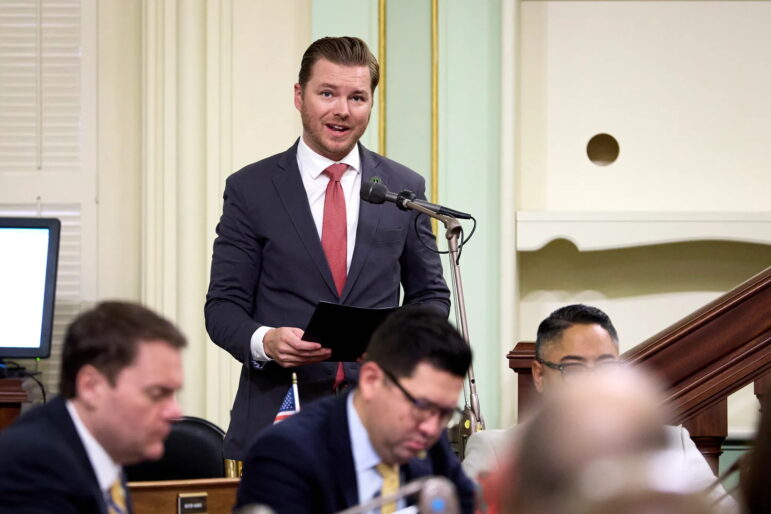
Assembly members Rebecca Bauer-Kahan, a Democrat representing the San Ramon area, and Republican Greg Wallis of Rancho Mirage each introduced legislation in February that would require the Legislature to post the letters online.
“Candidly, I had no idea that the public didn’t have access to support and opposition letters,” said Wallis, who authored Assembly Bill 2063. “It sort of blew my mind when I found out that that wasn’t readily available.”
Bauer-Kahan’s office didn’t respond to an interview request to discuss her Assembly Bill 2557, which is similar to Wallis’ bill.
Position letters from lobbyists and advocacy organizations, submitted through a portal on the Legislature’s website, are public records, according to the California Legislative Open Records Act. The law sets the rules for what correspondence lawmakers and their employees are required to disclose and says they must give the letters out upon request. They usually do.
But having to separately request letters to legislative staff for each bill before lawmakers — more than 2,000 each year — is tedious and time-consuming. Each proposal can generate dozens of letters.
The Legislature’s employees have to devote substantial time to giving the letters out to the army of advocates who rely on them to understand which groups support or oppose legislation and why.
“Even if staff had a desire to be very equitable about sharing that kind of information, that is not a good use of their time; absolutely not,” said Jennifer Fearing, a longtime lobbyist who advocates for nonprofits.
Former Democratic state Sen. Steve Glazer said the letters “can be very relevant to the legislative process of finding compromise” since they can contain valuable suggestions from organizations on how to improve legislation.
They are also one of the few windows into the secretive world of Capitol lobbying.
“There’s a lot of influencing that happens in the shadows,” Glazer said. “But that’s usually different than letters that are put on the record and submitted to a legislative committee.”
He questioned why legislative leaders would even need a law to post the letters online.
“If I were the leader … I’d say, ‘That’s bull—. Publish the goddamn letters.’”
CalMatters requested interviews for this story with Sen. President Pro Tem Monique Limón and Assembly Speaker Robert Rivas, both Democrats. They declined.
Some other state legislatures, such as Hawaii’s, post advocacy position letters on their websites.
Do legislative analyses give an unbiased picture?
CalMatters has sought for the past year to obtain the letters as they are filed through the Legislature’s online position-letter portal, which lawmakers and their employees can access but the public cannot. The Legislature denied CalMatters’ request, made under the Legislative Open Records Act.
CalMatters seeks to add the letters to its Digital Democracy database, which is free for the public to access.
The letters also would be used to help create a more accurate assessment of who supports and opposes each bill in the database. Without the letters, Digital Democracy can only track lobbyist and other advocate positions through their brief testimony at committee hearings or if the positions are listed in the public bill analyses that accompany legislation.
The staff of various legislative committees and the Senate and Assembly chambers write the analyses. They provide a basic summary of what a bill seeks to accomplish, some context behind the legislation and a brief description of the supporters and opponents and their positions, often based on the letters submitted through the portal.
Some question whether the committee consultants who write the analyses accurately reflect the support and opposition to a bill in an unbiased manner or provide all the relevant facts that lawmakers — and their constituents — need to make informed decisions.
Former Democratic Sen. Jerry Hill said he was frustrated by the slanted positions some committee consultants put in their analyses. He thinks the legislative process would benefit from having the letters posted online for everyone to see.
“I think it definitely will improve the process if all of these letters are made public,” he said. “It will create a better-informed Legislature to make those decisions at the end of the day, and not have to rely totally and solely on the opinions of a couple of committee staff writers and consultants.”