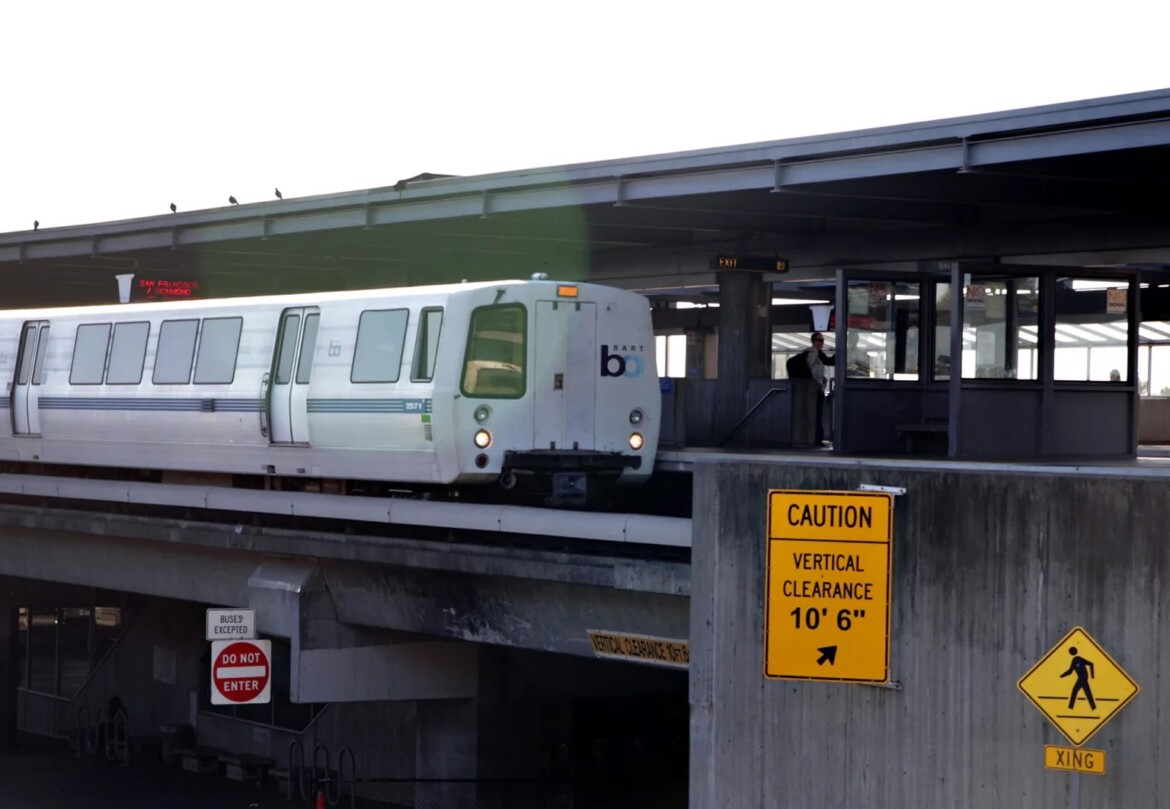
BART’s Board of Directors has approved a sweeping contingency plan that would slash service, close stations and raise fares if the transit agency fails to secure new funding to close a projected $367 million deficit next fiscal year.
In a statement Thursday, BART officials said the agency’s board adopted the Alternative Service Plan that outlines how BART would balance its budgets for fiscal years 2027 and 2028 if no new revenue becomes available. It faces a structural deficit of $350 million to $400 million because ridership remains about 50% below pre-pandemic levels, and BART’s funding model relies heavily on passenger fares.
The plan calls for major changes beginning in January 2027. Service would be reduced to three primary lines — Yellow, Blue and Orange — with limited peak-direction service on the Red and Green lines. Trains would run every 30 minutes, and the system would close at 9 p.m. daily. That represents a 63% reduction in service hours.
Fares and parking fees would increase by 30%, raising the estimated average fare from $4.98 to $6.38. The agency would also target about $30 million in savings over six months from cuts to fleet and non-fleet maintenance, police, cleaning and administrative support, while continuing to defer capital projects and retiree medical contributions. The rest of the fiscal year would be balanced with one-time resources and financial deferrals.
Deeper cuts possible
If further cuts are deemed safe and legally feasible, a second phase would begin in July 2027. That phase would aim for more than $175 million in annual cost reductions through a cumulative 70% reduction in service hours. BART officials said they would maintain the three-line structure, 30-minute frequencies and 9 p.m. closing time, and could close up to 15 stations and up to 25% of system track miles. Fares and parking fees could rise to a cumulative 50%, pushing the estimated average fare to $7.26.
The plan does not name specific stations for closure and makes clear that the BART board would decide which stations or line segments to shut down.
Under a contingency scenario, if BART determines it cannot safely or legally operate with available resources, it would stop passenger service, use existing tax revenues to secure system assets and determine the system’s future, agency officials said.
According to BART, a state bridge loan cannot be used to avoid service cuts without new revenue because the agency would have no way to repay it. If a regional sales tax measure scheduled for November 2026 succeeds, BART plans to use $97 million in loan funds to help balance the fiscal year 2027 budget. Sales tax revenue from a successful measure is projected to become available in July 2027, though it is expected it could take longer.
“At the end of the day, if this measure isn’t successful, you know, stations are getting closed. There’s no two ways about that.”
Robert Powers, BART general manager
The board’s action comes as ridership continues to recover slowly. In January, BART recorded nearly 4.6 million paid exits, a 10.7% increase from the same month in 2025. Average weekday ridership reached 182,487 trips, with several days topping 200,000 trips. The busiest day was Jan. 28, with 207,343 trips.
Use of Tap and Ride — which allows riders to pay with contactless bank cards or mobile wallets — rose 15.5% in January compared with December, accounting for 14% of all trips. Clipper START, which offers a 50% discount for low-income riders, increased 32.6% year over year.
Even if the regional sales tax measure passes, the agency would still face annual shortfalls of at least $45 million, according to previous staff presentations. General Manager Robert Powers warned earlier this month that deep cuts would be unavoidable without new revenue.
“At the end of the day, if this measure isn’t successful, you know, stations are getting closed,” Powers said. “There’s no two ways about that.”
The post BART board passes drastic contingency plan to close $367M deficit, slash service by 70% appeared first on Local News Matters.